



It’s easy to feel overwhelmed when starting a career. One moment, you’re preparing and trying to map things out; the next, you’re wondering whether the future of work is even certain, with AI reshaping almost everything.
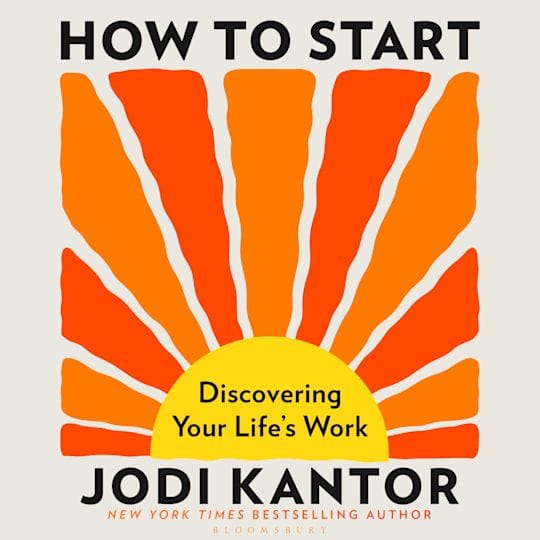
In How to Start: Discovering Your Life’s Work, Jodi Kantor, the Pulitzer Prize–winning New York Times journalist, offers a more grounded way to think about finding your path. Her insights speak not just to new graduates, but to anyone trying to figure out what comes next. Here are some of the key takeaways from the book.
1. Knowing when not to settle might be the first real career decision you make
“You’ll have to know when to refuse to settle. To insist on something better for yourself. To take yourself seriously and take on some risk. The decision is yours to make. Choose wisely. Brace yourself for some people to misunderstand or disapprove.”
There will be moments when you have to make difficult decisions that could define the trajectory of your career—the kind where the safe road is clearly marked, and everyone around you is pointing toward it, but you choose not to take it.
Kantor frames this as a defining line: the difference between people who build something meaningful and those who spend years wondering what might have been.
2. Your most human qualities are now your most valuable professional assets
As AI takes over more technical and repetitive functions, what rises in value is everything a machine cannot replicate. Kantor describes these as “the things that no computer can: Ethical North Stars. Artistic inspiration. The sustenance of connecting deeply with other people.”
Aneesh Raman, LinkedIn’s chief economic opportunity officer, puts it this way: “What makes us uniquely human is going to become core to the new definition of work. Work will index more and more around this idea that nobody beats you at being you.”
3. Craft is the only form of job security that belongs entirely to you
Many people assume their job will last indefinitely—until it doesn’t. That’s often when the reality sets in. Kantor encourages early-career professionals to focus on what actually lasts: “Most successful, fulfilled people are practising a combination of expertise and skill — the special thing they know how to do that other people do not. This is craft.”
A job is something an employer gives—and can take away at any time.
“Any employer can eliminate any job at any time. But your craft is truly yours and cannot be taken away,” she writes, adding, “When we hone our craft, we build up protection against being regarded as disposable or interchangeable.”
4. Don’t wait for clarity—find your path by starting
One of the most common mistakes early in a career is waiting for the “right” moment that never quite comes. We wait for clarity before we begin, when in reality, clarity often comes after.
Kantor addresses this directly: “If you don’t yet know your craft or need, just try to get the most interesting first job you can get. First jobs should provoke collisions: between your assumptions and reality, between your own background and compelling new people. You want ideas and challenges to land in your path. You want some urgency. You want to react.”
Waiting for certainty first is the wrong sequence. Exposure—real work, real environments, real stakes—is what reveals what you’re drawn to and what you’re capable of.
5. Chasing money exclusively is not ambition
“Pursuing only material gain can actually mean selling yourself short. Do not waste twenty years figuring this out from scratch. You’ll burn through the most precious resource any of us has, which is time.”
Twenty years spent chasing the wrong thing is twenty years you don’t get back. Financial stability matters—Kantor acknowledges that—but there’s a difference between establishing it and making it the entire point.
Students who treat wealth as their only North Star are often acting not from clarity, but from fear—holding on to money because they haven’t explored what else might be possible.
6. Adversity is the raw material of your career, not the obstacle to it
The people who shape history, Kantor argues, are not those who avoided disruption, but those who responded to it with intention. Every meaningful career is, in some way, built in response to a need.
As she puts it, “The best people in life and history are those who take negative, even devastating, stimuli and devise powerful and productive responses.”
The opportunity you’re looking for may be embedded in the very challenges you’re facing. The question is whether you’re focused on the damage—or on what can be built from it.
7. Work is our engine of progress
While many see work simply as a means to an end—something that funds needs, wants, and personal interests—Kantor argues that it plays a deeper role. It is one of the structures that hold a life together.
“Work is one of the legs that keeps the table of life standing up. Family, friendship, marriage, faith, rewarding work — take as many of these as you can get, because they operate in tandem. Relationships falter. People get sick. Jobs come and go. The combination keeps us upright, especially when one of the legs goes wobbly,” she writes.
Beyond the personal, work drives progress. “Work is our engine of progress.” Every major breakthrough—medical, technological, cultural—comes from people working together with discipline, curiosity, and purpose.
“To declare defeat on work is to surrender possibility itself — for yourself, for everyone.”
That’s not a small thing to walk away from.
 David Adubiina