



Last year, I stood in line at the Apple Store watching someone casually tap their card for a $1,199 iPhone 16 Pro Max as if they were buying chewing gum. I, on the other hand, was mentally calculating how many cartons of noodles that money could buy.
That was before the rumors about the iPhone 17 pricing started swirling. Now, I’m convinced some of us might need a loan to upgrade this year.
But, contrary to what some may think, Apple doesn't plan on raising prices just because it feels like it. It’s staring down a perfect storm, and we’re stuck right in the middle of it.
Let’s start with one of the big reasons we might see a price bump in the iPhone 17 lineup: tariffs
You’ve probably seen the headlines about Trump threatening a 25% tax on any iPhone made outside the U.S. That’s a problem because about 80% of Apple’s iPhones still come from China. Even if Apple shifts more production to India (which it’s trying), the timing is awkward.
A tariff like that could add hundreds to the price of a Pro model in the U.S., and the rest of the world isn’t safe either. Apple’s been known to “balance” U.S. prices by quietly charging more in other markets. Translation: your cousin in London or Lagos might end up paying more, so Americans don’t riot at the Apple Store.
iPhone 17 Pro is beautiful pic.twitter.com/d2osFRSVDS
— Majin Bu (@MajinBuOfficial) May 28, 2025
And this isn’t some far-off “maybe.” Apple's Tim Cook shared in the company's Q1 earnings call that, "we estimate the impact [of the tariff] to add $900 million to our costs." At the time of Cook's statement, the Trump administration had exempted smartphone manufacturers from “reciprocal” tariffs on China, though products made in China still faced a minimum 20% levy.
Now, if Trump imposes the 25% tariff + the 20% levy, the iPhone 17 price could multiply by nearly five. Analysts say a US-made iPhone could theoretically cost anywhere between $1,500 and $3,500. Nobody’s betting their AirPods that’ll happen, but the possibility is enough to make Wall Street sweat.
Another reason the iPhone 17 lineup might be the most expensive iPhone yet is what I like to call 'feature inflation'
The iPhone 17 lineup is shaping up to be a spec lover’s dream—a 48MP telephoto camera, 8K video, 12GB of RAM, and a wafer-thin iPhone 17 Air that’s just 5.5mm thick. Sounds nice, right? But every shiny new thing comes with a real cost for Apple. That camera upgrade alone could add $20 to what it costs them to make the phone. The RAM bump? Another $8–$12. And that thin Air model? Engineering it so it doesn’t overheat or die in four hours adds another $25–$40.
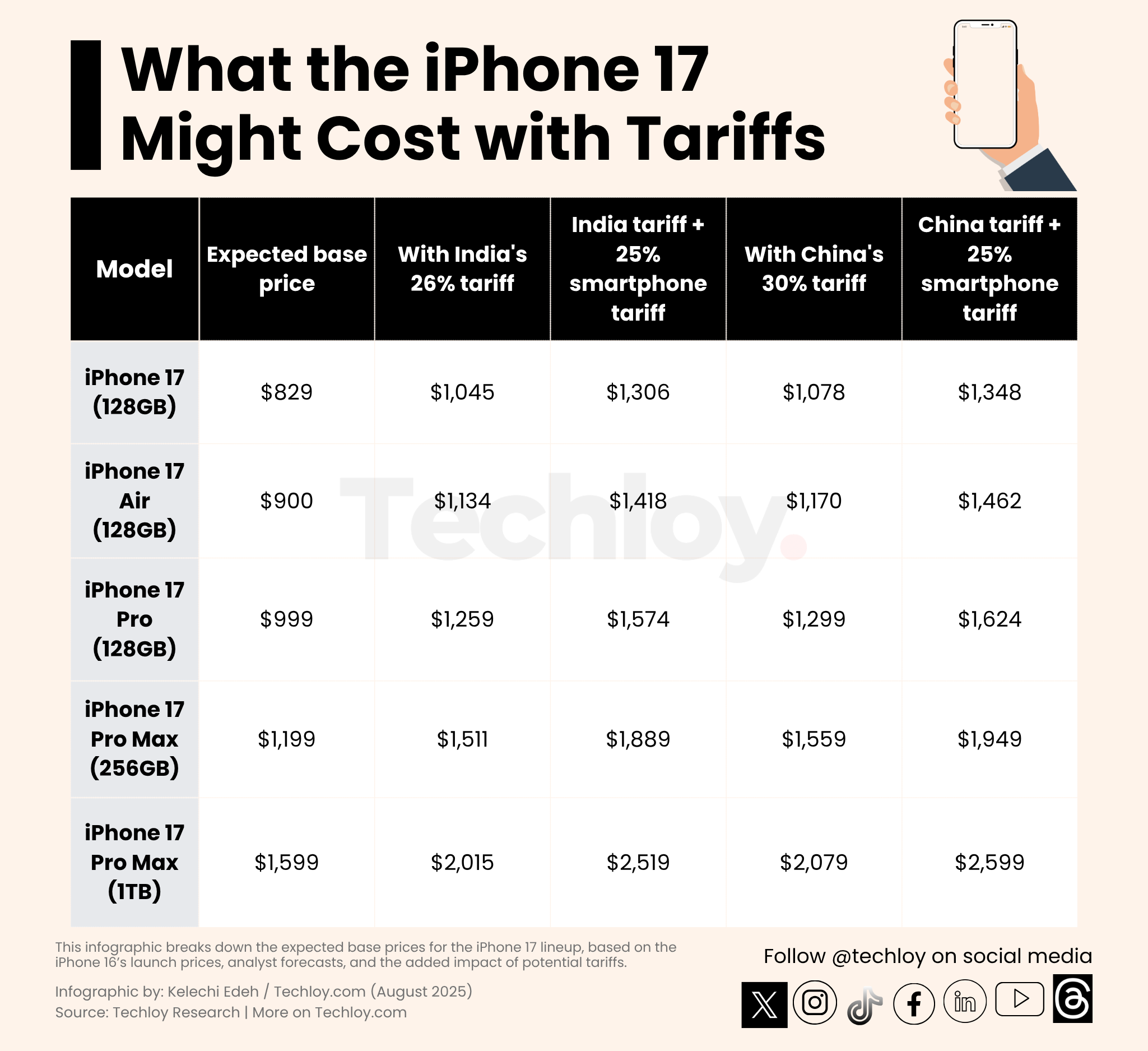
These costs don’t just add up; they stack. Combine them with tariffs, and we’re looking at serious price jumps. Analysts peg the iPhone 17 Pro between $1,500 and $1,600 in the U.S., the Pro Max around $2,300, and in India, it could hit ₹1,64,990 (about $1,970). Even the base iPhone 17, rumoured at $799, could creep into four-digit territory if import costs bite, while the Air could push past $900 before any tax is added.
But Apple’s not just sitting back
It says it's negotiating price cuts with suppliers like LG Display, a 10% OLED discount could save $57 per Pro Max, and ramping up assembly in India to dodge tariffs on some units. The problem, though, is that these savings may not arrive fast enough to save the iPhone 17. They’re more likely to benefit the iPhone 18, making the 17 the awkward middle child that takes the hit while its younger sibling reaps the rewards.
And before you think, well, Androids are just as bad, yes, and no. Flagships like Samsung’s Galaxy S25 Ultra or even some foldables from Huawei are creeping into iPhone pricing territory, but many Android brands, especially Chinese ones like Infinix or Oppo, are flooding markets in Africa and Asia with premium-feel devices at a fraction of the cost.
 Kelechi Edeh
Apple’s edge has always been the ecosystem, not necessarily being the best value for money. Which is why it can get away with charging more, because most of us aren’t about to give up iMessage, AirDrop, and that seamless “everything just works” vibe. But if tariffs widen the price gap further, Apple risks pushing more price-sensitive buyers into Android’s open arms, no matter how shiny iOS 26 looks.
The September keynote will tell us exactly how bad it’s going to be, but let’s be real, Apple’s not going to stand on stage and say, “We had to raise prices because the world is expensive and our margins are sacred.” They’ll frame it as the most advanced iPhone yet, which will be true… just might also be the priciest.
So if you’re planning to buy an iPhone 17, perhaps you should start cutting back on those weekend takeouts now. Your wallet will thank you later.


