Deezer is making its AI music detection technology available to rival streaming platforms, marking one of the strongest industry moves yet to combat the rapid rise of AI-generated music and streaming fraud.
The French music streaming service announced Thursday that it's opening access to the tool it launched last year, which automatically identifies fully AI-generated tracks, labels them for listeners, removes them from recommendation systems, and excludes them from royalty pools. Deezer says the decision is aimed at promoting transparency, protecting human creators, and preventing manipulation of streaming systems at scale.
This move comes as AI-generated music uploads continue to surge across streaming platforms worldwide. Deezer now receives roughly 60,000 fully AI-generated tracks per day, bringing the total number of AI-detected songs on its platform to 13.4 million. By comparison, in June last year, AI tracks accounted for just over 20,000 daily uploads, or about 18% of new content. The company says the volume has nearly tripled in under a year.
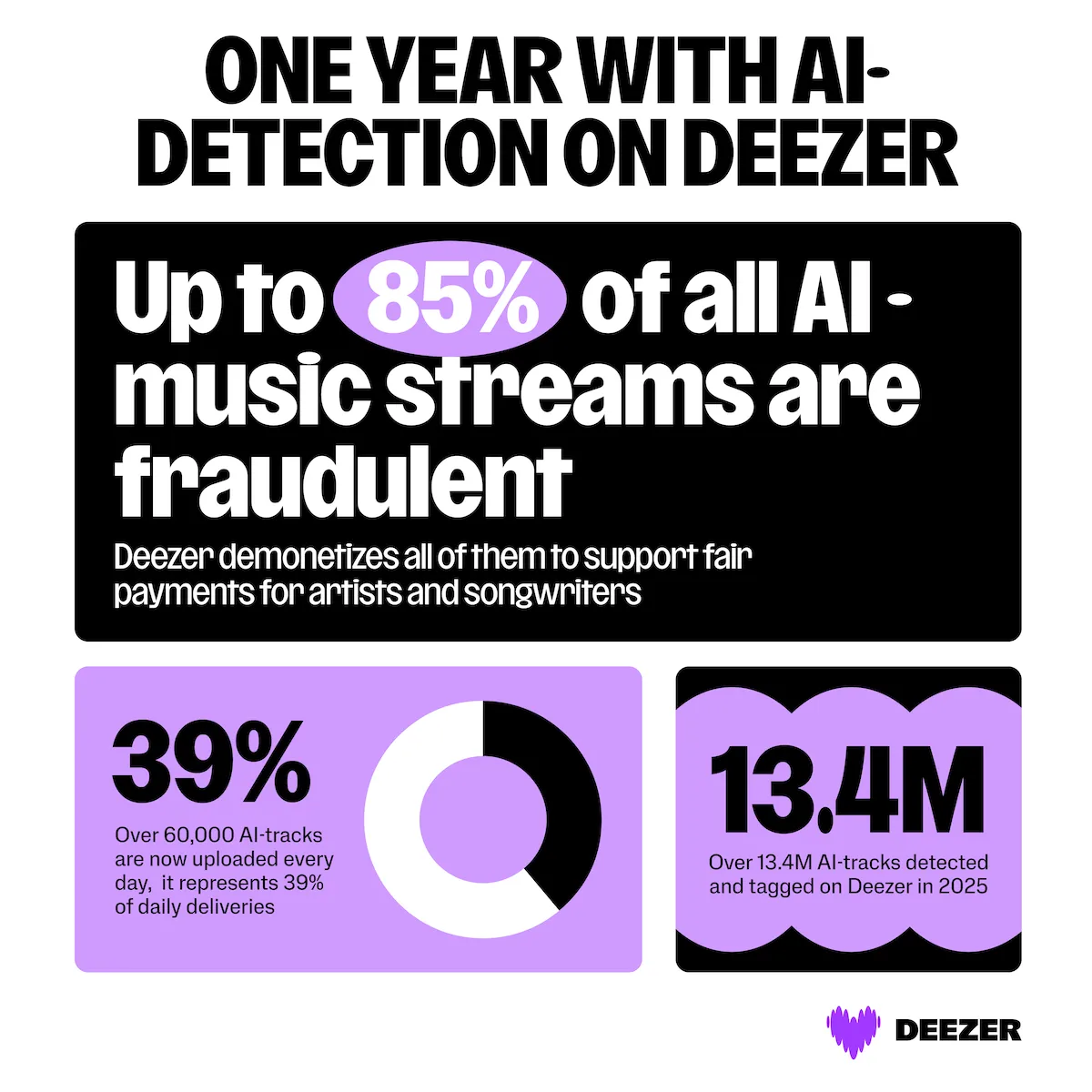
More concerning, Deezer reports that 85% of streams associated with fully AI-generated tracks are considered fraudulent. According to the company, these streams are largely driven by automated bots and coordinated manipulation schemes designed to exploit royalty systems rather than by real listeners engaging with music organically.
How Deezer’s AI Detection Tool Works
Deezer says its detection system can identify AI-generated music created by major generative models such as Suno and Udio with 99.8% accuracy. Once a track is flagged as fully AI-generated, Deezer removes it from algorithmic and editorial recommendations, demonetizes it, and excludes it from royalty pools.
It doesn't ban AI-generated music outright. Instead, it limits the reach and financial impact of fully synthetic tracks, distinguishing human-created music and content produced entirely by generative systems. Deezer says this approach allows experimentation with AI tools while preventing abuse of streaming infrastructure.
Deezer CEO Alexis Lanternier said there has already been "great interest" in the detection tool from across the industry, with several companies completing successful tests. One confirmed partner is Sacem, the French music rights management organization representing more than 300,000 creators and publishers, including artists such as David Guetta and DJ Snake.
Deezer didn't disclose pricing details for the tool, saying costs vary depending on the type of partnership and technical requirements. The company said its goal is broad adoption rather than competitive advantage, positioning the technology as shared industry infrastructure.
 Emmanuel Umahi
AI Music Fraud Is Becoming a Growing Problem
The expansion of AI-generated music has been accompanied by a rise in streaming fraud cases globally. In 2024, a North Carolina musician was charged by the U.S. Department of Justice for allegedly generating thousands of AI-created tracks and using bots to stream them billions of times, resulting in more than $10 million in stolen royalties.
At the same time, AI-native acts, like The Velvet Sundown, have attracted millions of legitimate streams, underscoring how synthetic music is becoming mainstream even as fraud concerns grow.
Beyond fraud, artists and labels have raised concerns about copyrighted material being used to train generative AI systems without consent, prompting lawsuits and regulatory scrutiny in multiple jurisdictions. These pressures have intensified calls for clearer rules around how AI-generated music should be handled within discovery, monetization, and rights management systems.
How Other Streaming Platforms Are Responding
Streaming services have taken different approaches to AI music. Bandcamp has banned AI-generated music entirely, citing concerns about protecting independent artists. Spotify has updated its policies to curb spam and prohibit unauthorized voice cloning, but has stopped short of excluding AI-generated music from its platform.
Meanwhile, major record labels, including Universal Music Group and Warner Music Group, have signed licensing deals with AI companies such as Suno and Udio, allowing catalog use for training while seeking to ensure artists and songwriters are compensated.
Deezer’s approach sits between these extremes. Rather than banning AI music or fully embracing it, the company is attempting to restrict the algorithmic and financial advantages of fully synthetic content while preserving space for human-led creativity that incorporates AI tools.
Why This Matters for the Future of Streaming
Music streaming platforms were built around the assumption that songs are created by humans, consumed by humans, and monetized accordingly. The rise of AI-generated music challenges that foundation, introducing the possibility of effectively infinite catalogs, automated listening behavior, and large-scale exploitation of payout systems.
By filtering AI-generated tracks out of recommendations and royalty pools and offering its detection technology to competitors, Deezer is positioning itself as an early driver of industry-wide standards for handling synthetic music.
Whether other major platforms adopt similar measures could shape how discovery algorithms, royalties, and creator protections evolve in the next phase of digital music distribution. For now, Deezer’s move signals that AI-generated music is no longer a niche issue, but a central structural challenge for the global streaming economy.
 Emmanuel Umahi