


Once upon a mixtape in Africa, survival for musicians meant hustling through endless shows, hawking CDs on street corners, begging for radio spins, and, let’s be honest, quietly blessing the pirates of Alaba Market for at least getting their songs heard—even if not a dime trickled back. Income was patchy, glory fleeting, and reach rarely went beyond a city or, at most, a region. The industry was vibrant but chaotic, with talent outpacing infrastructure.
Then the streaming giants rolled into town. Spotify, Apple Music, YouTube Music, Boomplay, Audiomack—all promising global reach, transparent reporting, and the golden carrot of recurring revenue from plays that never stop.
For fans, it was heaven: your favorite artist's entire catalog in your pocket, available 24/7 for the price of a snack and a drink. For artists, it looked like the beginning of a new kind of math problem, one that might finally solve their long-standing financial headaches. The show no longer ended when the DJ packed up; the music kept earning while you slept.
But as with every new system, the devil hid in the decimal points. Who’s really making money from digital streaming platforms (DSPs)? How much is actually flowing into African pockets? And why do so many artists still call streaming “exposure” rather than “income”?
 Emmanuel Umahi
How a stream becomes (maybe) cash
Here’s the unglamorous part. Streams don’t translate to a neat “$X per play” cheque. Platforms pool subscription and ad revenues into one pot, skim their share, and then divvy up what’s left across every track streamed worldwide. By the time labels, distributors, publishers, and managers take their cuts, the performer often sees little.
So while Spotify proudly declared in its Loud & Clear 2024 report that it paid out $10 billion in royalties, that figure was spread across millions of songs and countless middlemen. The billions headline can still mean peanuts once sliced wafer-thin.
That reality hit home in 2024 when Nigerian R&B artist Mannywellz voiced his frustration. Despite millions of streams, his payouts felt underwhelming. “The math just doesn’t math,” he said, echoing what many artists eventually discover: virality doesn’t always equal viability.
When we zoom out, the numbers explain why
Spotify’s $10 billion payout is historic, as it's currently the largest annual streaming payout in history. But when you zoom into Africa, the picture shifts. According to Reuters, royalties paid to artists in Nigeria and South Africa, Spotify’s two biggest African markets, reached about $59 million in 2024.
Sure, that’s real growth compared to five years ago, when payouts barely registered. But compared with wealthier Western markets, African artists still aren’t playing at the same financial table.
Part of the gap comes down to how payouts are calculated. DSPs don’t pay a flat, universal “per-stream rate.” Earnings depend on subscription revenue and ad spend in each region, which means a stream from the U.S. or U.K. is often worth more than one from Nigeria or Kenya. For many African acts, this arithmetic makes international listeners just as important as local fans.
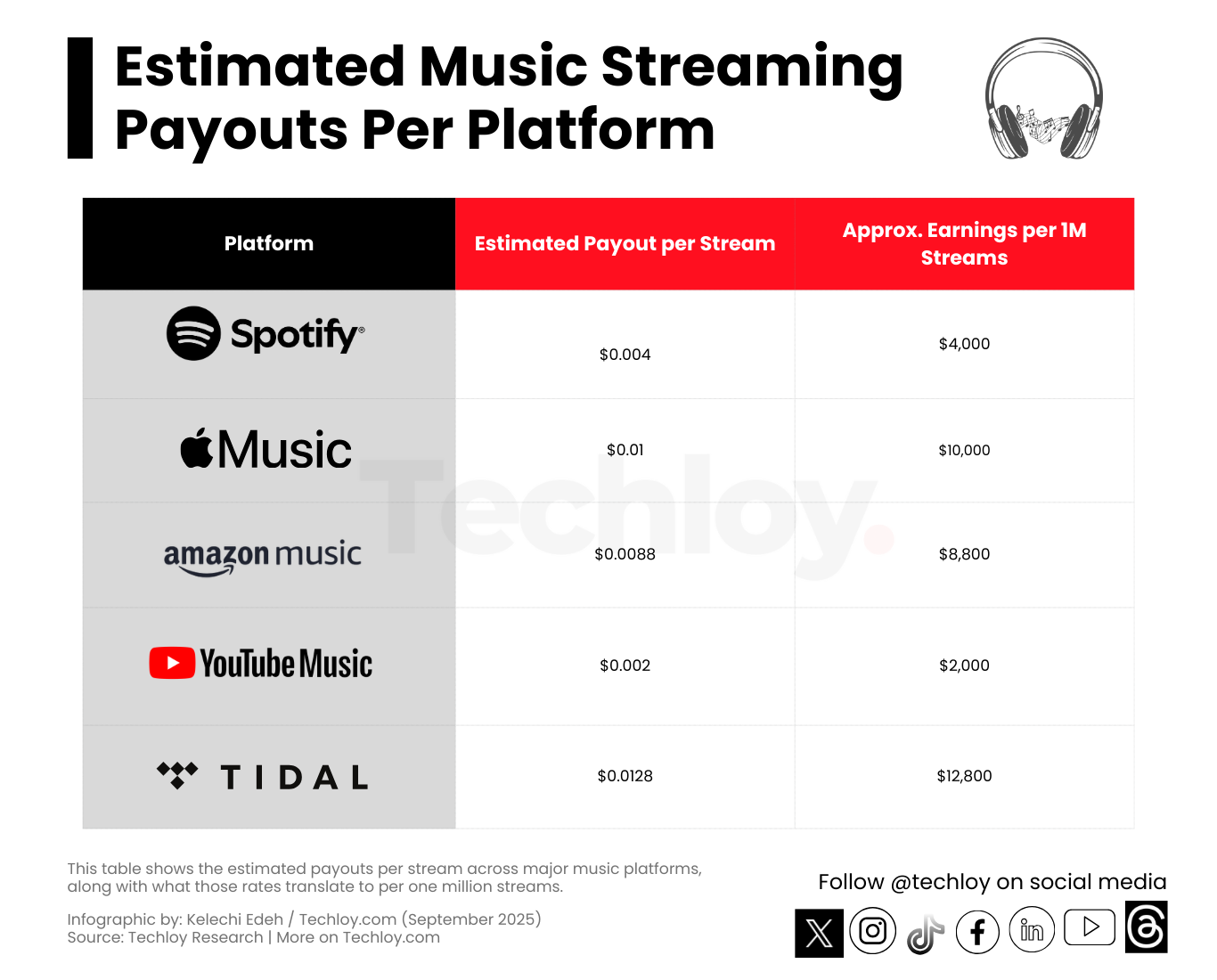
On platform averages, Spotify pays between $0.003 and $0.005 per stream. Apple Music sits higher at about $0.01, Amazon Music near $0.0088, YouTube Music at the bottom with roughly $0.002, and Tidal tops the league at around $0.0128, though its smaller user base limits scale.
And those decimals matter. At Spotify’s averages, it takes 200,000–330,000 plays to earn $1,000. Apple Music is about 100,000 streams. YouTube? A staggering 500,000. Tidal’s bar is lowest at roughly 78,000. Put another way, at 100,000 monthly streams, Spotify nets an artist $300–$500, Apple Music clears about $1,000, and YouTube hovers around $200. Scale it up to one million streams, and you’ll see why some artists like Mannywellz complain their bank accounts don’t match their virality.
Real artists, real examples

The math also plays out differently depending on the artist. CKay’s “Love Nwantiti” went from a catchy Afrobeats track to a global juggernaut on Spotify, TikTok, and YouTube. Beyond billions of plays, the song opened sync deals, licensing contracts, and long-tail visibility—a case study in how one viral hit can change everything.
Wizkid and Burna Boy, on the other hand, represent the empire model. Both boast billions of streams, translating into tens of millions in illustrative revenue, but their dominance comes from more than DSPs. World tours, brand endorsements, liquor campaigns, and licensing deals have turned them into cultural businesses, with streaming as the backbone.
Tyla, with her breakout hit “Water,” sits in between. One track shattered the billion-stream milestone, propelling her to festival bookings, awards, and collaborations. In Tyla’s case, streaming wasn’t just another revenue source; it was the launchpad that turned her into an international star almost overnight.
For most artists, though, streaming alone can’t pay the bills. A single stream pays fractions of a cent, and geography adds another problem: royalties from African streams often earn less than those from U.S. or European listeners. Trust issues don’t help either. Boomplay, one of Africa’s biggest DSPs, has faced catalogue withdrawals and late-payment allegations. And with labels, publishers, and managers all taking cuts, the artist’s slice shrinks further.
Playlist politics also deepens the frustration. Landing on a top playlist can send a song into millions of ears. Missing it often leaves tracks buried in the algorithm’s long tail, no matter how good they are.
Fixes and future upside

Not all the streaming story is doom and gloom. There are still some glimmers of progress as more platforms experiment with local monetization programs designed to put more money directly into artists’ pockets. Audiomack’s AMP program, for example, gives artists a clear revenue share from monetized streams—one of the more transparent systems on the continent.
Paid subscriptions are also rising across Africa, nudging per-stream values upward. Reuters has already tracked higher payouts in Nigeria and South Africa, reflecting both global appetite for Afrobeats and Amapiano, and local willingness to pay for music.
The bigger truth is that artists who thrive aren’t leaning on streaming alone. They’re stacking income streams—touring, merch, endorsements, sync deals, direct-to-fan subscriptions. In that mix, streaming works less like a paycheck and more like a calling card: proof of reach that opens bigger doors.
 Emmanuel Oyedeji
Overall, streaming is a miracle for reach, and in today’s music economy, it’s non-negotiable. For stars, it brings cultural clout and cash. For mid-tier acts, it’s a side hustle that cushions touring or merch. For emerging artists, it’s visibility—a gateway to ears they could never have reached through radio spins or CD sales.
But the charts don’t lie: the arithmetic is brutal. Streaming pays, but turning plays into a paycheck takes strategy, multiple revenue streams, and often, luck with playlists or virality. In Africa, where talent has never been in short supply, the challenge isn’t the reach anymore, but whether the numbers can truly sustain the artists behind the music.


