Fujitsu just introduced Kozuchi Physical AI 1.0 in collaboration with NVIDIA, and it could solve a problem that’s been quietly killing enterprise AI adoption for months: getting AI agents to work together without creating security nightmares.
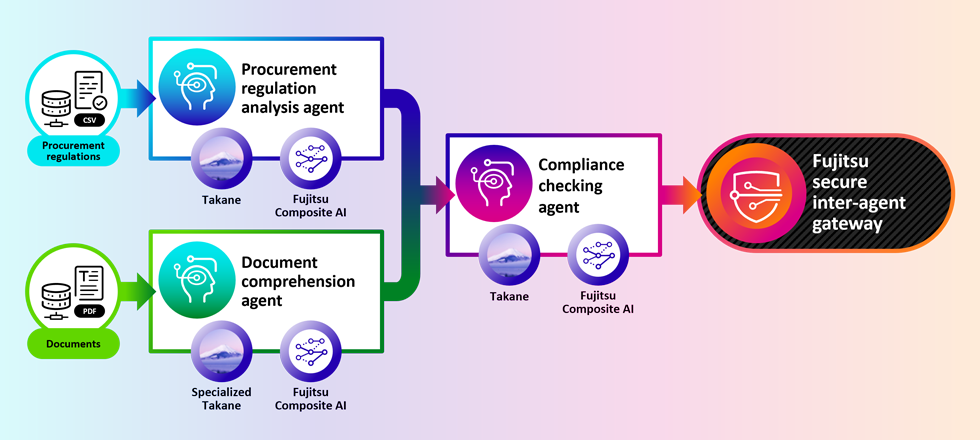
Here’s the scenario most companies face right now. Your procurement team receives a vendor contract. You need one AI to read that confidential document, another to verify it against government regulations, and a third to check internal compliance rules. Simple enough, right?
Except connecting these AI systems without accidentally exposing sensitive pricing data, trade secrets, or proprietary information is nearly impossible with current tools. One slip and you’re looking at lawsuits, regulatory fines, or worse—headlines about your data breach.
Fujitsu’s answer is something it calls a “secure inter-agent gateway.” Think of it like a translator at the UN who lets different delegates communicate without any of them seeing classified documents from other countries. Different AI systems can collaborate on the same task while each stays locked in its secure zone, only sharing what’s absolutely necessary.
 Partner Content
Instead of building one massive AI that tries to handle everything (and usually excels at nothing), Kozuchi uses specialized agents. Fujitsu created three specialized agents based on its Takane LLM for procurement work. One agent focuses primarily on understanding complex legal language. Another stays updated on regulatory requirements. The third handles compliance verification.
When Fujitsu tested this in their own purchasing department, the results were striking. The multi-agent system cut order confirmation workload in half. Integration with NVIDIA NIM is expected to boost processing speed by another 50%. Which means procurement teams can go home on time, and critical purchases don’t sit in approval limbo for weeks.
Most AI automation tools treat security as something you add later. Kozuchi builds it into the foundation. That matters enormously for industries where data breaches aren’t just embarrassing—they’re existential threats. Financial services handling customer accounts. Healthcare managing patient records. Government contractors dealing with classified information. These sectors desperately need AI efficiency but can’t afford the security trade-offs most tools demand.
By the end of fiscal 2025, Fujitsu plans to extend this framework beyond paperwork to control robots on factory floors and in warehouses. That’s the “Physical AI” part—AI-driven systems that can coordinate physical operations while keeping proprietary manufacturing processes locked down.
Cutting workload by 50% in your own controlled environment is impressive. The harder question is whether this scales to thousands of companies with completely different security requirements, ancient legacy systems, and conflicting compliance frameworks. That’s what Fujitsu needs to prove next.
But unlike most AI announcements that promise to revolutionize everything, this one’s focused on solving one very specific, very painful problem that real companies face every single day. And that might be exactly what enterprise AI needs right now.
 Partner Content