


If we look back to 2021, African tech was basking in its golden moment. Record-breaking venture deals, inflated valuations, and foreign funds racing into Lagos, Nairobi, and Cairo created the illusion that capital would never run dry.
But now in 2025, the mood is far more sober. Liquidity has thinned, inflation and devaluation continue to squeeze markets, and investors are pressing founders with a single hard question: Can your business survive on its fundamentals?
That reckoning took center stage at the Gulf Information Technology Exhibition (GITEX) Nigeria 2025 Startup Festival, held at Landmark Centre in Lagos, where a fireside chat titled “Venture in 2025 – Liquidity scarcity, thesis realignment, and the rise of operator-led funds” gathered leading venture capitalists and fund managers. Their message was clear that the era of hype is over, and African founders must now build with discipline.
Liquidity, blended capital, and the cost of money
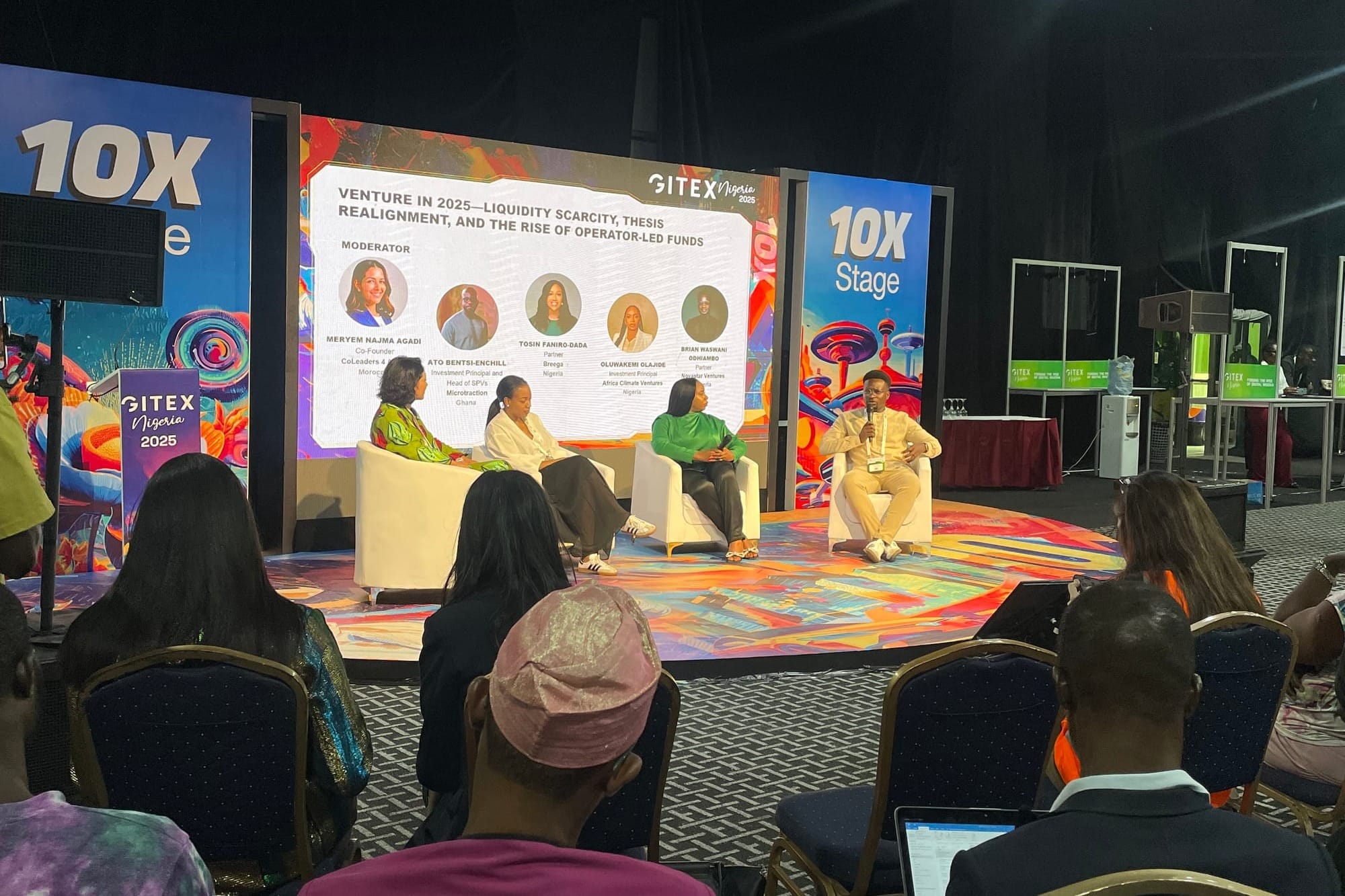
Throughout the panel, the conversation kept circled back to the same reality: capital has become harder and more expensive to access. And with global markets pulling back, one way African VCs are adjusting is by experimenting with blended structures to de-risk capital and attract new investors.
Olajide pointed out how inflation and devaluation have changed the economics of capital:
“The pricing is no longer the same. The cost of capital is too high whether on the debt or equity side. In countries where there are three recessions every year, you need systems in place that allow companies to grow beyond those macro shocks. That’s why co-investments from Development Financial Institutions (DFIs) and foundations are important; they help de-risk capital and improve return profiles.”
This trend, often called blended finance, is becoming a crucial lever for keeping ventures alive in frontier markets like Nigeria. Catalytic capital, from first-loss guarantees to structured co-investments, is helping shore up early-stage ventures against macroeconomic turbulence.
At the same time, Brian Waswani Odhiambo, Partner at Novastar Ventures, stressed that diversifying capital is key not only for startups but for VCs themselves: “When Europe and US capital markets dried up, we said why not look at Japan? And we’ve gotten over $50M for our fund from the country.”
Interestingly, he noted that the retreat of foreign capital has also created space for local investors:
“We liked it when the foreign funds kind of ran away because that creates more opportunities for us and there is more sensibility in pricing of companies,” he said.
The implication for African founders is twofold: money may be harder to access, but the capital that does come is likely to be more grounded in local realities and less prone to chasing hype.
 Emmanuel Oyedeji
Unit economics over growth
Naturally, this liquidity crunch has shifted investor expectations. The loudest theme throughout the conversation was a decisive shift away from growth at all costs. Investors now want startups that can prove financial discipline from day one.
“It’s not growth at all costs, it’s unit economics at all costs. We [investors] are really keen on founders who are focused on that from day one and companies that are trying to turn towards profitability long term.” said Brian Waswani Odhiambo, Partner at Novastar Ventures.
Just a few years ago, a large user base or eye-catching top-line growth was enough to unlock capital. In today’s climate, those vanity metrics have lost their shine. Now, in markets hit by currency crashes, inflation, and policy swings, what counts is whether the economics of each product, customer, and market add up.
From “value-add” promises to real operator support
Yet discipline doesn't rest only on founders. Investors themselves are being forced to prove their worth beyond capital. The conversation revealed that while 2021 was about capital chasing deals, 2025 should be investors proving they can build alongside founders.
Panellists admitted that investors often overpromise and underdeliver when it comes to adding value beyond the check.
“There’s this idea of value creation that a lot of people [investors] talk about and very few people do in practice. Founders ask, ‘What are you bringing apart from capital?’ and investors often have a laundry list of promises. But very few people actually spend time sitting on boards, looking at founders’ problems, and really understanding them.” Odhiambo said.
Now, we're seeing a rise in operator-led funds willing to close that gap. Unlike traditional investors who stop at writing checks, these funds roll up their sleeves to help companies scale.
Oluwakemi Olajide, Investment Principal at Africa Climate Ventures, explained: “We’re seeing a shift to operator-led funds where people are venture building, like what we [Africa Climate Ventures] are doing. That support naturally helps scale businesses, and because of that, there’s a waterfall of capital into the sector.”
This shift signals a deeper redefinition of “active investing,” less about quarterly governance check-ins, more about actually helping companies survive the valley of death.
Local solutions, not copycats
Just as investor behavior is changing, so too are expectations of what kinds of businesses get funded. And another theme at the event was an end to the copycat era. Gone are the days when a pitch starting with “we’re the Amazon of Africa” could turn heads.
Tosin Faniro-Dada, Partner at Breega, was direct when saying, “We’re looking for startups that are building localised solutions based on the current market reality. In some markets, you can get away with online distribution; in others, you need offline distribution. We expect founders to have deep expertise in their local market.”
This local-first mindset extends to expansion, too. Instead of scaling prematurely across borders, investors want founders to dominate their home market first. “Go deep in your market and capture it before expanding,” Tosin stressed. In a tight capital environment, inflated valuations can also be deadly. Investors now expect founders to grow into their numbers, or risk scaring off future rounds.
Hard truths for African founders at GITEX Nigeria 2025
For all the talk about capital structures and fund theses, the discussion ultimately came down to blunt, practical advice for founders.
Olajide cautioned:
“As you build, you’ll get all sorts of advice from investors. Be open-minded, but also remember your why. Don’t get derailed. Stay grounded in your unit economics, don’t overpromise and under-deliver.”
Odhiambo added a sharper edge:
“If you’re a founder in Africa, you’re probably one of the best entrepreneurs in the world. But venture capital isn’t for everyone, maybe just 1% of entrepreneurs. It comes with big obligations and expectations. It’s not free money, so think deeply before you take it.”
The collective message echoed from all the VCs present at the event was that discipline, resilience, and clarity of purpose matter more than flashy growth charts or hot valuations.
Overall, GITEX Nigeria 2025 revealed a venture industry in transition. The frothy optimism of 2021 has given way to a more pragmatic model. From growth-at-all-costs to unit economics at all costs. From passive investors to operator-led, value-creating funds. From foreign hot money to blended, diversified, and local capital. And finally, from copycat models to localized, resilient solutions.
If the event was a barometer, the African venture is entering a new era. One defined not by hype, but by hard questions, and harder answers.
 Louis Eriakha
Reporting by Kelechi Edeh; Writing by Louis Eriakha; Editing by Emmanuel Oyedeji


