



2025 is really an insane year for the foldable future, and while this gives you a lot of options, you're left confused about which device deserves your money in 2025. Samsung’s Galaxy Z Fold 7 is the seasoned pro of foldables in the category, refined after years of iteration, while Google’s Pixel 10 Pro Fold is the bold newcomer, bringing Google's AI smarts and hardware upgrades into its first big leap into foldables.
Both devices promise a stellar experience, but they go about it in very different ways. Samsung leans on raw power, multitasking tools, and the security of its hardware, while Google bets on smarter AI features, brighter screens, and friendlier pricing to win your attention. Whether you want the productivity beast or the AI-first innovator, this matchup has something for everyone.
Let’s compare them feature by feature to see which foldable is right for you.
 Oyinebiladou Omemu
/1. Software & Features
Both phones run Android 16 and promise seven years of updates, which is a huge win for buyers. But the difference is that Google leans into AI with tools like Magic Cue, which surfaces info before you need it. Samsung’s foldable software makes multitasking a dream with support for more than two apps at once, plus DeX desktop mode for external displays. Samsung gives you productivity muscle, Google gives you AI smarts.
Verdict: Tie. Depends on whether you want productivity or AI-first features.
/2. Design & Build
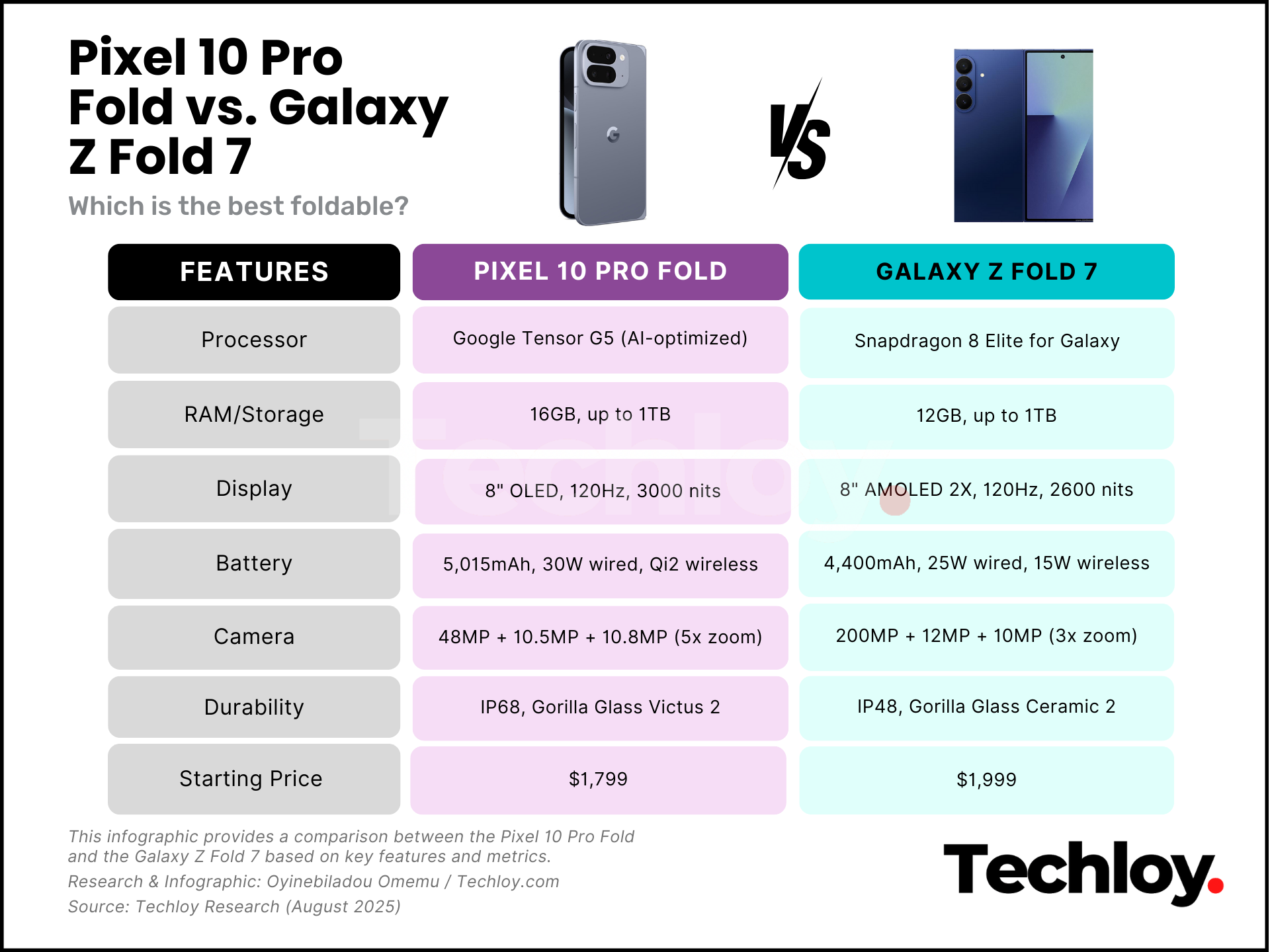
Both phones stick to the book-style foldable approach, but they feel quite different in hand. The Pixel 10 Pro Fold is chunkier and heavier, tipping the scales at 258g, while the Z Fold 7 is surprisingly slim and light at 215g, almost as thin as a regular flagship phone when closed. For durability, Google is far ahead with its IP68 dust and water resistance, compared to Samsung’s IP48 rating. Samsung does fight back with tougher Gorilla Glass Ceramic 2 on the front, while the Pixel uses Gorilla Glass Victus 2.
Verdict: Pixel for durability, Samsung for portability.
/3. Displays
Open them up and you’ll see both 8-inch OLED main displays with 120Hz adaptive refresh rates. The Pixel edges ahead in brightness, hitting 3,000 nits, compared to Samsung’s 2,600 nits, which makes a real difference outdoors. On the cover screen, Samsung offers a slightly larger 6.5-inch display compared to the Pixel’s 6.4-inch, and it also supports smoother refresh variability (1Hz–120Hz) compared to the Pixel’s 60Hz–120Hz.
Verdict: Samsung for smoother outer display, Pixel for brighter inner screen.
/4. Performance
This is where Samsung flexes hard. The Z Fold 7 runs Qualcomm’s Snapdragon 8 Elite for Galaxy, the fastest Android chip out there, paired with 12GB of RAM. The Pixel 10 Pro Fold uses Google’s Tensor G5, built on TSMC’s 3nm process, with a stronger AI engine and a base of 16GB of RAM. On paper, Samsung still leads in raw performance and gaming power, but Google’s chip is optimized for on-device AI, which means smarter voice features, better photo processing, and unique AI tools. Both promise seven years of Android updates, so you’re covered long-term either way.
Verdict: Samsung wins on speed, Pixel on AI.
/5. Cameras
Google has never been shy about flexing its camera game, and the Pixel 10 Pro Fold continues that tradition with a 48MP main shooter, a 10.5MP ultrawide, and a 10.8MP telephoto with a strong 5x optical zoom. Samsung goes all in with sheer numbers: a 200MP primary sensor, plus a 12MP ultrawide and 10MP telephoto with 3x zoom. In practice, Samsung gives you ultra-detailed shots and 8K video capture, while Google pushes versatility with its longer zoom and signature computational photography. Both deliver excellent selfies via dual 10MP front-facing cameras.
Verdict: Samsung for raw detail, Pixel for zoom versatility.
/6. Battery & Charging
The Pixel 10 Pro Fold has a clear edge here with its 5,015mAh battery, compared to Samsung’s 4,400mAh cell. Google also adds Qi2 magnetic wireless charging, letting you snap on accessories just like MagSafe on iPhones. Samsung charges slightly faster wired at 25W versus the Pixel’s 30W, but the difference won’t be night and day. Samsung’s real-world endurance is already solid, and Google promises up to 30 hours of use per charge.
Verdict: Pixel wins with a bigger battery and magnetic charging.
/7. Price
The Pixel 10 Pro Fold starts at $1,799, which is still a hefty price tag, but it undercuts Samsung’s Galaxy Z Fold 7 at $1,999. Both offer multiple storage options, but across the board, the Pixel is consistently about $200 cheaper than its Samsung rival. To sweeten the deal, the Pixel ships with 16GB of RAM by default, while the Fold 7 starts at 12GB unless you go for pricier tiers.
Verdict: Pixel 10 Pro Fold wins for value.
Conclusion
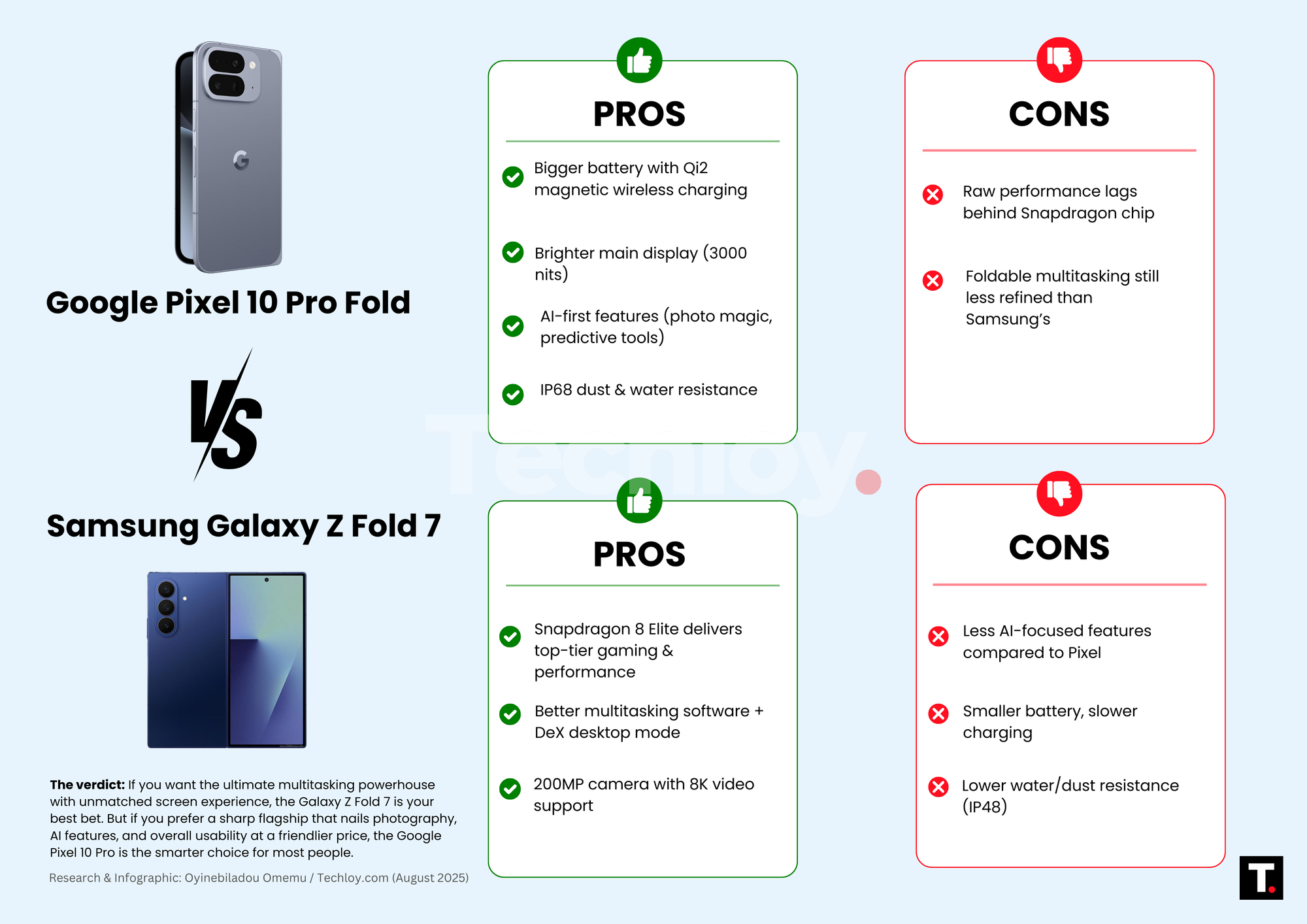
At the end of the day, both the Pixel 10 Pro Fold and the Galaxy Z Fold 7 are powerhouse foldables, but they’re built for different buyers. Samsung offers a lighter design, faster chip, stronger multitasking capabilities, and an overall more refined experience. It’s the safe pick if you want your foldable to feel like a productivity laptop in disguise.
Google, meanwhile, is playing to its strengths. The Pixel 10 Pro Fold delivers smarter AI features, a larger battery, a brighter screen, and magnetic charging, all while shaving a couple of hundred dollars off the price. If you value AI features and long-term durability over raw power, the Pixel makes a compelling case.


