Most people treat work phones as a necessary inconvenience, not a surveillance tool. You answer Slack messages, check your calendar, maybe squeeze in a quick text to a friend. But a new Android update is fundamentally changing the unspoken boundary between personal space and corporate oversight, raising questions employees never thought they’d need to ask about their own messages.
Google has now introduced RCS Archival on fully managed Pixel devices, allowing companies to save every RCS message sent or received on a work phone. The update was designed to solve a long-running frustration for regulated industries that must keep complete communication logs.
For years, archival tools couldn't reliably capture RCS messages because they travel with end-to-end encryption. The message was protected in transit, making it impossible for third parties (like carriers) to read and log.
Now, the technical nuance of this update changes the entire dynamic. Archival apps can now plug directly into Google Messages on a managed Pixel. They receive the message after it lands on the device, once the encryption layer has already done its job. Encryption still protects the journey, but the destination—your phone—is where employers can now keep a permanent record. That subtle shift is what heightens the privacy concern.
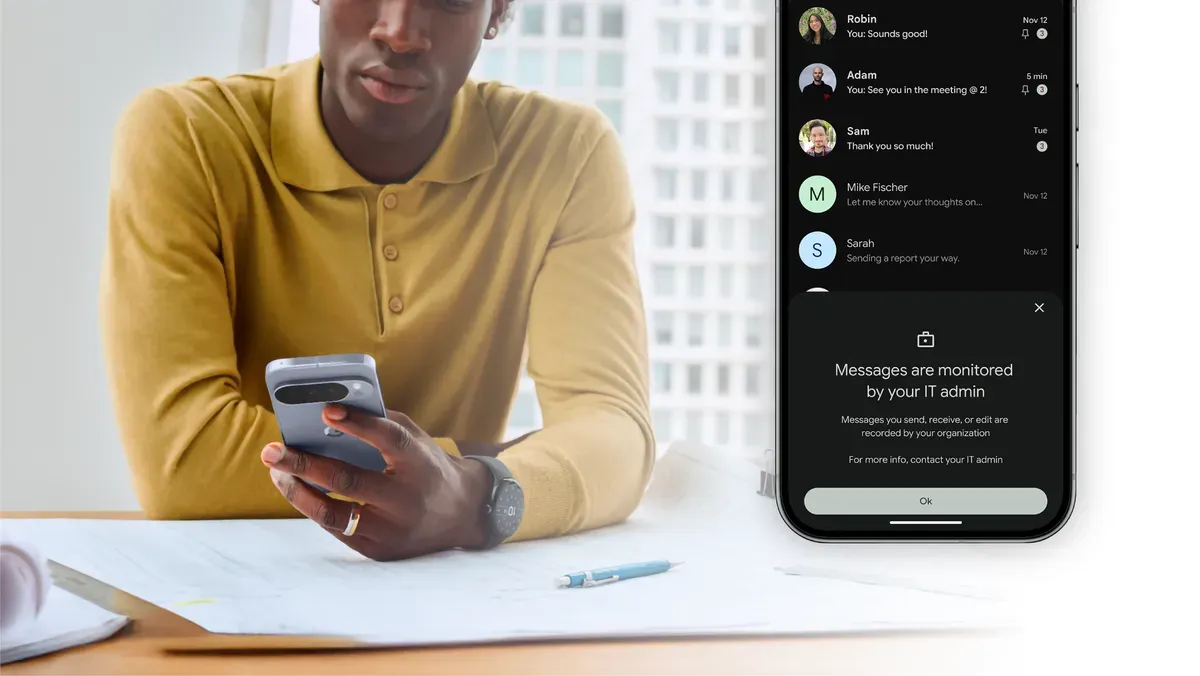
Employees tend to view texting differently from email. Email feels formal, logged, and often monitored. Texting feels conversational and private. This update challenges that assumption, because those “private” RCS chats become part of a company’s record-keeping system the moment they’re sent on a managed device. Users do see a notification when archival is active, but notifications rarely soften the surprise that your texts aren’t as private as you thought.
And Google isn't the only company that has wandered into a similar territory. Just a few weeks ago, Microsoft sparked frustration with a Teams feature that alerted organisations when staff appeared inactive. Both updates point to a broader pattern: employers tightening their grip on digital behaviour, reshaping the boundaries of workplace privacy. One focuses on productivity, the other on legal compliance, yet together they paint a picture of employees losing control over spaces they assumed were private.
 Ogbonda Chivumnovu
For companies, the change makes legal sense. Lawsuits, audits, and regulatory inquiries often require businesses to produce internal communications on request, and missing data puts organisations at risk. RCS Archival closes that gap, giving companies a cleaner way to meet those obligations without relying on external carriers.
The update doesn’t touch personal phones, but anyone using a work-issued Pixel now carries a device that functions as both a communication tool and a permanent ledger. The safest move is simple: keep personal conversations on a separate phone. Work phones now belong fully to the workplace, messages included.
 Emmanuel Oyedeji