- Nollywood, now the world’s second-largest film industry, grew 60% since 2023, generating ₦11.5 billion in 2024.
- YouTube’s Nollywood ecosystem earned an estimated $120–180 million in 2024, outpacing many traditional distribution channels.
- Netflix, Prime Video, and Showmax pay higher per-title licensing fees but offer smaller catalogs and limited visibility for independent producers.
I grew up watching Nollywood movies on scratched CDs that my parents bought or rented from local stores. The actors felt like family, and their stories of love, greed, and faith played out in our living room long before Netflix ever heard of Nigeria. Back then, making movies depended on who could afford to shoot on tape. Now, it’s about who can upload quickly enough to keep up with the algorithm.
This change is part of a bigger story. Nollywood has gone from a local hustle to a global creative force. The industry grew by 60% since 2023, bringing in ₦11.5 billion in 2024, according to the Nigeria Creator Economy Report 2025. But behind these numbers, something else is happening: filmmakers are now using YouTube as their main source of income, not just as a backup.
It’s ironic that the platform once seen as a place for low-budget uploads is now Nollywood’s most reliable box office.
MORE INSIGHTS ON THIS TOPIC:
- Is Indonesia Quietly Building the Future of Cinema?
- This AI actress doesn’t exist but Hollywood already wants to represent her
- Warner Music wants Netflix to turn its legends into a cinematic universe
The New Streaming Battlefield
The streaming wars have gone global, and Nollywood has found itself right in the middle of it. Between YouTube, Netflix, Prime Video, and Showmax, filmmakers now have more doors to walk through than ever before. But each door leads to a very different kind of opportunity.
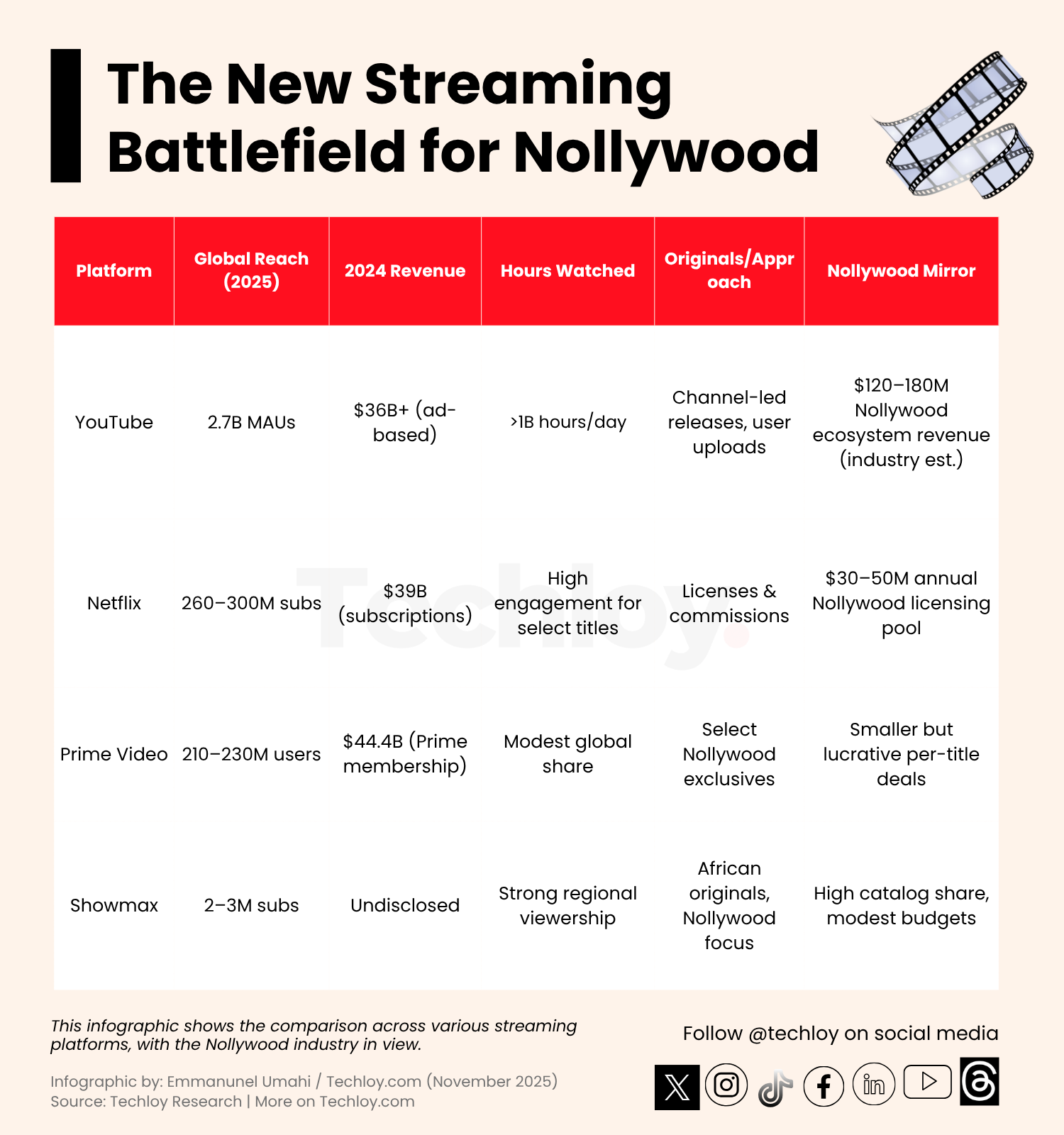
Let’s start with YouTube, the giant of them all. With around 2.7 billion people watching videos every month, it’s basically the internet’s biggest cinema. Per the Global Media Insight, YouTube pulled in over $36 billion from ads in 2024 alone, with users streaming over a billion hours of content every single day. For Nollywood, this open platform has become a goldmine, driving an estimated ₦120–₦180 million in revenue across the ecosystem. It’s where everyday creators, production houses, and even classic movies get a second life. No gatekeepers, no restrictions, just stories and audiences connecting directly.
Then comes Netflix, the polished, red-carpet version of streaming. With between 260 and 300 million subscribers, it made about $39 billion last year, mostly from people who just can’t stop watching. Netflix’s relationship with Nollywood has been about selective investments and high-impact titles, with roughly ₦30–₦50 million flowing into licensing and commissions each year, per the Netflix Engagement Reports. It’s where Nollywood gets to dress up, travel the world, and be seen alongside Hollywood.
Prime Video is a bit more reserved part of Amazon’s larger $44.4 billion Prime ecosystem that reaches around 210–230 million users. It doesn’t have as many Nollywood titles as YouTube or Netflix, but when it does, it pays well. Think fewer releases, higher deals. For filmmakers, it’s like having a smaller but more premium audience that’s ready to pay attention.
And then there’s Showmax Africa’s very own player. With around 2–3 million subscribers, it’s not competing on size but on heart. Its focus on African originals and Nollywood stories means it understands the culture better than anyone else. Budgets might be smaller, resulting in an undisclosed amount on revenue, yet, its connection with the audience runs deep. It’s home turf, and that matters.
When you look at it closely, each platform offers Nollywood something unique in its own way. YouTube gives reach for filmmakers. Netflix gives prestige. Prime gives a premium. Showmax gives belonging.
Together, they’re shaping how Africa’s biggest film industry earns, grows, and tells its stories to the world.
 Emmanuel Umahi
The Trade-Off: Freedom vs. Stability

For smaller creators and filmmakers, YouTube is both a blessing. It gives everyone a shot at visibility. Filmmakers in the YouTube Partner Program (YPP) make money with ads by receiving a 55% share of the net revenue generated from ads on their long-form videos. For YouTube Shorts, they receive 45% of the revenue allocated to them from the creator pool. It’s a creative economy powered by rewarding consistency and luck in equal measure.
Netflix and Prime Video, on the other hand, operate like traditional studios offering filmmakers guaranteed pay for exclusive rights. It’s stable, predictable, and prestige-filled. But that stability often comes with limits. Once a film is licensed, the creator loses control over where it can go next or how long it stays visible. It’s like getting paid once for a song that could’ve played forever.
That’s why more producers are starting to blend both worlds, chasing the money and the momentum. The strategy goes something like this: from Cinema debut to Exclusive streaming window, and lastly, YouTube release for long-term revenue.
This provides a form of hype and credibility among theatres and streaming platforms, thus giving YouTube the benefit of keeping the stories alive while generating views, conversations, and steady income long after release. It’s a smart balance of prestige, exposure, and sustainability, modeled after global best practices but deeply rooted in Nollywood’s trademark hustle.
Because at its heart, Nollywood has never been just about making movies. It’s about making moves, adapting, experimenting, and finding new ways to keep the lights on and the stories rolling.
Cost Per Mille (CPM) Challenges: Lower Ad Revenue, Yet Nollywood Thrives
While Nollywood’s YouTube growth looks impressive, creators earn far less per view than counterparts in North America, Europe, or even Asia. YouTube pays creators based on CPM (Cost Per Mille), the amount advertisers pay per 1,000 ad impressions. In markets like the U.S. or U.K., CPMs range from $5 to $20, depending on the niche and audience. In Nigeria and most of Sub-Saharan Africa, CPMs often hover between $0.30 and $1.50, sometimes even lower.
So, how is Nollywood thriving despite these odds? The first factor is volume and consistency. Channels such as RealNollyTV, iBAKA TV, and Uduak Isong TV upload movies almost daily, keeping audiences engaged, advertisers active, and the algorithm in their favor. This relentless output ensures that, while individual earnings per view are small, cumulative income can be substantial.
The second factor is diaspora viewership. Many Nollywood channels attract viewers from the U.S., U.K., and Canada, generating higher CPMs despite the content being produced in Nigeria. Some channels report that up to 40% of ad revenue comes from diaspora audiences, effectively creating a hybrid revenue stream.
A third key element is the long-tail earnings model. Unlike cinema releases or streaming exclusives, which generate revenue once, YouTube allows films to earn for years after upload. For instance, Love in Every Word, Treasure in the Sky, and Unexpected Places continue to attract millions of views months after release. Films like Last Straw, The Homecoming, and Broken Hallelujah regularly hit the 10 million views mark, while Fame and Fury, Love or Money, and A Night with Mr. Daniels keep adding incremental income over time. Even titles like Shining Star, Hearts at Play, Meant to Be, Sweet Vengeance, The Wedding Party, and Chief Daddy illustrate that Nollywood’s library content can generate meaningful revenue long after its premiere.
Despite lower CPMs, lean production budgets amplify profit margins. Many Nollywood films are made for ₦2–10 million ($1,300–$6,500), meaning that YouTube earnings—even modest per view—can cover production costs and yield healthy profit. Add YouTube Shorts, behind-the-scenes clips, and teasers to the mix, and the ecosystem becomes a continuous funnel for driving views, building audiences, and monetizing content.
In short, Nollywood has hacked the global digital creator economy: consistent uploads, diaspora audiences, low production costs, and long-tail revenue make YouTube not just a platform for visibility, but a sustainable source of income. The success of films like Love in Every Word, Treasure in the Sky, and Chief Daddy proves that even with low CPM, the combination of scale, engagement, and smart distribution can turn millions of views into a billion-naira industry.
What This Means for Nollywood’s Future
Nollywood has always been a masterclass in speed, creativity, and adaptability traits born out of necessity and sharpened by hustle, over the years. YouTube simply takes those strengths and amplifies them for the world to see. It’s the great equalizer: open to anyone, rewarding authenticity, and tearing down the old barriers of who gets to be seen.
Through this, YouTube gives Nollywood something far more valuable, as it eliminates cultural gatekeeping.
This provides filmmakers with sustainable freedom, visibility, and cash flow. Hence, it builds an industry that keeps the story going.
Conclusion
Nollywood was born out of pure resourcefulness from VHS tapes sold in bustling markets to glossy YouTube thumbnails competing for clicks. At every turn, it’s adapted faster than anyone expected, rewriting the rules of filmmaking with personal grit and imagination.
Now, as the global creator economy explodes, Nigeria’s filmmakers aren’t waiting for validation or distribution deals from foreign investors, and they are now in control of their uploads.
 Emmanuel Umahi