



Spending over a thousand dollars on a phone should mean buying into the very best any brand has to offer. At least, you don’t expect what you’d normally see in a mid-budget or low-budget device, like blurry cameras or slow performance. At this price, everything should feel premium.
That’s exactly the arena where the iPhone 17 Pro Max and Huawei’s Pura 80 Ultra square off. Both sit at the very top of their lineups, both promise cutting-edge features, but they don’t deliver in the same way. Apple doubles down on polish, consistency, and ecosystem perks, while Huawei flexes its hardware with monster cameras, bigger batteries, and charging speeds that feel futuristic.
So if you’re eyeing either of them and wondering which one truly gives you more of that premium edge for your money, here’s a breakdown of how they stack up.
 Kelechi Edeh
/1. Design & Build
If you have held the iPhone 16 Pro Max, you would notice that the iPhone 17 Pro Max comes in a little higher in size and weight, 163.4 × 78.0 × 8.75 mm and 233 g, to be exact. The added weight doesn’t make it awkward, though; it still sits comfortably in hand and comes with three stylish colors of silver, cosmic orange, and deep blue.
Compared to the 17 Pro Max, the Pura 80 Ultra is a few millimeters less at 163 × 76.1 × 8.3 mm and 0.5 g more in weight. Its rounded corners give it a smoother look and flashier finishes in Prestige Gold and Golden Black that feel more showy than subtle. It is rated IP68/IP69, which means it can handle dust, water, or even the occasional spill without drama.
/2. Display
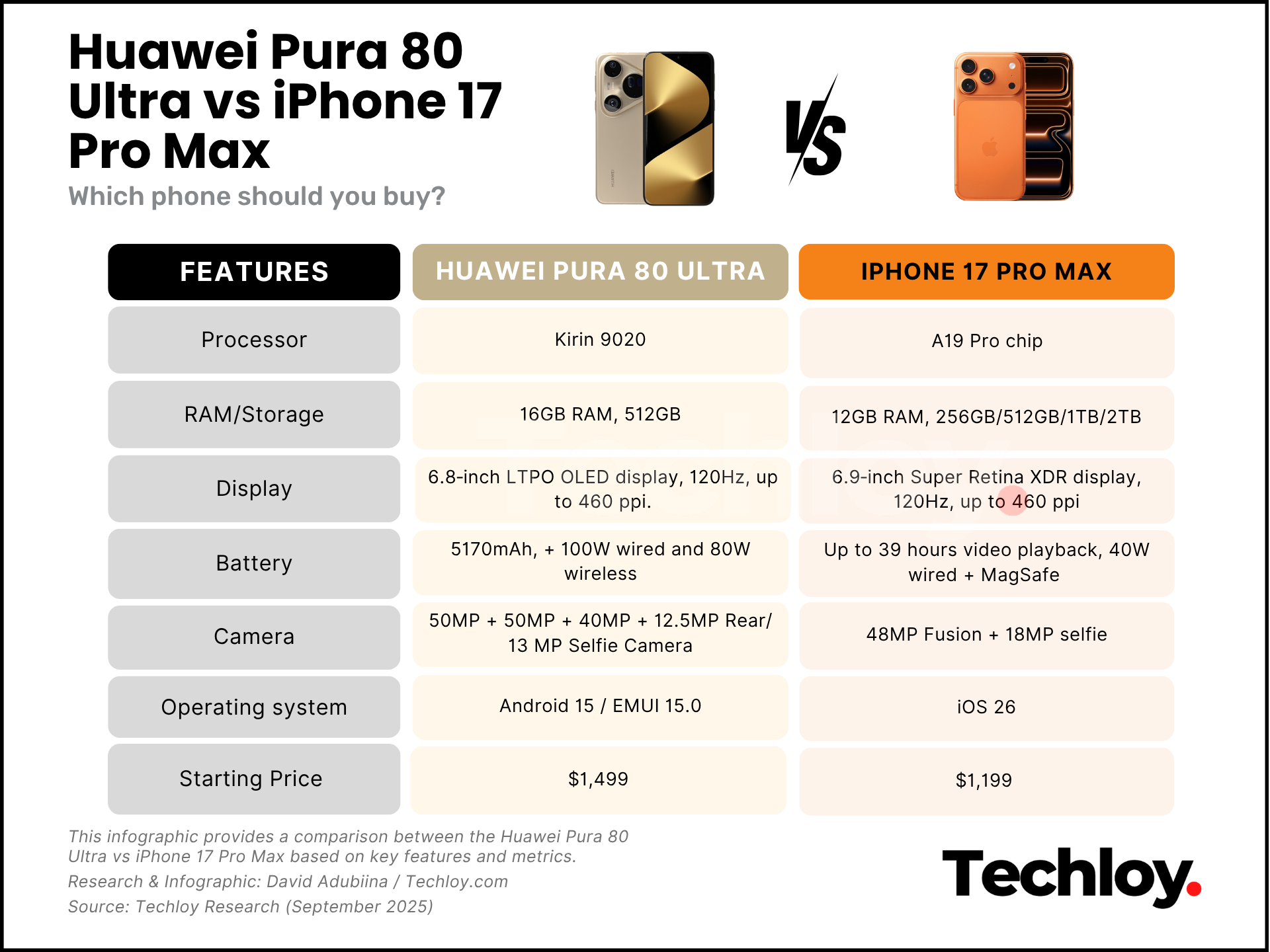
On closer look, Apple stretches the Pro Max’s display to 6.9 inches, with a crisp 2868 × 1320 resolution at 460 ppi. The big upgrade this year is that brightness peak levels now hit 3,000 nits, making it much easier to see the screen outdoors. Protecting it all is Ceramic Shield 2 on both the front and back glass.
Slightly smaller, Huawei's flagship has a 6.8-inch LTPO OLED panel at 2848 × 1276, matching the same 460 ppi sharpness. Its real hedge is flexibility: the refresh rate smoothly shifts between 1 Hz and 120 Hz depending on what you’re doing. A bonus touch is the 1440 Hz PWM dimming, which helps reduce eye strain when you’re scrolling in dim light.
/3. Performance
When it comes to performance, both phones rely on custom chips, but Apple’s A19 Pro gives you plenty of processors to work with. The 6-core CPU and GPU handle demanding apps smoothly, while the 16-core Neural Engine steps in for faster AI-driven tasks. Gamers will notice the hardware-accelerated ray tracing, which makes graphics look sharper and more realistic, and the new vapor chamber keeps performance steady so the phone doesn’t overheat mid-session.
On Huawei’s side, the Pura 80 Ultra runs on the Kirin 9020. There’s not much to go by in chips when it’s not all spelled out in detail, but paired with 16 GB of RAM and 512 GB of storage, the phone doesn’t feel short on power. You can multitask freely, jump between heavy apps, and still have room to store photos, videos, and more without worry.
/4. Cameras
In terms of cameras, there’s no denying that the Pura 80 Ultra comes better equipped. Its 50 MP main sensor is a full 1 inch, with a variable aperture (f/1.6–f/4.0) and optical image stabilization to keep shots steady. Backing it up are a 50 MP telephoto with 3.7x zoom, a 12.5 MP periscope that stretches close to 10x optical zoom, and a 40 MP ultra-wide for sweeping shots. Up front, a 13 MP selfie camera handles video calls and everyday snaps with ease.
It is surprising, though, that the iPhone 17 Pro Max still maintains the 48 MP setup. Apple hasn’t joined the megapixel race—instead, it doubles down on consistency. The new 4x tetraprism telephoto lens delivers up to 8x optical-quality zoom, while the 18 MP wide Centre Stage camera makes video calls feel more natural. Apple’s edge is reliability: whichever lens you pick, the results come out sharp, balanced, and ready to share.
/5. Battery & Charging
Battery life is another area in which Huawei's flagship topples the competition. The Pura 80 Ultra carries a 5170 mAh cell, but what is more fascinating is its 100W wired and 80W wireless charging speed. That means even a quick top-up during a coffee break can leave you with more than enough power to get through the rest of the day.
Though it’s not up to what the Pura can do, the iPhone 17 Pro Max still holds its own. Apple doesn’t reveal the exact battery size, but it’s rated for up to 39 hours of video playback (35 when streaming). Charging caps at 40W, hitting about 50% in 20 minutes. And with MagSafe and Qi wireless support, it’s easy to keep topped up if you already use Apple’s accessories.
/6. Storage & RAM
Both smartphones offer sizeable storage and RAM capacity, but the Pura 80 Ultra takes the crown for RAM. It comes with 16 GB paired with 512 GB of storage — a single configuration that should be more than enough for heavy multitaskers and media hoarders alike. There’s no expandable slot, but most people won’t come close to filling it up.
Although it’s not up to what the Pura offers in raw RAM, the iPhone 17 Pro Max makes up for it with storage flexibility. You get 12 GB of RAM, but storage options range all the way to 2 TB, the first time Apple has pushed a phone that far. For users living on endless photos, 4K videos, or giant apps, that’s a serious advantage.
/7. Price
Generally, both prices indicate top-notch premium, but Apple keeps things slightly more approachable. The iPhone 17 Pro Max starts at $1,199, which feels in line with what you’d expect from a flagship iPhone.
Huawei’s Pura 80 Ultra, meanwhile, pushes higher at around $1,499. It’s a steeper tag, but considering its massive camera setup and blazing-fast charging speeds, I think the price seems worth it.
Final Verdict
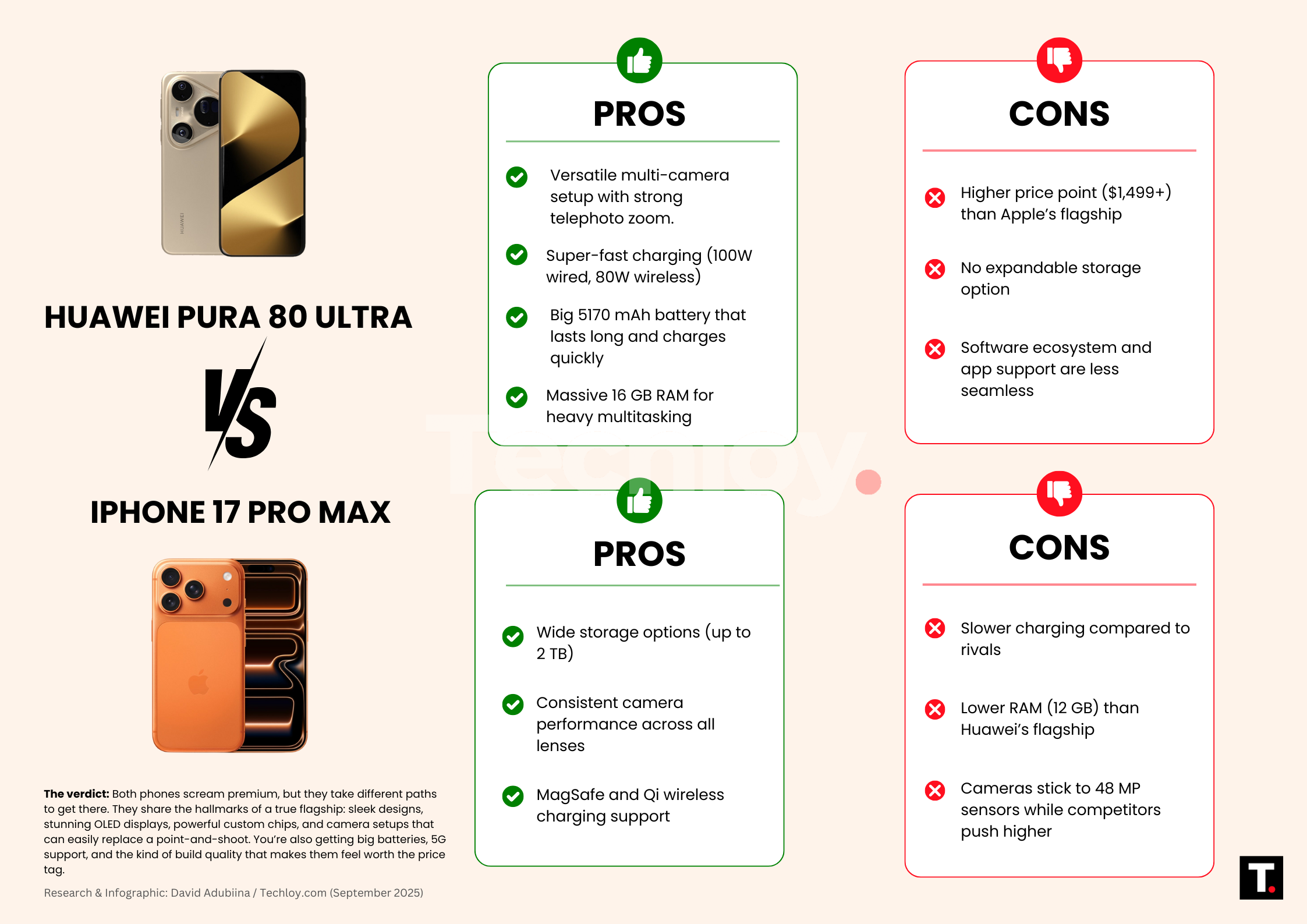
Between both phones, the Pura 80 Ultra is the one to consider if you’re chasing raw hardware setup, more RAM, and charging speeds that leave the competition gasping.
The iPhone 17 Pro Max, though, still makes a strong case as the safer, more balanced choice. Its cameras may not scream “wow” to camera enthusiasts, but they deliver a balanced spectrum of capability. Add the ecosystem, longer support, and Apple's custom software, and you’ve got a phone that just works across the board.
So, if you want cutting-edge, Huawei takes the crown. But if you’d rather have the whole polished package, Apple still rules. That’s my take—what’s yours? Would you go for Huawei’s bold flagship or Apple’s tried-and-true all-rounder?


