



Latin American startups raised over $280 million this week, spanning fintech, healthcare, mobility, and education. Once again, Brazil led the charge, with founders reimagining everything from urban transport and electric motorcycles to financial access and debt solutions. Meanwhile, new players in Mexico and Colombia continued to prove that early innovation and sector-specific technology remain top investor magnets.
Colombian healthtech Welli topped this week’s list with a $75 million structured debt round provided entirely by Community Investment Management (CIM). Founded by Felipe Gómez and Felipe Jaramillo, Welli operates as a financing platform tailored to the healthcare sector, helping providers, physicians, and patients access essential financial services.
The new capital, added to its $25 million Series A in June 2025 led by Costanoa Ventures, Animo VC, and Crestone VC, will accelerate its mission to close healthcare funding gaps across Colombia and Latin America. The company plans to develop new financial products and expand regionally as it positions itself as the strategic financial partner for the medical ecosystem.
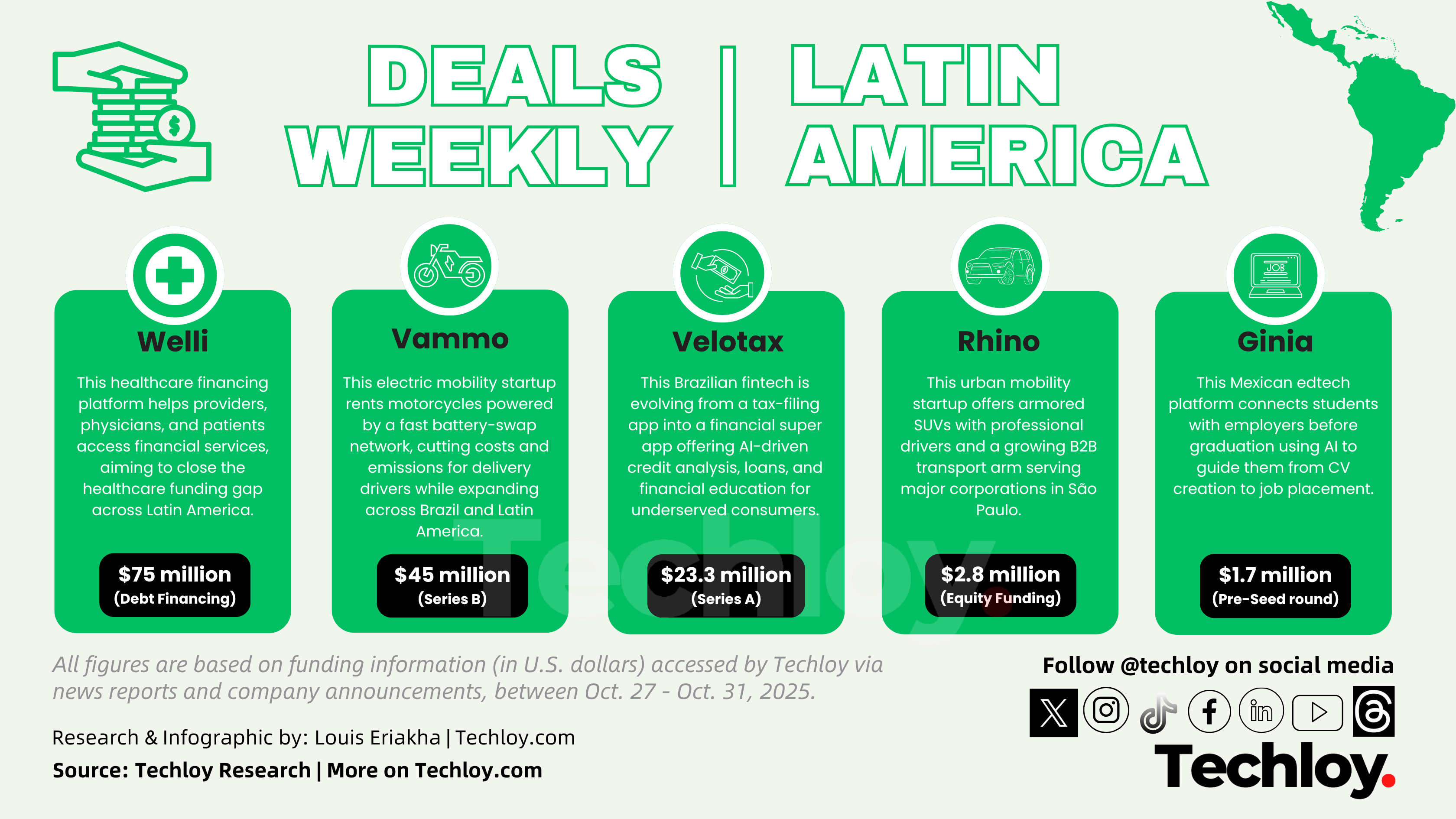
In Brazil, electric mobility startup Vammo raised $45 million in a Series B round led by the Ecosystem Integrity Fund, with participation from Qualcomm Ventures, 2150, Monashees, Construct Capital, Maniv Mobility, Endeavor Catalyst, and several former Tesla employees. Founded in 2022, Vammo rents out electric motorcycles supported by a fast battery-swap network that eliminates charging downtime.
With a fleet of 5,000 vehicles and 150 exchange points around São Paulo, the startup aims to expand nationwide and across Latin America. Vammo also announced plans to raise an additional $75 million in debt and invest R$500 million in its manufacturing plant in Amazonas to develop hybrid electric-ethanol vehicles. Its model targets delivery drivers, promising up to 40% lower monthly operating costs while cutting carbon emissions by up to 90%.
Next up, Brazilian fintech Velotax completed a $23.3 million Series A round backed by QED Investors, Valor Capital, and Picus Capital, funds known for supporting companies like Nubank, Stone, and Clara. Initially known for simplifying tax filing, Velotax now aims to evolve into a full-fledged financial super app. The platform plans to expand its offerings with personal loans, payroll-based credit, and financial education tools. Its proprietary AI analyses hundreds of variables to assess credit risk, enabling access for consumers typically rejected by traditional banks. With Brazil’s rising household debt levels, the company hopes to democratise financial access and strengthen its role in an expanding digital credit market.
Brazil’s Rhino, the first urban mobility app in the country to offer armoured SUVs with professional drivers, received an additional $2.8 million in funding led by TMT Investments and AngelsDeck, both based in Dubai. Founded in 2022 by Daniil Sergunin and Alexander Karbankov, Rhino has now raised a total of R$40 million. With over 300,000 users in Greater São Paulo, the company plans to expand its fleet, strengthen marketing, and scale its B2B service—Rhino for Business, which already serves clients like Mitsubishi, PepsiCo, and RedeTV. Focused on combining safety, comfort, and efficiency, Rhino is redefining urban mobility in a market where armoured vehicle demand continues to rise.
Finally, in Mexico, edtech startup Ginia secured $1.7 million in pre-seed funding led by Wollef, with participation from NFX and Latitud. Founded in 2025 by Antía Vázquez, Melissa Manrique, and Renata Millet Ponce, the platform connects students with employers before graduation, using AI to guide them from CV creation to interview preparation and job placement. The funds will be used to accelerate product development and expand operations across Mexico and Latin America as the company builds a smarter bridge between education and employment.
From healthcare financing in Bogotá to AI-powered tax apps in São Paulo and talent-matching platforms in Mexico City, Latin America’s tech scene continues to evolve at full throttle—powered by a shared goal of accessibility, innovation, and regional expansion.


