



This year’s flagship phone cycle has felt less like a race and more like three competing philosophies. Apple staged another high-gloss September 'awe-dropping' event for the iPhone 17 Pro, Google slipped the Pixel 10 Pro out a week earlier with a heavy AI pitch, and Samsung’s Galaxy S25 has already been on shelves long enough to collect dust in reviewer labs.
On paper, all three are powerful slabs of glass and metal. But the focus here is how differently they define “flagship.” In this review, I cut through the hype and see which one actually makes sense for you.
 Emmanuel Umahi
/1. Design & Display
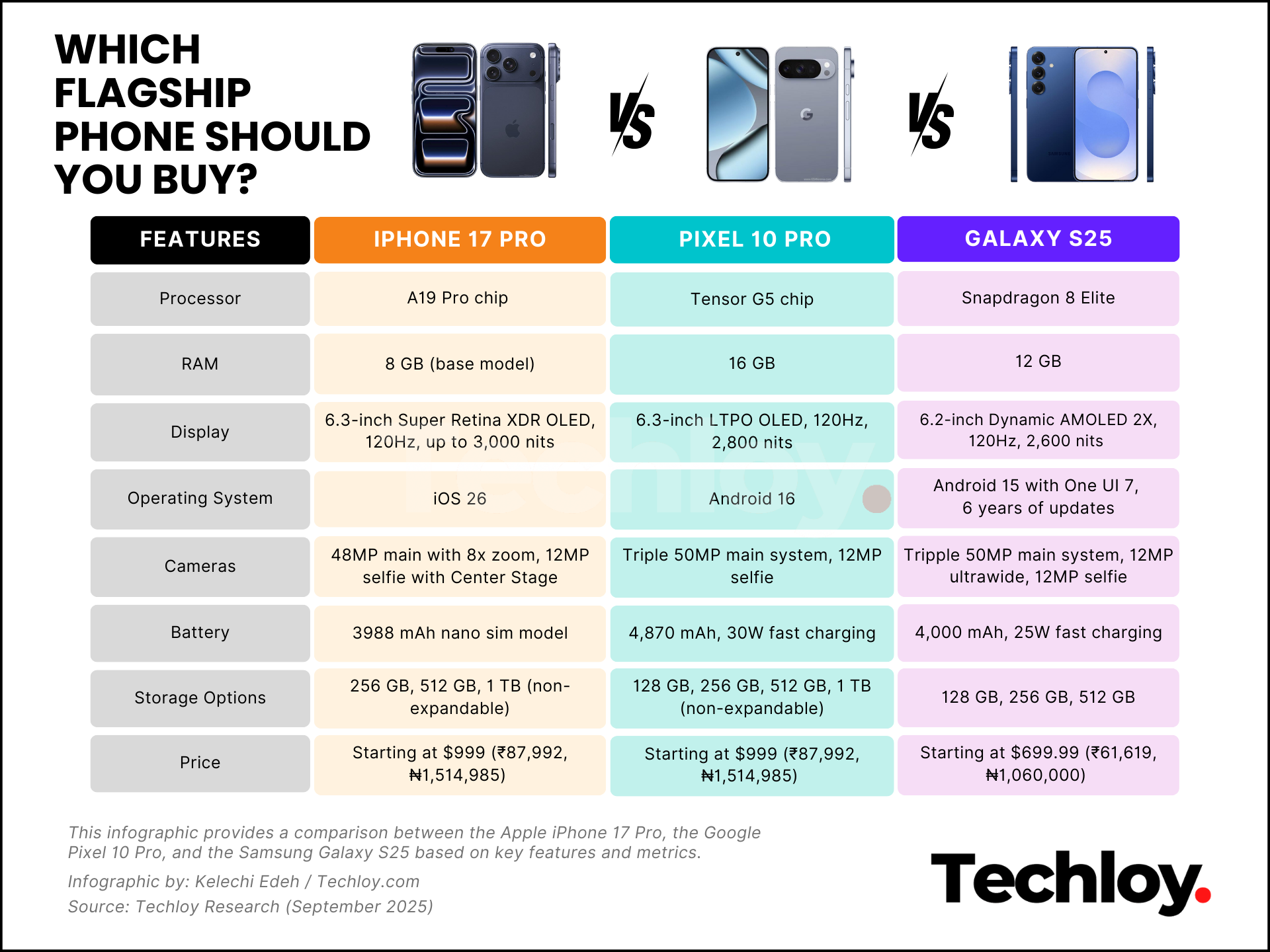
Holding the iPhone 17 Pro, you’d immediately notice how Apple redesigned the chassis. The new “camera plateau” isn’t just cosmetic, as it protects the lenses and makes internal space more efficient. The matte aluminum finish is also tougher, and the 6.3-inch Super Retina XDR OLED feels fluid at 120Hz. My only gripe is that the matte finish makes it feel slightly less “blingy” than previous glossy models.
Switching to Samsung’s Galaxy S25, it’s compact, almost perfect for one-handed use, and the 6.2-inch Dynamic AMOLED 2X is ridiculously bright. Armor Aluminum and Gorilla Glass Victus 2 make it feel like it could survive a drop. That said, it’s a familiar design when compared to the S24, functional, but not exciting.
Google’s Pixel 10 Pro, meanwhile, feels different. The display is the brightest of the three, which is a joy outdoors, and the ultrawide selfie lens is clever. But it’s noticeably heavy; after a few hours, your hands could get tired, and the bulk slightly dulls the “premium” feel.
Verdict: iPhone 17 Pro edges out for design—premium yet practical. Pixel shines in brightness, but heft drags it down. Samsung is safe, compact, but uninspired.
/2. Performance
Apple’s A19 Pro chip feels buttery smooth, but the real story is thermal efficiency. With its vapor chamber cooling, the phone keeps up peak performance for longer. One reviewer said they played Genshin Impact for over an hour and hardly noticed any throttling.
On the other hand, the Samsung Galaxy S25 is all about raw Android muscle. The Snapdragon 8 Elite doesn’t flinch, multitasking, video, gaming, it handles everything consistently. You don’t have to think about it; it just works.
Pixel 10 Pro takes a different path, though. Its Tensor G5 chip is optimized for AI tasks, and you notice that when using real-world features: smarter suggestions, better on-device editing, and faster AI-assisted photo adjustments. But push it into heavy gaming, and it shows limits. It throttles sooner, and benchmarks lag behind the other two.
Verdict: Samsung = raw Android power. Apple = balance between speed and endurance. Pixel = brilliant AI tricks, weaker under sustained heavy loads.
/3. Cameras
I’ll admit that the Apple iPhone 17 Pro cameras impressed me. Three 48MP Fusion sensors, up to 8x zoom in the viewfinder, and a new Center Stage selfie cam make it versatile for photos and video. But the camera UI has quirks, and some upgrades feel incremental.
Pixel 10 Pro still wins in single-shot photos thanks to Google’s software. HDR, AI editing, and low-light shots are consistently solid. It’s like having a camera that thinks for you. The downside here is the hardware didn’t move as far forward, so extreme low-light zoom or wide-angle shots can fall behind Apple.
Samsung is the Swiss Army knife here with versatile lenses and consistent daylight shots, though the setup hasn’t evolved much from last year. Some color profiles can feel oversaturated, but it handles most scenarios decently.
Verdict: iPhone = best for creators/video. Pixel = best computational stills. Samsung = most versatile but less exciting hardware.
/4. Battery & Charging
Apple quietly improved endurance. The bigger internal volume plus chip efficiency translates into noticeably longer real-world battery life. Charging isn’t blazing fast, but you won’t need to top up midday if your day is typical.
Samsung’s S25 is predictable. 4,000mAh plus 25W charging isn’t flashy, but it gets you reliably through the day.
The Pixel 10 Pro struggles here. Google’s software optimizations help, but charging is painfully slow, and endurance varies by model. If I were hopping from meetings to calls, I’d worry about hitting the wall too soon.
Verdict: Apple = best endurance. Samsung = reliable. Pixel = inconsistent charging and endurance.
/5. Software & Ecosystem
iOS remains cohesive. Everything just works, and updates are predictable. Pixel is where experimentation happens — clever AI features, but some region-limited and still in flux. Samsung balances nicely: One UI 7 packs useful tools, AI enhancements, and a solid update roadmap.
Verdict: Apple = polished and long-lasting ecosystem. Samsung = best Android compromise. Pixel = most experimental.
Final Thoughts
If video, durability, and consistent performance matter to you, the iPhone 17 Pro is your pick. Slightly incremental upgrades, but Apple’s ecosystem and hardware tweaks solve real annoyances.
On the other hand, the Galaxy S25 is Compact, reliable, and fast, which makes it a safe choice for Android users. It’s not flashy, but it works beautifully day after day.
Finally, the Pixel 10 Pro is great for an AI-first experience. But if you push it hard or need fast charging, you might feel the limits.


