



If you're hunting for a premium smartphone in 2025 that represents the best of its respective ecosystem while still on budget, two powerhouses likely top your consideration list: Apple's refined iPhone 17 and Google's AI-forward Pixel 10.
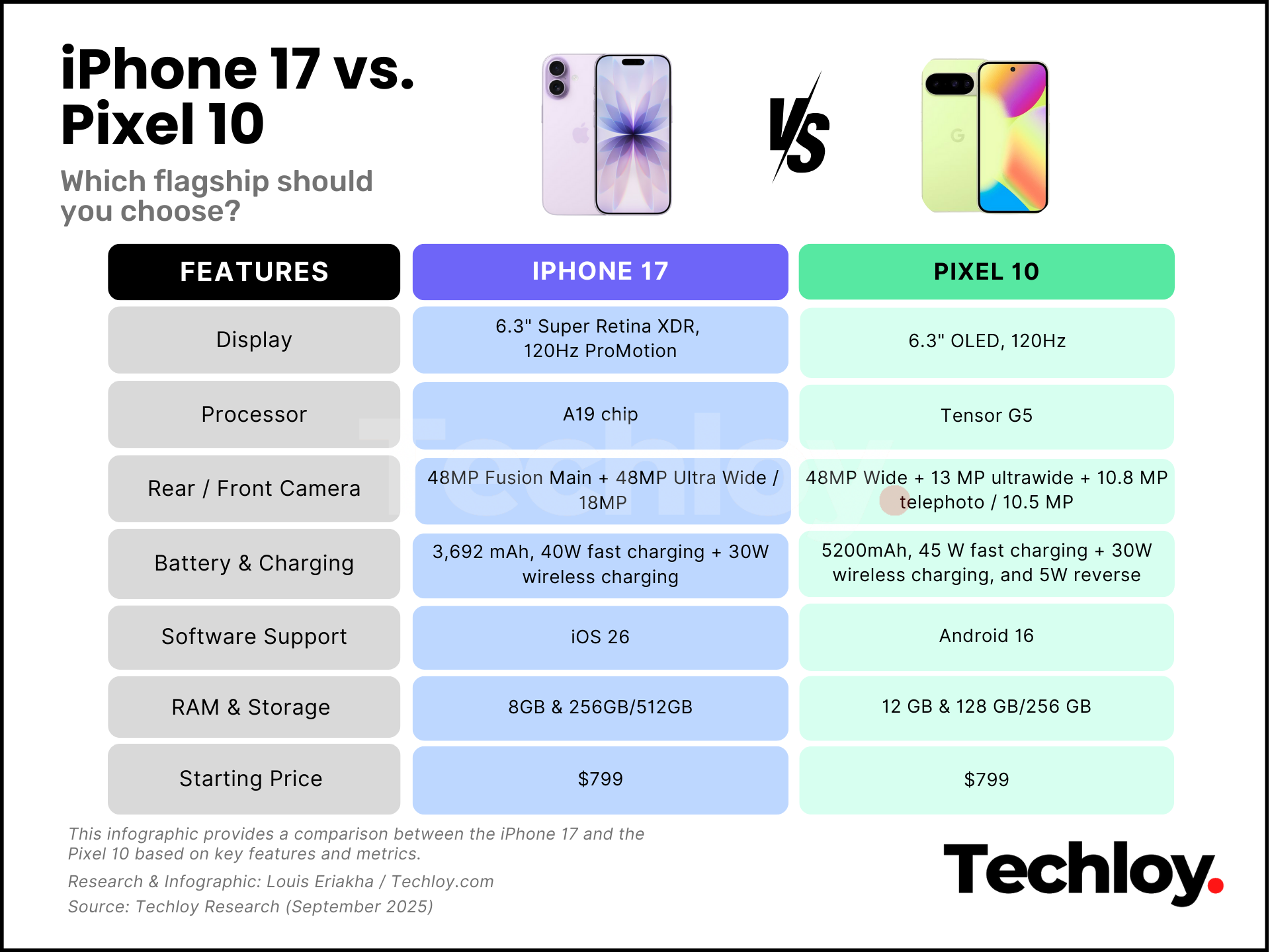
Both start at $799 (iPhone 17 with 256GB, Pixel 10 with 128GB), feature cutting-edge processors, stunning displays, and computational photography that pushes boundaries. But peel back the surface, and you'll discover they target distinctly different user philosophies: one emphasises seamless ecosystem integration and premium build quality, while the other champions AI innovation and photographic excellence.
So, which flagship earns your investment? Here's our comprehensive breakdown by category.
 Kelechi Edeh
/1. Design & Build
Apple continues its evolution toward refined minimalism with the iPhone 17, featuring a 6.3-inch form factor that's both familiar and fresh. The iPhone 17 features a 6.3-inch Super Retina XDR display, wrapped in a durable glass and aluminium construction that feels premium in hand. At 8mm thickness, it maintains Apple's commitment to sleek profiles while offering solid build quality and water resistance.
Google takes a more utilitarian approach with the Pixel 10, sporting a 6.3-inch display housed in a slightly thicker 8.6mm body that weighs 204g. The design language focuses on functionality over flash, with Google's signature camera bar providing a distinctive rear aesthetic that's instantly recognisable as a Pixel.
Which wins? iPhone 17 for premium materials and refined aesthetics; Pixel 10 for distinctive design character and practical ergonomics.
/2. Display
Both devices deliver exceptional visual experiences, but with different technological approaches. The iPhone 17 features a 6.3-inch Super Retina XDR display, featuring Pro Motion that offers an adaptive refresh rate of 120Hz, with the ability to drop the refresh rate down to 1Hz when not in use. Peak brightness reaches impressive levels suitable for outdoor use, complemented by Apple's industry-leading colour accuracy.
The Pixel 10 matches with its own 6.3-inch OLED panel featuring 120Hz refresh rates and Google's latest display technology. While specific brightness figures vary, Google's focus on computational display enhancement and AI-driven brightness adjustment provides excellent real-world visibility across various lighting conditions.
Which wins? iPhone 17. Apple's display technology remains slightly ahead, with better power efficiency and more refined adaptive refresh rate implementation.
/3. Performance
The iPhone 17 is powered by Apple's A19 chip, delivering flagship-level performance that's become synonymous with iPhones. Apple's tight integration between hardware and software ensures smooth operation across all tasks, from basic usage to intensive gaming and video editing.
The Pixel 10 runs on Google's Tensor G5, which represents the most notable processor upgrade for Pixels since the original introduction of Tensor. Tensor G5, our new custom silicon, is the most significant upgrade to our chip since Tensor's debut. It delivers snappy performance while optimising AI workloads and computational photography tasks.
Which wins? iPhone 17. While Tensor G5 is impressive for AI tasks, Apple's A19 still leads in raw computational power and sustained performance.
/4. Cameras
The iPhone 17 features the new Centre Stage front camera, a 48MP Fusion Main camera, and a new 48MP Fusion Ultra Wide camera. Apple's computational photography has reached new heights, with improved Night mode, Cinematic mode, and enhanced video recording capabilities that leverage the A19 chip's imaging prowess.
The Pixel 10 features a Triple camera system setup that continues Google's legacy of computational photography excellence. The Pixel 10 phones also come with a range of new AI-focused features, including Camera Coach, Guided Frame, Auto Best Take and Ask Photos for conversational AI editing, powered by advanced machine learning algorithms.
Which wins? Google Pixel 10. While both are excellent, Google's computational photography and AI-driven features give it the edge for versatility and innovative shooting modes.
/5. Battery & Charging
The iPhone 17 includes Apple's latest battery technology with all-day performance, though specific capacity figures aren't publicly detailed. Apple's optimisation between hardware and iOS typically delivers excellent real-world battery life, with wireless charging and MagSafe compatibility.
The Pixel 10 features a substantial 4970 mAh battery, complemented by faster charging speeds than Apple typically offers. Google's battery management, combined with Tensor G5's efficiency improvements, provides solid all-day performance with quicker top-ups when needed.
Which wins? Google Pixel 10. The larger battery capacity and faster charging give it a practical advantage for heavy users.
/6. Software & AI Features
The iPhone 17 ships with iOS 26 and Apple's commitment to long-term software support, typically offering 5-6 years of major updates. Apple Intelligence integration provides AI features across the system, focusing on privacy and on-device processing for enhanced user experience.
The Pixel 10 runs Android 16 with up to 7 major Android upgrades, making it one of the longest-supported Android devices. Google's AI integration runs deeper, with Gemini built in and constant updates to AI-powered features that showcase Google's machine learning expertise.
Which wins? Google Pixel 10, narrowly. While both offer excellent long-term support, Google's AI implementation is more comprehensive and innovative.
Conclusion
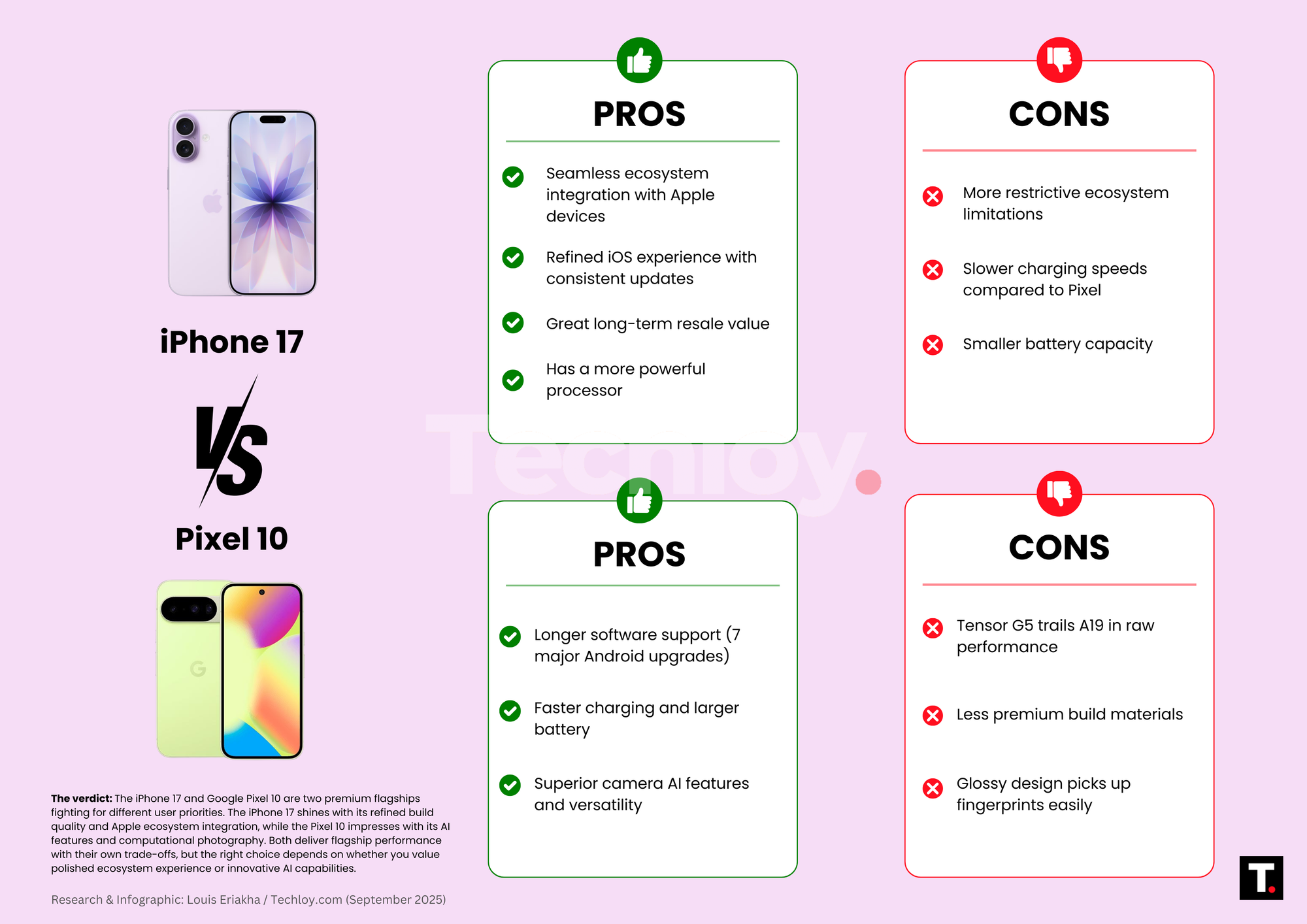
If you prioritise premium build quality, seamless ecosystem integration (especially with other Apple devices), and proven long-term reliability, the iPhone 17 delivers the polished experience Apple users expect. It's ideal for those invested in the Apple ecosystem or preferring iOS's refined interface.
But if cutting-edge AI features, computational photography innovation, and the flexibility of Android appeal to you, the Google Pixel 10 represents the future of smartphone intelligence. It's perfect for users who want the latest AI capabilities and don't mind being early adopters of new technology.
In essence, Apple delivers refined perfection; Google pushes innovative boundaries. Either choice gets you a premium 2025 flagship that excels in its own distinctive way.


