



The laptop market in 2026 has just been turned on its head. With the surprise release of the MacBook Neo, Apple is finally chasing the budget-conscious crown, bringing macOS to its lowest price point ever.
But they aren't entering an empty arena. Lenovo’s Chromebook Plus 14 (Gen 10) has been the reigning champion for students and cloud-first professionals, offering high-end hardware for a fraction of the cost of a Pro machine. Both laptops promise to be the ultimate daily driver for around $600, but they prioritise very different things.
Let’s break it down by category.
1) Display and Visual Fidelity
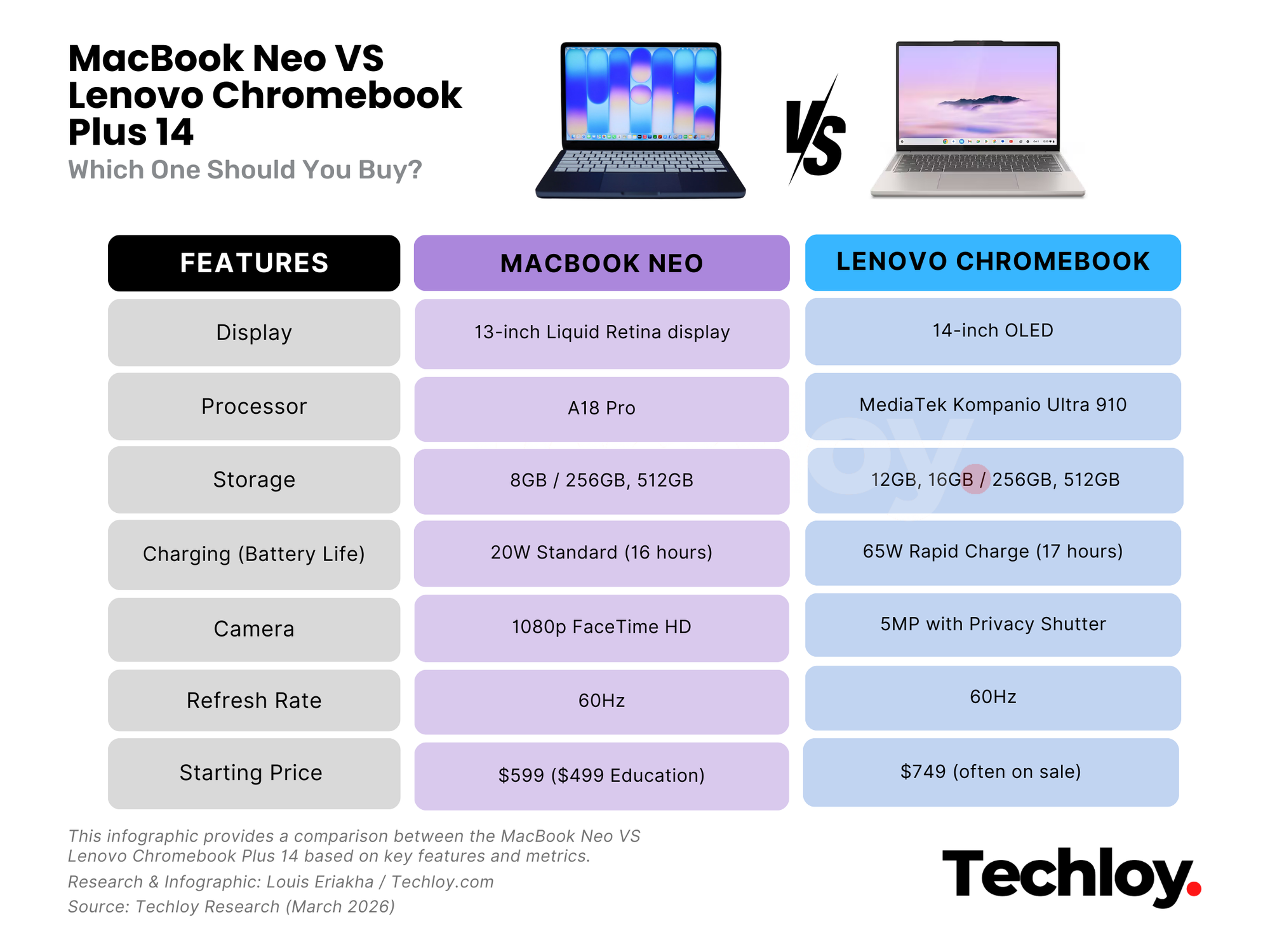
The MacBook Neo features a 13-inch Liquid Retina display at a crisp 2408 x 1506 resolution. With 500 nits of brightness and an anti-reflective coating, it has one of the best panels in this price bracket.
However, Lenovo has gone for the "wow" factor. The Chromebook Plus 14 packs a 14-inch OLED panel with a 100% DCI-P3 colour gamut. OLED means infinite contrast and true blacks that an LCD simply cannot match. Plus, Lenovo offers an optional touchscreen, something still absent from the Mac lineup (but leaks say maybe not for long).
2) Performance and Silicon
Apple has done something unconventional here: the MacBook Neo is powered by the A18 Pro chip—the same silicon found in the iPhone 16 Pro. While it sounds like a mobile compromise, the 6-core CPU and 16-core Neural Engine are optimised for "Apple Intelligence" and everyday macOS tasks. It is fanless, making it almost completely silent, though users are limited to 8GB of unified memory.
The Lenovo uses the MediaTek Kompanio Ultra 910. While it's a beast in the ChromeOS world with its 50 TOPS NPU for Gemini AI features, it really shines in multitasking with up to 16GB of RAM. However, the A18 Pro’s raw single-core speed gives the Neo a snappier feel during heavy browser sessions or light photo editing.
3) Portability and Build Quality
Both machines are impressively light. The MacBook Neo weighs in at 2.7 pounds with a 0.5-inch-thin aluminium chassis. It comes in fun new colours like Citrus and Blush, giving it a modern, "iPhone-esque" vibe. However, to hit this price, Apple removed the keyboard backlighting, which may frustrate night owls.
Lenovo’s Chromebook Plus 14 is slightly lighter at 2.58 pounds and features a MIL-STD-810H durability rating. However, while it uses an aluminium chassis, reviewers have noted it doesn't quite have the "unibody" rigidity that Apple is famous for.
4) Battery Life and Charging
Battery endurance is a tight race. Apple claims up to 16 hours of battery life, which is more than enough for a full day. One catch: the Neo lacks MagSafe, and of its two USB-C ports, one is limited to USB 2.0 speeds, meaning you'll want to be careful which port you use for data.
Lenovo, however, pushes the envelope with up to 17 hours on a single charge from its 60Wh battery. Furthermore, Lenovo includes 65W Rapid Charge, which can juice the laptop to 80% in about an hour. The Neo, meanwhile, ships with a more modest 20W adapter and lacks fast-charging support.
5) Webcam and Audio Experience
Video calls have become the "killer app" for these devices. Lenovo brings a 5MP webcam with a physical privacy shutter and quad speakers tuned with Dolby Atmos (including two dedicated woofers). It’s a multimedia powerhouse.
The MacBook Neo features a 1080p FaceTime HD camera and dual side-firing speakers. While the Neo’s camera processing is excellent, it lacks the physical privacy shutter and the sheer "oomph" of Lenovo’s four-speaker setup.
6) Ecosystem and Software
This is the "great divide." The MacBook Neo runs macOS Tahoe, offering the full suite of Mac apps and seamless integration with your iPhone (Handoff, Universal Control, and iMessage).
The Lenovo runs ChromeOS, which is leaner and faster for web-based work. It leans heavily into Google AI (Gemini), offering a year of Google AI Pro for free. If your life is in Google Docs and the Chrome browser, it's arguably more efficient.
So Which One Should You Pick?
If you want the prestige of a Mac, the reliability of macOS, and a device that slots perfectly into your Apple ecosystem without breaking the bank, the MacBook Neo is the breakthrough you’ve been waiting for.
However, if you prioritise a stunning OLED screen for movies, a touchscreen for navigation, and the best-in-class audio for a Chromebook, the Lenovo Chromebook Plus 14 offers hardware specs that simply shouldn't be possible at this price point.
The choice ultimately depends on whether you want a premium "lite" computer or the most powerful "cloud" machine ever made.


