The global race for tech talent has expanded significantly since the COVID-19 pandemic accelerated remote work and cross-border hiring. Across Latin America, countries are investing in digital infrastructure, startup ecosystems, and innovation programs to attract software developers, engineers, data scientists, and other tech experts.
According to the International Organization for Migration's World Migration Report 2026, mobility within Latin America remains an important driver of economic opportunity, with workers increasingly relocating in search of better jobs, improved living conditions, and greater career prospects.
For global talents considering Latin America, Mexico and Paraguay are emerging as top destinations for digital nomads and startup founders alike. Yet the opportunities and benefits both countries offer differ in more ways than one.
Mexico, a mature technology ecosystem
Mexico is widely regarded as one of Latin America's strongest technology markets. The country benefits from a large population of more than 130 million people, a growing digital economy, and proximity to the United States.
Major cities such as Mexico City, Guadalajara, and Monterrey have become important technology hubs, attracting multinational companies, venture capital firms, and startup founders. Mexico has also produced some of the region's most successful technology companies, including fintech, e-commerce, and software startups that have expanded across Latin America.
For digital nomads and technology professionals, this translates into access to a larger job market, greater career mobility, and opportunities to work with international companies. Mexico's proximity to the United States and its integration with North American supply chains also provide valuable exposure to one of the world's largest technology markets.
Paraguay, a destination of affordability and emerging opportunities
Paraguay may not receive the same attention as Mexico when discussing technology hubs, but it offers advantages that appeal to a growing number of professionals.
One of the country's strongest selling points is affordability. Housing, transportation, and everyday expenses are generally lower than in many major Latin American cities. This makes Paraguay particularly attractive to remote workers earning foreign income or entrepreneurs seeking to reduce operating costs.
The government has also taken steps in recent times to modernize its economy through digitalization initiatives and efforts to improve the business environment. While Paraguay's technology ecosystem remains relatively small with a population of roughly 7 million people, it provides opportunities for professionals interested in entering an emerging market where competition is less intense.
How does Mexico compare to Paraguay for tech talents?
Here's the difference between both countries and the clear winner for each category:
/1. Job opportunities and career growth
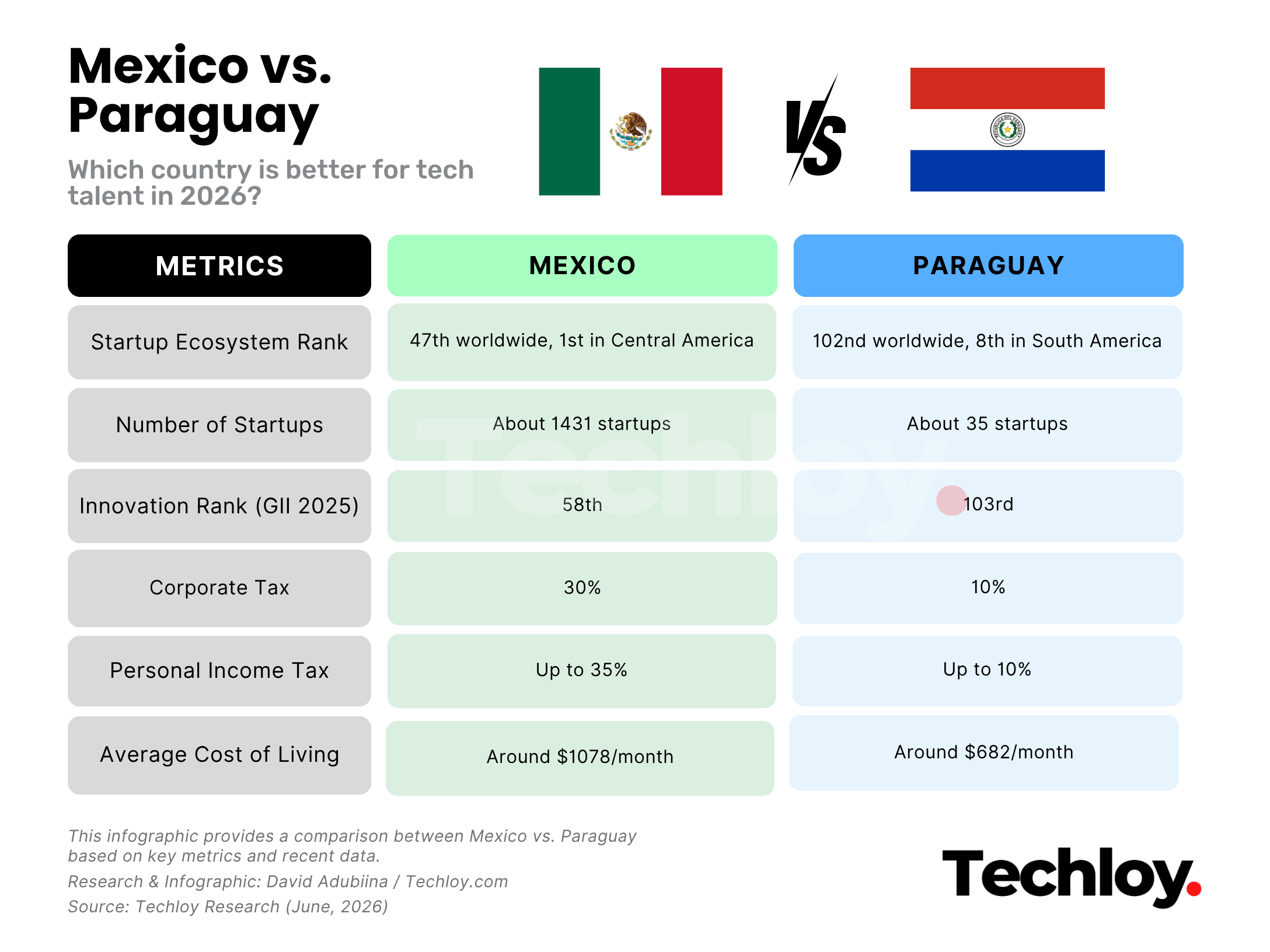
When comparing employment opportunities, Mexico holds a clear advantage. Mainly the country attracts substantially more foreign investment and hosts a larger number of technology companies. Its startup ecosystem is among the most developed in Latin America, ranking first in Central America, according to StartupBlink. Combined with the country's growing role in the nearshoring boom and its close economic ties to the United States, these factors continue to drive demand for skilled technology professionals.
As a result, workers can access opportunities across a wide range of sectors, with some of the most sought-after roles including full-stack and software development, data science and AI engineering, cloud and DevOps engineering, and cybersecurity.
Unlike Mexico's mature technology ecosystem, Paraguay's tech sector is still in its growth phase. Although the country ranks eighth in South America on StartupBlink's ecosystem rankings, its smaller economy naturally limits the number of available positions. This makes Paraguay an attractive option for entrepreneurs and remote workers, and, as such, professionals seeking roles in artificial intelligence, software engineering, cloud computing, cybersecurity, fintech, or product development are more likely to find a wider range of opportunities there.
/2. Startup ecosystem and innovation
Mexico's advantage extends beyond jobs and investment into the startup ecosystem itself. Ranked 47th globally by StartupBlink, the country has established itself as one of Latin America's leading hubs for innovation, far ahead of Paraguay, which ranks 102nd.
This position has been supported by strong venture capital activity. Over the past decade, Mexican startups have raised more than $12.65 billion, accounting for 82.04% of startup funding across Central America. The availability of capital has helped startups in fintech, healthtech, logistics, and enterprise software grow into major employers and innovation drivers.
For professionals, this creates a broader range of opportunities to work with high-growth companies, gain exposure to investors, and participate in scaling businesses.
Paraguay's startup ecosystem, meanwhile, is still finding its footing. Total startup investment stands at roughly $12.27 million, a figure that reflects both the smaller size of its economy and the early stage of its entrepreneurial landscape. Although Paraguay's ecosystem is still far from matching Mexico's scale, it offers potential for founders willing to bet on a growing market as digital adoption continues to expand.
/3. Tax environment and business conditions
Taxation and business regulations also play an important role in shaping where you decide to base yourself. In Mexico, personal income tax rates can reach up to around 35%, depending on earnings, while businesses are subject to a standard corporate tax rate of 30%.
Paraguay, by contrast, is widely considered one of the more tax-friendly environments in Latin America. It operates a territorial tax system, meaning individuals and corporations are only taxed on income generated within its borders. Foreign-sourced income, wealth, inheritance, and capital exports are generally untaxed. Local income and business profits are subject to low, flat rates, typically around 10%.
/4. Cost of living comparison
While Mexico offers a larger technology ecosystem and stronger career prospects, Paraguay holds a clear advantage when it comes to affordability. According to LivingCost, the average cost of living for a single person is approximately $682 per month in Paraguay, compared to $1,078 in Mexico, making Mexico about 58% more expensive overall.
For tech professionals, this creates an interesting trade-off. Mexico's larger job market and higher earning potential may justify its higher living costs, especially for those working with multinational companies or fast-growing startups. Paraguay, on the other hand, offers greater purchasing power for remote workers, freelancers, and entrepreneurs whose income is not tied directly to the local economy.
As a result, the decision often comes down to whether an individual prioritizes higher earning potential or greater purchasing power.
Which country is better for tech talent?
There is no one-size-fits-all answer when it comes to choosing where to pursue new opportunities. The better destination depends on one’s professional career goals, lifestyle preferences, and long-term ambitions.
If you are seeking access to established technology companies, well-funded startups, venture capital, and a clear path for career advancement, Mexico remains the stronger choice. Its robust tech ecosystem and close ties to the U.S. market provide opportunities that are difficult to match elsewhere in the region.
But if you are more attuned to emerging markets with significant growth potential, lower operating costs, and the opportunity to establish an early presence in a developing ecosystem, Paraguay may prove to be the more rewarding destination.
Regardless of which destination comes out on top, both Mexico and Paraguay are positioning themselves as increasingly attractive hubs for tech talent in the region.
 David Adubiina