


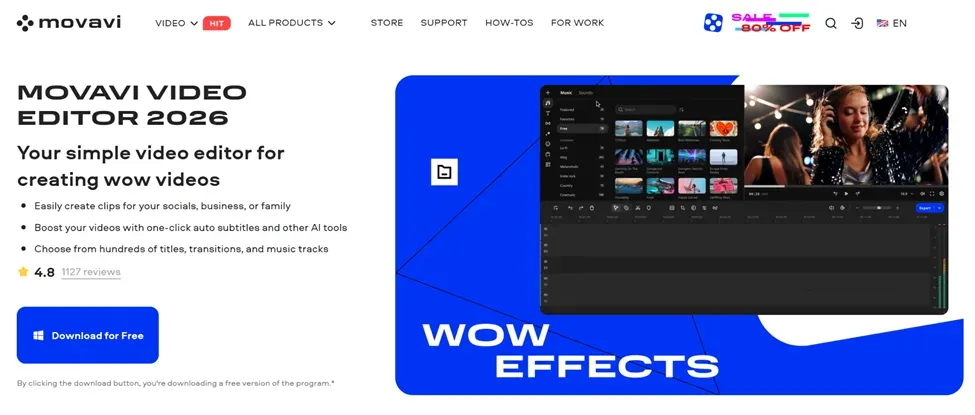
Movavi has been quietly pushing its desktop editor toward a very specific goal: let the software handle the boring parts, so creators can focus on ideas. Movavi Video Editor is still a classic timeline-based video editor, but recent updates make it feel much closer to an everyday AI video editor than a traditional “cut and trim” app.
If you’re making YouTube videos, short social clips, tutorials, or branded content, and you don’t want to wrestle with complexity, Movavi is positioning itself as an approachable choice for Windows and macOS that still has enough smart tools to keep up with a packed upload schedule.
Part 1: Key AI Features in Movavi Video Editor
1.1 AI Background Removal and Motion Tracking: Fast, Social-Ready Visuals
Movavi’s AI background removal has been around for a while now, but it’s still one of the features that instantly feels next-gen when you try it. Instead of messing with green screens, you drop a clip on the timeline, use the background removal tool, and let the AI cut your subject out automatically. The feature arrived as part of a major AI push in version 23, where Movavi introduced AI-powered background removal and AI noise removal in one go.
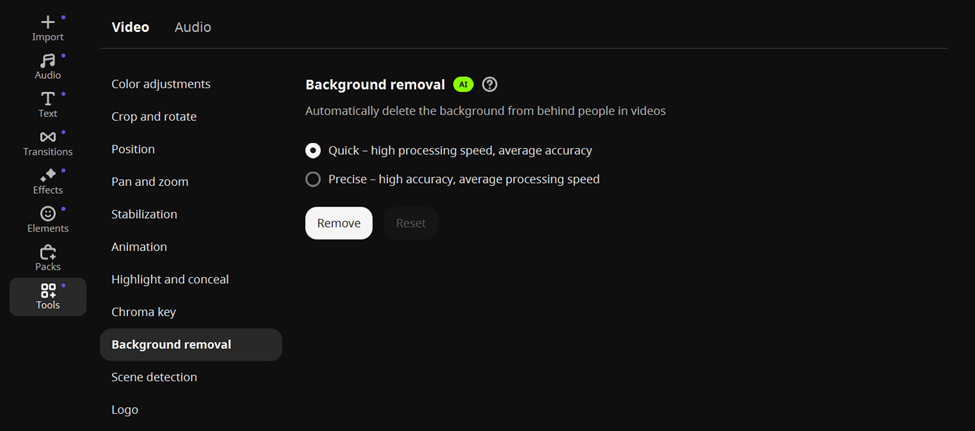
For creators, this is a simple but powerful shortcut. You can put yourself in front of screenshots, product UIs, gameplay, or branded backdrops. Pair that with AI motion tracking, and you can attach titles, emojis, or callouts to moving objects in a few clicks. Movavi’s motion tracking uses AI to follow objects in your footage, so overlays stick to them as they move, which is ideal for explainer-style YouTube videos, product demos, and “follow the cursor” educational content.
1.2 AI Noise Removal and Smarter Audio Tools
Audio cleanup is another area where Movavi Video Editor leans on AI. AI noise removal was rolled out alongside background removal, aimed at cutting traffic hum, wind, and other background sounds automatically.
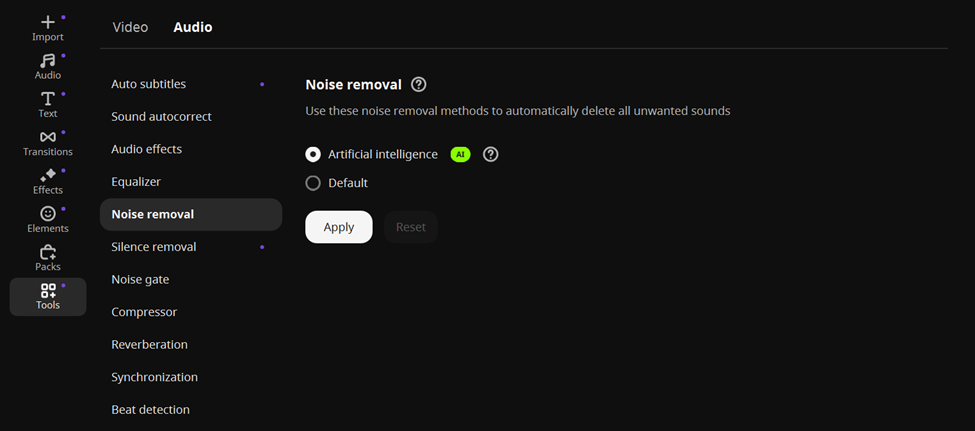
On top of that, Movavi has long offered a one-click audio enhancement button and manual audio controls, so you can boost clarity, tame volume, or combine multiple audio effects without touching a separate DAW.
If you’re recording at home, in a small office, or on the go, this matters more than it sounds on paper. Instead of exporting your video, sending it to a separate app, re-exporting the audio, and importing it back, you can fix most audio issues in the same timeline.
1.3 Automatic Subtitles That Keep Evolving
Automatic subtitles are where Movavi has been moving the fastest over the last two years. In October 2024, the team shipped the “Auto subtitles” feature: the app uses AI to recognize speech, generate subtitles, and sync them with your video, with tools to tweak lines for perfect accuracy.
That alone already made life easier for YouTubers, educators, and marketers who need accessible content and better retention. No more manual typing; you get a full subtitle track in one pass, ready to adjust.
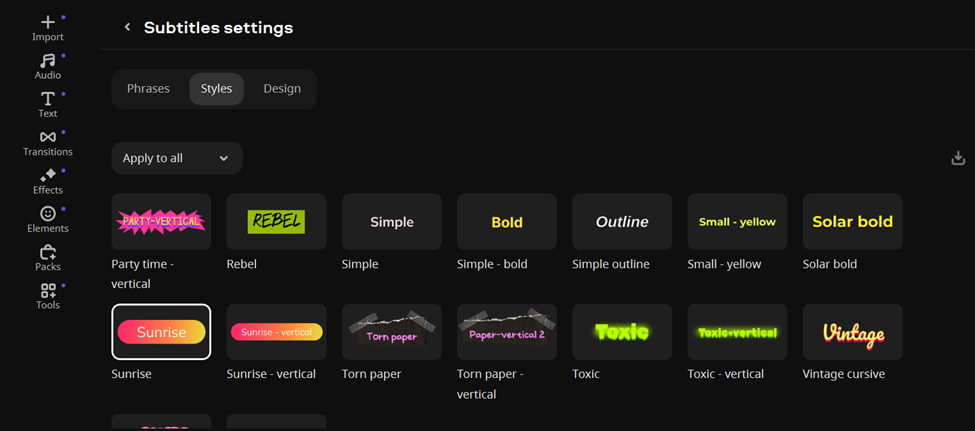
The October 2025 major update took that foundation and turned it into a full captioning workflow. Version 26 added 30+ fresh subtitle styles, so you can restyle your auto-generated captions with a single click in the Styles tab, plus advanced controls in the Design tab if you want to fine-tune. It also introduced instant translation of auto subtitles into English and the ability to export captions as SRT files.
1.4 Silence Removal and Ultra-Fast Playback for Smarter Pacing
Another recent addition that feels very “everyday AI” (even though it’s not technically an AI feature) is Silence Removal. Introduced in mid-2025, it automatically detects pauses in speech and cuts them based on a configurable threshold and minimum pause length.
Instead of hunting for gaps in the waveform, you press a button, get a cleaned-up vocal track, and then tweak if necessary. Pair that with the new speed controls of up to 100x playback, and you get a workflow that is very friendly for time-lapses, tutorials, and “build in 5 minutes” type content.
Part 2: Everyday Editing Experience and 2025 Quality-of-Life Changes
Movavi’s AI features sit on top of a timeline that has quietly become much more pleasant over the last few versions. Version 24 brought a revamped timeline, clearer layout, easier cuts with the Blade tool, and better color correction controls aimed at non-experts.
Throughout 2024 and 2025, Movavi kept layering in small improvements: snapping, so clips automatically align on the timeline, easier track management, faster effect installation, smoother previews, and better performance when projects get larger.
The October 2025 cycle continued this trend with:
- Faster loading of transitions, stickers, titles, and other effects so you don’t wait for content packs to initialize.
- Trimming that works just by hovering over a clip edge and dragging, instead of entering a dedicated trim mode.
- Export optimizations and smaller file sizes in previous builds, which make repeated uploads and revisions more manageable for creators on laptops.
All of this lines up with Movavi’s positioning as an everyday AI video editing software rather than a niche pro suite. You get serious tools like AI motion tracking and background removal, but they live in a UI that doesn’t punish you for being a beginner.
Part 3: How Movavi Fits Into a Creator’s Toolkit
3.1 YouTube and Social Creators
If you’re looking for the best video editing software for YouTube for normal humans, Movavi makes a strong case. You can cut a talking-head video, remove silence, clean up audio, add B-roll, apply motion-tracked callouts, and generate subtitles. All in one place.
For Shorts, Reels, and TikTok, background removal plus AI motion tracking are especially handy: you can quickly build those “floating head over screen recording” formats or overlay stickers that follow a moving product. Direct SRT export also helps you keep subtitles consistent when you repurpose content across platforms.
Movavi Video Editor won’t replace high-end color grading suites or mega-complex compositing tools, but that’s the point. It’s a social media and YouTube editing software tuned for speed, consistency, and reducing friction. Basically, it’s more of an iMovie alternative, than a Premiere Pro one.
3.2 Where Movavi Video Editor Shines… and Where It Doesn’t
Strengths:
- AI features that actually remove grunt work
- A timeline that’s been steadily refined
- A captioning pipeline that keeps getting better
Limitations:
- No deep node-based compositing or advanced color grading
- While the UI is friendly, the growing number of tools means absolute beginners will need a little time to explore
- Not a fully free product, so if you only want zero-cost tools, you’ll be comparing it with other free video editing software first
Conclusion: Is Movavi Video Editor Worth It in 2025?
If you strip away the marketing buzz and just look at what Movavi Video Editor has been adding over the last few years, a pattern is obvious: less fuss, more output. AI background removal, AI noise removal, motion tracking, automatic subtitles, silence removal, and speed tools are all designed to compress the distance between “I recorded something” and “I can publish this today.”
For those who want an AI video editor that feels familiar and doesn’t demand a steep learning curve, Movavi is a very solid option. It’s not trying to be the most complex AI video editing software out there. Instead, it aims to be the thing you open every day, get your edit done, and move on with your life.


