So, you’ve decided 2025 is the year you finally go foldable. Now comes the real question: do you play it safe with the polished, proven Galaxy Z Fold 7, or roll the dice on the bold and budget-friendlier OnePlus Open?
Samsung’s latest Fold is the “been there, perfected that” of foldables. It comes with a sleek design, top-tier specs, and years of software updates. The OnePlus Open, on the other hand, is here to shake things up with a brighter screen, a lighter build, and a price tag that might make you rethink brand loyalty.
Both are tempting, but which one deserves your pocket space? Let’s dive in.
 Kelechi Edeh
1/ Design & Build
Both are book-style foldables, but they feel quite different in hand. The Fold 7 is slimmer, lighter, and more polished with its boxy edges and thinner bezels, making it easier to slip into a pocket.
The OnePlus Open, on the other hand, goes bolder with rounded corners, a huge circular camera module, and a textured finish. Samsung’s IP48 rating also beats OnePlus’s IPX4 splash resistance, meaning the Fold 7 is better protected.
Verdict: Samsung takes it for portability and durability.
2/Display
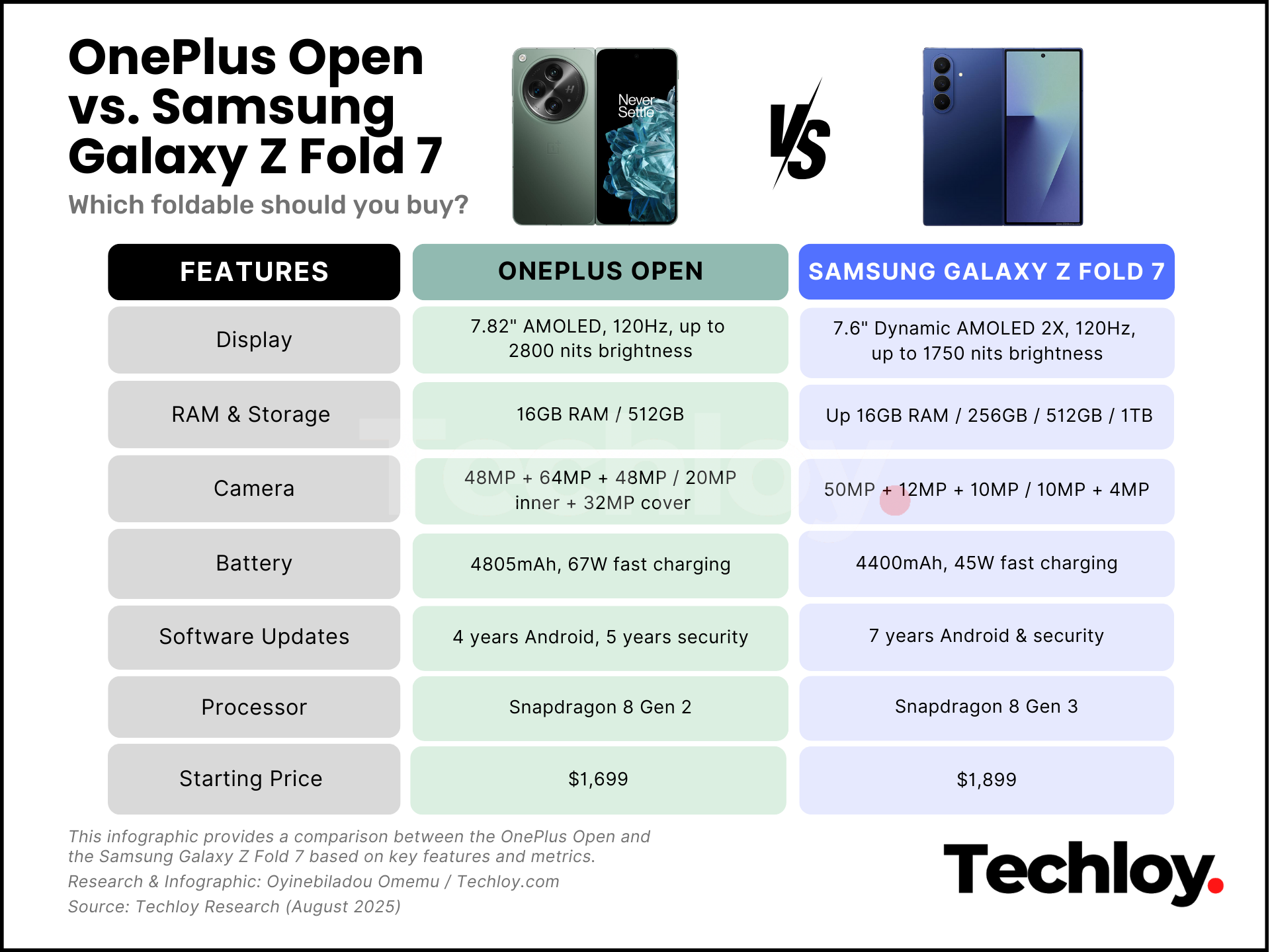
The Fold 7 gives you slightly bigger screens, 6.5" outside and 8.0" inside, with Samsung’s excellent Dynamic AMOLED 2X tech and 2,600 nits of peak brightness.
The OnePlus Open’s 6.31" cover and 7.82" inner OLEDs may be a hair smaller, but they get brighter at 2,800 nits and use more efficient LTPO3 tech. On paper, OnePlus wins brightness, but Samsung still has that slightly larger canvas.
Verdict: OnePlus is obviously brighter, but Samsung is bigger.
3/ Performance & Software
This is where Samsung flexes. The Fold 7 runs on Qualcomm’s Snapdragon 8 Elite, a custom-tuned 3nm powerhouse that crushes the older Snapdragon 8 Gen 2 in the OnePlus Open.
Benchmarks show huge gains in both CPU and GPU performance, and that’s before you factor in Samsung’s promise of seven years of updates compared to OnePlus’s three years.
Verdict: Samsung wins hands-down for speed and longevity.
4/ Cameras
The Fold 7’s 200MP main sensor sounds impressive, but the OnePlus Open fires back with more megapixels across its other lenses, especially the 64MP telephoto with 3x optical zoom that can stretch to 120x hybrid zoom.
While Samsung still excels in image processing and video features like 8K recording, OnePlus arguably offers more resolution versatility.
Verdict: OnePlus edges ahead for pure camera flexibility.
5/ Battery & Charging
OnePlus leads with a 4,805mAh battery and 67W fast charging, nearly triple Samsung’s 25W. The Fold 7’s smaller 4,400mAh cell might still last about the same thanks to its efficient chipset, but you’ll be waiting longer to top it up.
Verdict: OnePlus wins for charging speed and capacity.
6/ Connectivity
Here’s a feature you might not consider until you need it: satellite messaging. The Fold 7 supports Snapdragon Satellite for emergency texts via orbiting networks, plus faster USB 3.2 speeds. The OnePlus Open lacks satellite support and uses USB 3.1, but does have an IR blaster.
Verdict: Samsung wins for future-proof connectivity.
7/ Price & Availability
When it comes to cost, the OnePlus Open immediately has the upper hand. At $1,699 for the 512GB model, it’s a solid $300 cheaper than the Galaxy Z Fold 7’s base $2,000 price tag. If you’re simply looking to save money, the Open makes that decision easy. But, as always, the cheaper price comes with some compromises.
Verdict: OnePlus wins for value.
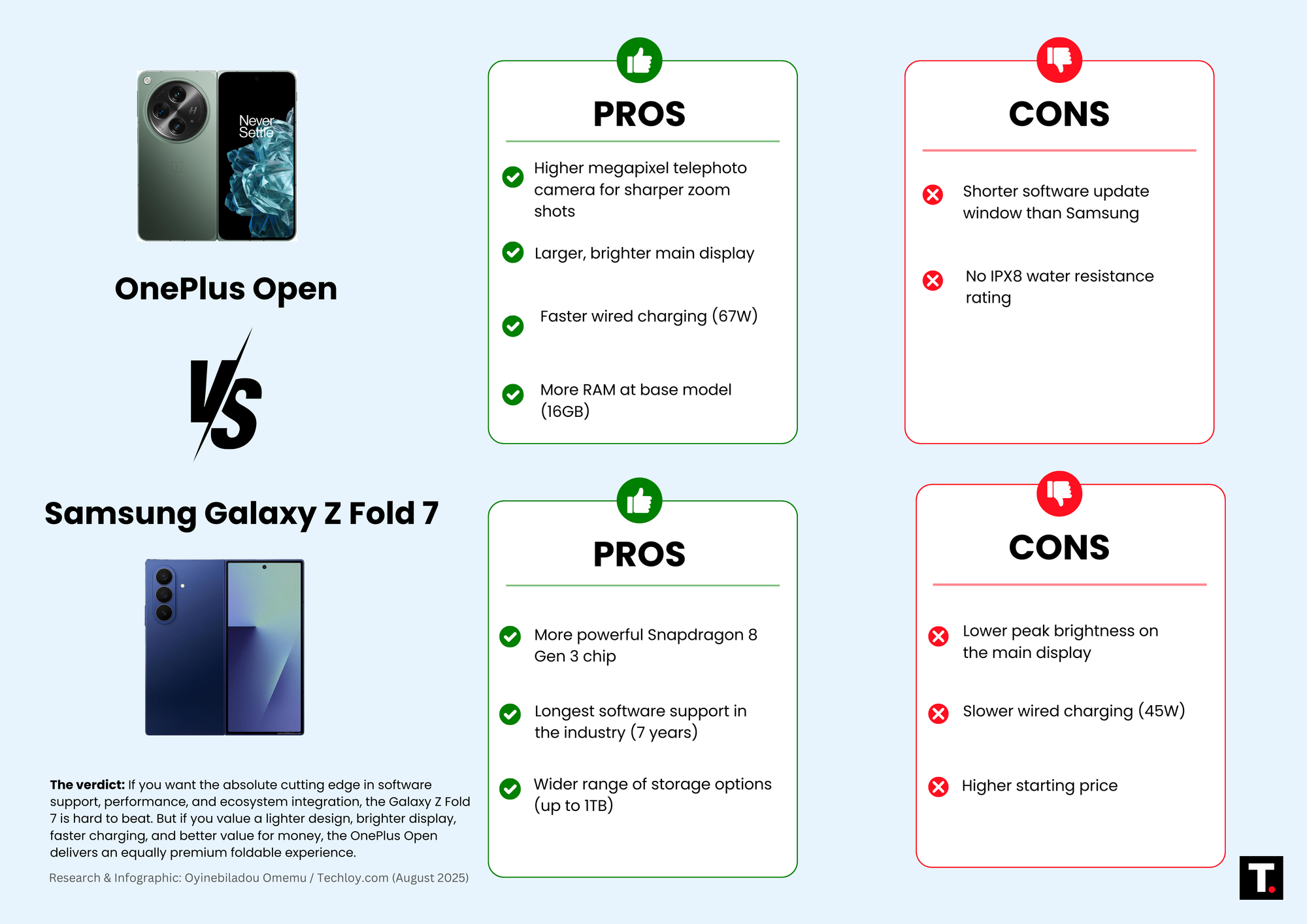
Conclusion
In the end, the Galaxy Z Fold 7 feels like the foldable you buy when you want the best of everything, not just for today, but for years to come. It’s impressive, ridiculously powerful, built to survive more than drizzles, and backed by long-term updates.
The OnePlus Open, though, is the kind of device that makes you do a double take at the price tag and just want to pick it. It’s lighter, brighter, charges in a flash, and still manages to deliver flagship-level cameras and performance for hundreds less. It might not have Samsung’s long-term support window, but for most people, it’s the more sensible choice.
 Louis Eriakha