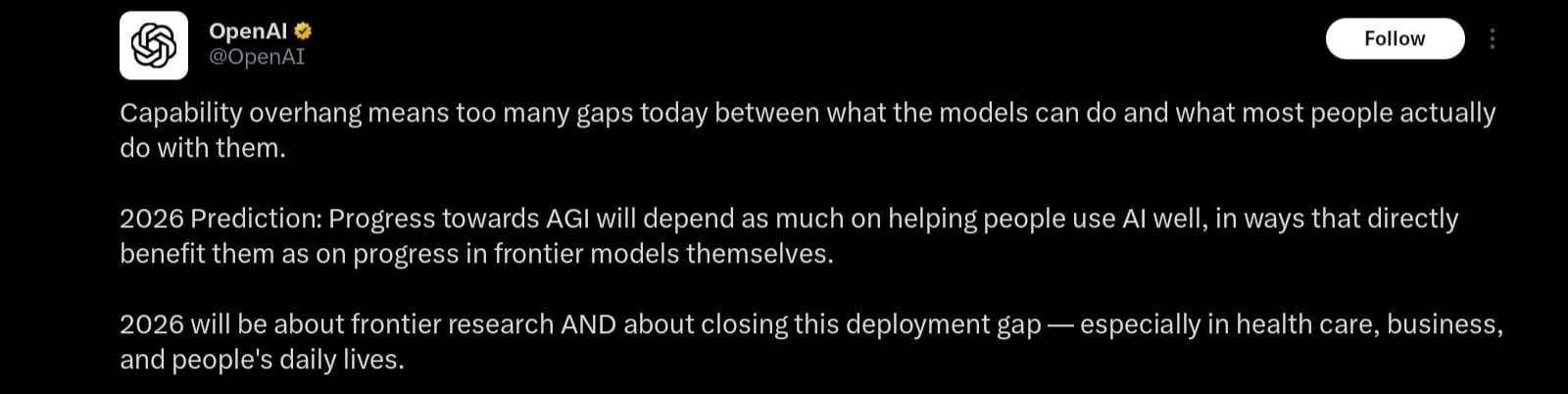
OpenAI just changed the conversation around artificial general intelligence. In a post shared Tuesday, December 23, the company stated that reaching AGI in 2026 will depend as much on helping people use AI effectively as on advancing frontier models themselves. The core concept is “capability overhang” the gap between what AI models can already accomplish and what most users actually do with them.
OpenAI’s own assessment states this gap is “immense,” despite current models demonstrating expert-level performance across knowledge work tasks. The company’s 2026 roadmap now emphasizes closing this “deployment gap” in healthcare, business operations, and people’s daily lives, not just building more powerful models.
The evidence backing this shift is tangible. Enterprise data shows that 75% of workers report AI improves either speed or quality of their output, with users saving 40 to 60 minutes daily. Yet, a widening gap exists between “frontier” workers in the 95th percentile—who send six times more AI messages than median employees—and the majority of knowledge workers who still interact with AI through basic queries, unchanged workflows, and isolated tasks rather than integrated systems.
Real-world deployments reveal both the potential and the challenge. In Kenya, OpenAI partnered with Penda Health to deploy an AI clinical copilot across 15 clinics, resulting in a 16% reduction in diagnostic errors and a 13% reduction in treatment errors across 39,849 patient visits. However, success required intensive implementation work, including clinician training, workflow integration, and continuous refinement based on frontline feedback.
According to OpenAI, market opportunities will increasingly focus on this type of AI deployment, user enablement, and integration into practical workflows, rather than solely on developing new frontier models. The strategic pivot acknowledges that as AI models advance, the primary challenge is no longer model capability but real-world implementation.
Credit: OpenAI
The reaction on social platforms split sharply. One observer noted that "capability isn’t the bottleneck anymore, adoption is," seeing validation that existing models are powerful enough to transform work. Others pushed back harder, arguing that the gap reflects design failure rather than user failure, stating, "The problem isn’t that users are behind. It’s that the models stopped walking beside them."
The stakes are measurable. Healthcare enterprises that leverage AI are experiencing deeper workflow integration, though the sector started from a smaller base compared to finance or technology. Companies that master implementation see compounding returns, where frontier firms send twice as many AI messages per seat and show deeper integration across teams, with time savings increasing as users engage across more distinct tasks.
This marks a fundamental shift in how progress toward AGI gets measured. The race isn’t just about which lab builds the smartest model. It’s about which organizations figure out how to deploy intelligence at scale across real workflows in healthcare, business, and daily life. OpenAI’s 2026 prediction suggests the next breakthrough might come not from a research lab, but from a hospital or an enterprise that cracks workflow integration.
 Ogbonda Chivumnovu