



OpenAI offerings have always been capable, delivering major improvements in every new release, whether in coding or reasoning. But having to pick a specific OpenAI model for a specific task can sometimes be a challenge. Meanwhile, the other option of settling for a general-strength model might not be the most efficient approach.
This is the bottleneck that OpenAI’s long-awaited GPT-5 aimed to solve. And on Thursday, during a livestream, OpenAI announced GPT-5 arriving in three variants—GPT-5 Pro, GPT-5 Mini, and GPT-5 Nano, each designed to balance speed, cost, and depth of reasoning in different ways. The company calls it “the best AI system in the world.”
The GPT-5 family is the newest brain inside ChatGPT, and it changes the rhythm of conversation from previous models.
This comes after months of anticipation and represents OpenAI’s latest attempt to unify all ChatGPT experiences into a single system.
Sam Altman said GPT-5 would offer a unified experience for users, and the new model delivers on that promise. The first thing you’ll notice is that GPT-5 appears inside ChatGPT as just one model, not a regular model alongside a separate reasoning model.
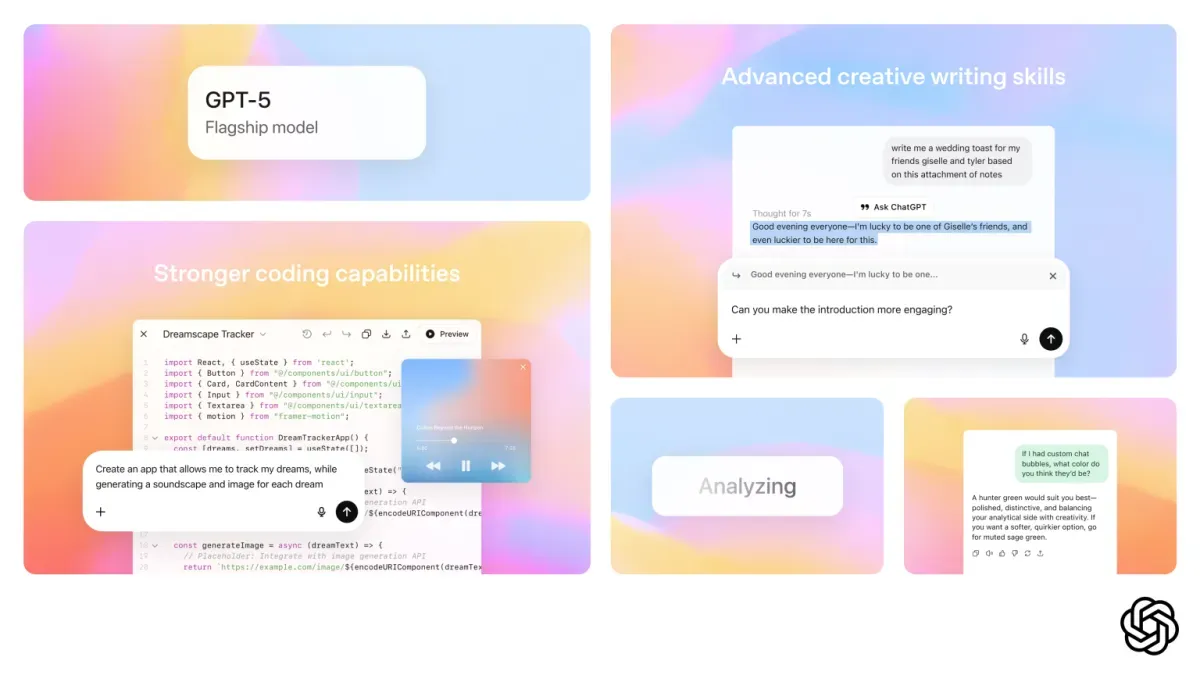
The goal is to make ChatGPT simpler to use. GPT-5 includes a real-time router that decides which approach to use based on conversation type, complexity, tool needs, and user intent. It is agile, able to switch between rapid-fire responses and deliberate, multi-step reasoning without you having to choose.
Ask it to debug complex code, and it will break down the problem, testing each step along the way. Ask for a quick summary, and it will reply almost instantly. Instead of manually selecting the “Think Longer” option, GPT-5 decides when to think faster, when to think deeper, and when to slow down so you can explore an idea together.
It is also fully multimodal, capable of handling text, images, and voice in the same chat. The model is built not just to respond but to adapt to the way you want to work.
 Louis Eriakha
How It Stacks Up Against the Competition
ChatGPT arrives with claims of reduced confabulations, improved coding capabilities, and a new approach to sensitive requests that OpenAI calls “safe completions.”
With these new upgrades, OpenAI claims GPT-5 is state-of-the-art in several domains, edging out competitors like Anthropic's Claude, Google Gemini, and Elon Musk’s xAI on key benchmarks.
For months, Anthropic and Google have traded the top spot in AI. Claude Opus 4.1 is setting the bar for reasoning, and Gemini 2.5 Pro is for speed and context. GPT-5 arrives with competitive and, in some cases, superior scores on both fronts, although it underperforms in certain areas.
On the SWE-bench Verified benchmark, which tests AI on real-world coding problems, GPT-5 scored 74.9%, higher than Claude Opus 4.1 and well above Gemini 2.5 Pro. Developers say it can complete complex coding tasks from start to finish with minimal prompting and can even design software interfaces for users without coding experience.
Other benchmarks
Benchmark GPT-5 Pro Claude Opus 4.1 Gemini 2.5 Pro GPQA Diamond science benchmark 89.4% 87.3% 86.6% SWE-bench Verified coding benchmark 74.9% 74.4% 72.8% Medical hallucination reduction over 7x fewer errors than GPT-4o N/A N/A
The improvements aren’t limited to coding and problem-solving. OpenAI claims GPT-5’s “thinking” mode produces far fewer hallucinations than GPT-4o or the o3 reasoning model. With web search enabled, GPT-5’s responses are about 45% less likely to contain factual errors than GPT-4o’s and about 80% less likely than o3’s when in “thinking” mode. On long-form content tests, GPT-5 with thinking shows six times fewer confabulations than o3.
In OpenAI’s medical benchmark, its hallucination rate is more than seven times lower than GPT-4o’s. While the company makes it clear that ChatGPT is not a replacement for doctors, it is better at identifying potential issues and helping users prepare for a medical visit.
OpenAI has also changed how the model handles sensitive requests. With “safe completions,” GPT-5 attempts to provide the most helpful answer possible within safety limits, rather than outright refusing. If it cannot help, it explains why.
Another change addresses “sycophancy,” the tendency for models to agree excessively with users. In targeted evaluations, GPT-5 reduced sycophantic replies from 14.5 percent to under 6 percent.
Beyond Benchmarks: Upgrades for Consumers and Developers
Alongside the GPT-5 release, ChatGPT is getting several user experience upgrades. Users can now choose from four new personalities in settings—Cynic, Robot, Listener, and Nerd—without having to prompt for them manually. The interface now includes customizable chat colors and, for Pro users, integration with Gmail, Google Calendar, and Google Contacts. Voice mode is being unified into an “Advanced Voice” system that better understands instructions and adapts its speaking style.
The Long Road to GPT-5
The launch of GPT-5 feels like a big leap, but it’s the latest step in a seven-year climb. Back in 2018, GPT-1 was little more than an experiment—117 million parameters trained to predict the next word in a sentence. It could string together a thought, but only in short bursts.
In 2019, GPT-2 arrived with 1.5 billion parameters. It was sharper, more coherent, and just capable enough to spark a wave of concern about what AI might do in the wrong hands. OpenAI held back the full release for months, citing potential misuse, before eventually making it public.
Then came GPT-3 in 2020. With 175 billion parameters, it stunned the AI world. It could answer trivia, write essays, generate code, and improvise in ways that felt almost uncanny—all from just a few examples in a prompt. People began to talk seriously about general-purpose AI.
By 2022, OpenAI had refined the approach with GPT-3.5 and InstructGPT. These models were better at following directions and less prone to drifting off-topic. That November, ChatGPT launched and became an overnight sensation, introducing millions of people to AI-powered conversation for the first time.
GPT-4 arrived in 2023 with a big shift: multimodal input. It could read both text and images, making it far more versatile. The following year, 2024, GPT-4o made it faster, cheaper, and more efficient, enabling real-time voice conversations.
2025 brought a series of specific upgrades. GPT-4.1 pushed reasoning further, GPT-4.5 improved reliability, and the “o-series” models like o3 zeroed in on complex problem-solving, paving the way for GPT-5’s all-in-one design.
 Emmanuel Oyedeji
From GPT-1’s 117 million parameters in 2018 to GPT-4.5 in 2025, every generation has taught OpenAI more about how people use AI and what gets the most use. GPT-5 is the product of those lessons, combining scalable reasoning, natural multimodal input, and an accuracy boost that makes it more trustworthy for complex and sensitive tasks.
This release is set to boost its 700 million–strong user base even further. The platform also recently hit a milestone of 2.5 billion daily prompts, a number that’s only expected to keep climbing.
 Oluwaseun Bamisile
Developer Access, Pricing and Rollout
OpenAI is making the GPT-5 reasoning-capable model available to everyone who uses ChatGPT, including those on the free tier.
However, for developers, GPT-5 comes in three API versions: GPT-5, GPT-5 Mini, and GPT-5 Nano, each offering different latency and cost trade-offs. The context window has expanded to 256,000 tokens, up from 200,000 in the o3 model. Pricing for GPT-5 is $1.25 per million input tokens with a 90% cache discount and $10 per million output tokens.
GPT-5 Mini is priced at $0.25 for input and $2 for output per million tokens, while GPT-5 Nano is $0.05 and $0.40, respectively. GPT-5 Pro pricing for API use has not yet been announced.
New developer features include free-form function calling, which allows raw strings like SQL commands to be sent directly to tools without JSON formatting, verbosity controls for response detail, and a “reasoning effort” toggle to switch between fast answers and deeper analysis.
The rollout begins immediately for all user tiers, with enterprise and education customers gaining access next week. Pro customers can use GPT-5 without limits. Plus, users get significantly more usage than free accounts, and free users switch to GPT-5 Mini after hitting their GPT-5 limit.


