



Run flat tires prioritize temporary mobility after a puncture, while regular tires prioritize comfort, cost, and broader repair options—and the “better” choice depends on your driving risk, budget, and whether your vehicle carries a spare.
What run-flat tires actually do
Run-flat tires are still normal air-filled tires. The difference is that they’re engineered to support the vehicle for a limited distance at reduced speed after losing air pressure, giving you time to reach a safer stop or a tire shop.
Most consumer run-flats achieve this through reinforced sidewalls that resist collapse when pressure drops. Because the tire may not visibly look flat, run-flats are intended to be used with a working TPMS (Tire Pressure Monitoring System) so you’re alerted early.
The practical value of run-flats
Run-flats are designed for the moment nobody plans for:
- You’re on a highway with narrow shoulders
- It’s raining or dark
- You’re in an area where stopping feels unsafe
What regular tires do better
Regular (non–run-flat) tires are the standard tire design most drivers have used for decades. They typically:
- Ride more comfortably (softer sidewall compliance)
- Offer wider brand/model choices in most sizes
- Cost less on average than equivalent run-flat options
- Are often more “repair-friendly” for simple tread punctures
The real differences that matter (not marketing)
If you’re trying to choose between run-flats and regular tires, these are the decision variables that actually change your day-to-day experience.
1) What happens after a puncture
Run-flat tires: You can often drive a limited distance at reduced speed to reach safety or service. That reduces the odds of being forced into an immediate roadside stop.
Regular tires: A puncture often means you must stop and either:
- mount a spare
- use a sealant/compressor kit (if suitable), or
- call roadside assistance
Bottom line: run-flats are about controlling the “after” scenario.
2) Comfort and noise
Run-flat sidewalls are reinforced so they can carry weight temporarily without air pressure. That reinforcement can translate into:
- a firmer ride over potholes and expansion joints
- more impact “sharpness” in the cabin
- and sometimes more road noise depending on the tire model
Regular tires typically absorb small impacts more naturally and can feel smoother.
Bottom line: if ride comfort is your top priority, regular tires usually win.
3) Cost over the life of the tire
Run-flats often cost more up front. Depending on your driving conditions and the tire model, some owners also report replacing run-flats sooner due to wear or because the tire becomes non-repairable after a puncture event.
Regular tires usually offer more price tiers and promotions, and a simple tread puncture is often repairable—meaning you may avoid an early replacement.
Bottom line: if total cost of ownership matters most, regular tires generally have the advantage.
4) Repairability and “one nail = new tire” risk
This is one of the biggest practical differences.
Run-flats can sometimes be repaired, but repair policies are often stricter—especially if the tire was driven while severely underinflated. Some shops refuse run-flat repairs because internal heat/structural damage can be difficult to confirm from the outside.
Regular tires more commonly follow straightforward repair rules (tread puncture, not sidewall, correct method, etc.).
Bottom line: if you want maximum repair flexibility, regular tires are typically easier.
5) Availability when you’re in a hurry
Run-flat inventory can be inconsistent depending on your region and size. If you need a same-day replacement in a less common size, you may have fewer options.
Regular tires are widely stocked almost everywhere.
Bottom line: if you value convenience of replacement anywhere, regular tires usually win.
6) Vehicle setup: spare or no spare
Many vehicles that come with run-flats from the factory also come without a spare tire. That’s intentional.
If you switch from run-flats to regular tires on a no-spare vehicle, you should plan for flats with one of the following:
- add a compact spare (if your vehicle can accommodate it)
- carry a high-quality mobility kit (sealant + compressor) if compatible
- or have reliable roadside assistance and a plan for where you can stop safely
Bottom line: your “flat strategy” matters as much as the tire type.
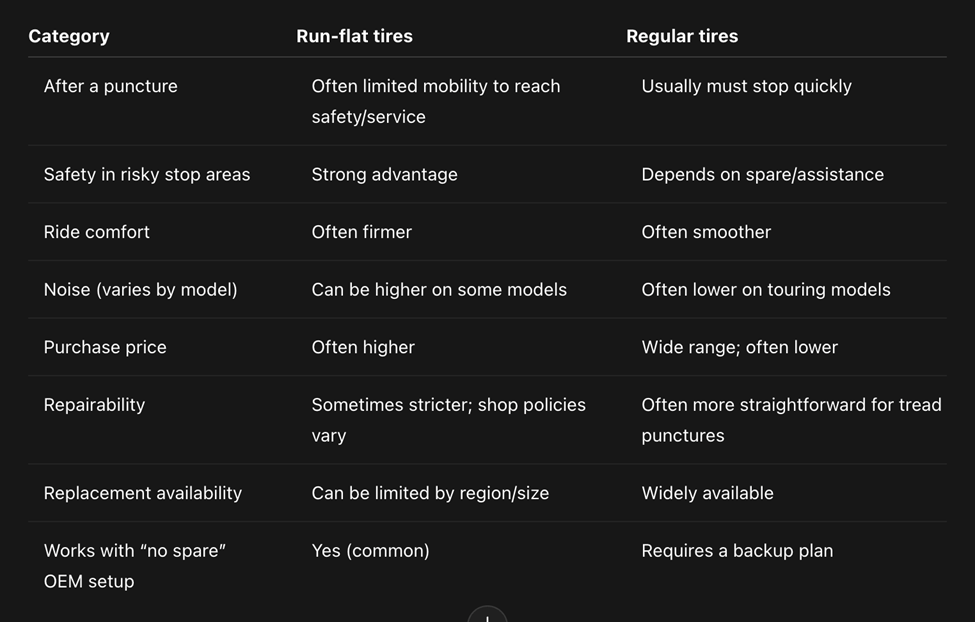
Comparison table (quick decision view)
Which one should you choose? (Buyer fit guide)
Here is a practical way to decide—based on real use cases.
Choose run-flats if you want:
- A safer, more controlled plan after a puncture
- Less likelihood of being forced into an immediate roadside stop
- The intended setup for a vehicle that came OEM with run-flats and no spare
- Peace of mind for highway driving, night driving, or areas where stopping is risky
Choose regular tires if you want:
- Better ride comfort and often better value
- More brand and model options in your size
- Easier repair outcomes for common tread punctures
- Maximum availability when you need replacement fast
A simple decision shortcut
If the thought of changing a tire on the side of a busy road is a top fear, run-flats can be worth the tradeoff.
If you drive mostly locally, have easy access to roadside help, and want comfort/value, regular tires plus a solid backup plan often make more sense.
What to do after a puncture (both setups)
If you have run-flats
- Treat the TPMS warning as urgent
- Reduce speed smoothly
- Take the shortest safe route to service
- Avoid potholes and aggressive maneuvers
- Get the tire inspected—do not assume it’s automatically repairable
If you have regular tires
- Reduce speed and stop safely as soon as practical
- Install the spare (if you have one), or use a mobility kit if appropriate
- Avoid driving on a fully flat tire to protect the wheel
- Have the tire inspected for repairability
Common mistakes people make when switching
- Switching from run-flats to regular tires without adding a backup plan (no spare + no kit).
- Mixing run-flats and regular tires on the same vehicle without understanding handling implications.
- Ignoring TPMS alerts because the tire “looks fine.”
- Assuming every puncture is repairable (especially on run-flats).


