



Last January, I was in the market for a new phone. I had been using an Infinix Note 12 for a while, and it was starting to give up on me, so I decided it was time to switch things up a bit. Nothing is more exciting than getting a new toy to play with.
Seeing that I wasn't willing to go as far as jump ship to iOS, I found myself having to make a decision from the long line of offerings from the King of Android, Samsung.
As we all know, Samsung offers a device for pretty much every price range you can think of, from phones that do the most basic things you would need a phone for to the eccentric, over-the-top, power user offerings.
But what many forget to consider sometimes (and what I had to consider a lot on this trip) is that budget phones are no longer what they used to be; they have become a lot better now. Gone are the days when these phones were no better than an electric brick that make phone calls; now, you can get a standard 6GB Ram, OLED screen with 5000 mAh for about $160.
And at the same time, while the budget phones have gotten better, the cost of older flagships have been slashed. Pick any flagship Android phone released at least two years ago, and you'll see that the price has most likely tanked since its release, putting it at about the price range of a lot of new-gen budget/mid-range devices.
In other words, I was left with two options. Buy a new low-budget device that could get me pretty much all I need in a phone. Or buy an older flagship that would offer me the premium experience at a not-so-premium cost.
Here's a rundown of how and why I ultimately made my decision.
The Two Phones I Had to Choose Between
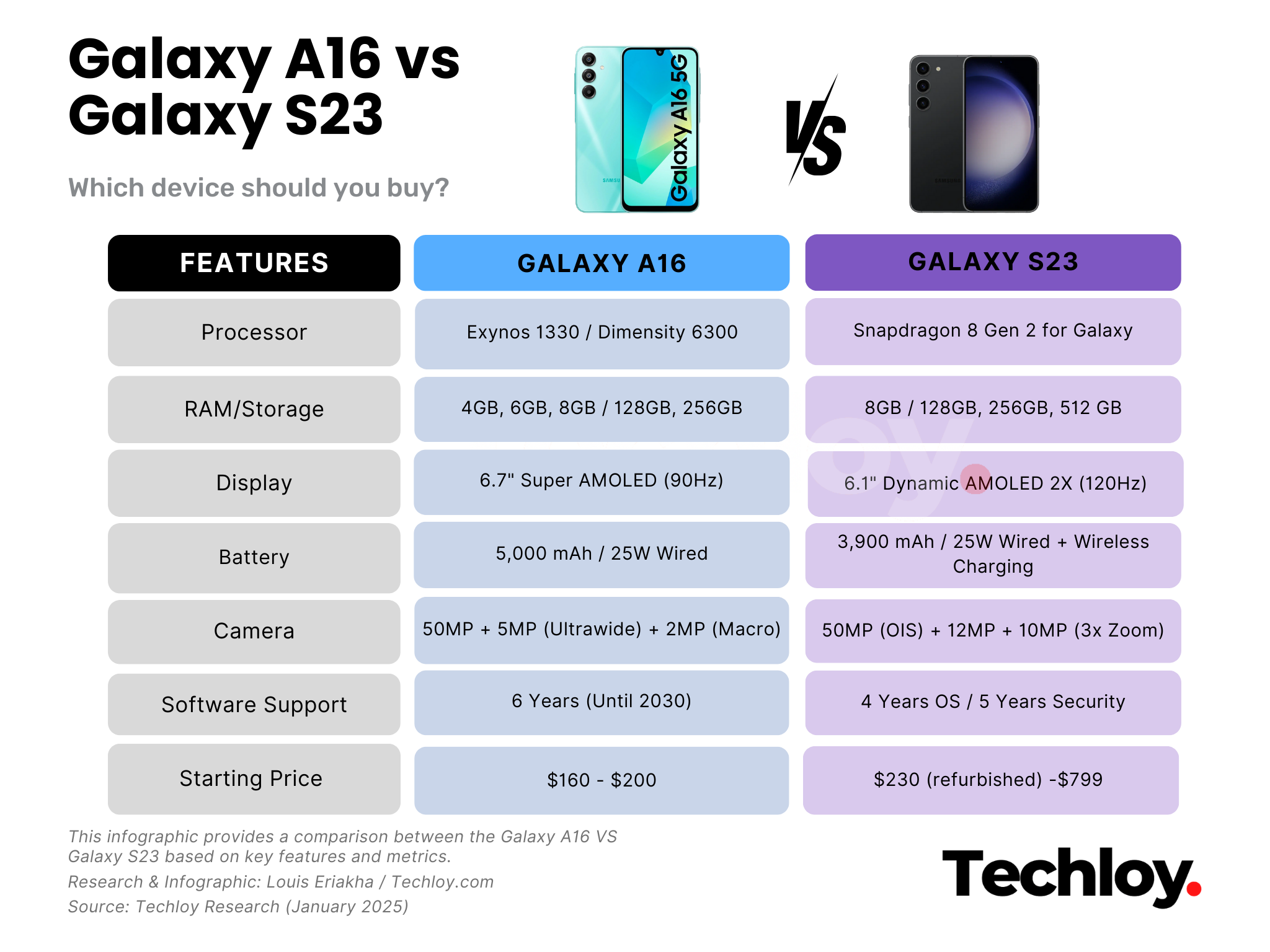
After weighing my options (and my pocket), I found myself having to decide between the then recently released Galaxy A16 and the Galaxy S23, a 2-year-old flagship at that point. Here are the main things I had to consider along the way
/1. Processor
Right off the bat, if you're asking which phone is able to handle more “load,” that easily goes to the S23, since it runs the Snapdragon 8 Gen 2 for Galaxy. Even two years later, this chip remains a monster. It handles 4K video editing, heavy gaming (like Genshin Impact), and intensive multitasking without breaking a sweat.
But here's the part I really had to sit and think about. Do I really need to be playing Genshin Impact? Am I even a mobile video editor? What's the point of all this power if I'm never really going to use it?
The Galaxy A16, on the other hand, is powered by either the Exynos 1330 or the Dimensity 6300 (depending on your region). And it’s built for the basics, think social media, emails, and light gaming. It’s efficient, but you’ll notice a slight stutter if you try to push it with heavy multitasking or high-end games.
/2. RAM and Storage
The Galaxy A16 usually starts with 4GB or 6GB of RAM, but you can find 8GB variants. It also has 128GB and 256GB storage options, but unlike its flagship brother, this phone has a secret weapon: a microSD card slot. Meaning, in addition to whatever storage option you get, you can slap in a 1TB card and never worry about photo storage again.
For the power hungry users, though, the Galaxy S23 comes with 8GB of higher-quality RAM, meaning it can keep more apps open in the background and juggle things easier than the Galaxy A16. However, it follows the modern flagship trend: no expandable storage. What you buy is what you get (128GB or 256GB).
/3. Display
The last two categories have tipped me towards the A16. More than anything, good storage and a phone that doesn't lag are more than enough for most people. But if you're like me, you would also want your phone to at least look pretty, you know? This category is usually what makes or breaks things for people, and both phones couldn't be more different.
The Galaxy A16 has a massive 6.7-inch Super AMOLED screen. It’s big, vibrant, and great for watching movies and for lovers of big phones. A slight nitpick would be that it's sadly capped at a 90Hz refresh rate and has slightly thicker bezels with a "waterdrop" notch. The screen also only has a max brightness of 800 nits, which isn't the brightest thing out there. It's bright enough for most scenarios, but you might struggle a bit under a bright sun.
The Galaxy S23, however, is a "compact" flagship with a 6.1-inch Dynamic AMOLED 2X display. It is significantly brighter (easier to use in direct sunlight) with a max manual brightness of 1200 nits, and 1750 nits in High Brightness Mode. The device features a smoother 120Hz refresh rate. The bezels are much thinner, and it uses a modern "hole-punch" cutout for the camera so things feel less obtrusive at the top.
/4. Battery
Now it’s one thing to be able to watch movies clearly and in their best quality, it's another for your phone to stay on long enough for you to enjoy the movie without having to scramble for a cable. And if there's one thing almost all flagship users have in common, it's that their phone's battery is almost never the device's selling point.
It's very apparent here. The Galaxy A16 is a marathon runner. With a massive 5,000mAh battery and a less power-hungry processor, it can easily last two days of moderate use. It’s the "set it and forget it" choice for long trips.
But the Galaxy S23 consumes a lot of energy compared to the A16. We're talking about more powerful screens, loading higher refresh rates. Even though it has a very efficient chip, it'll still swallow your battery if you push it. All this, coupled with the fact that it only has a smaller 3,900mAh battery, you'll probably catch yourself constantly reaching for the charger by dinner time.
/5. Camera
On paper, both have 50MP main sensors, but they are not the same. The Galaxy A16 takes decent photos in daylight, but the secondary lenses (Ultra-wide and Macro) are strictly average. It also lacks Optical Image Stabilization (OIS), meaning shaky hands lead to blurry photos.
As expected, the Galaxy S23 takes things up a notch. It features a dedicated Telephoto lens (3x optical zoom), which the A16 lacks entirely. It also supports 4K and even 8K video recording with incredible stabilisation. The colours, dynamic range, and low-light performance are just significantly better here.
/6. Software Updates
The Galaxy A16 was when Samsung decided it was time to try things a bit differently with software updates. For this device, it promised a staggering 6 years of OS and security updates, potentially taking it all the way to 2030.
The Galaxy S23 was promised 4 years of OS updates and 5 years of security. Since it launched in early 2023, it has only a few years of "prime" life left before it stops receiving the latest Android versions (likely ending around Android 17 in 2027).
Not everyone prioritizes software or security updates, but these things are really important, especially if you plan to keep the device long term.
/7. Starting Price
Now hear me out. I wasn't willing to spend a small fortune going into this. I had a hard budget of $270 before going to Computer Village, the gadget market in Lagos, Nigeria. I was well aware that a brand new Galaxy S23 would run me something around $800, and I was not willing to spend that much. But a refurbished or second hand one costs much less. Somewhere in the neighbourhood of $250.
That's about as much as it would cost me to get a brand new Galaxy A16, by the way.
So for this category, if it's a must for you to get things fresh out of the box and crack that seal yourself, then it's the depth of your pocket that will determine if you even consider this comparison. But if you don't mind grabbing a second-hand phone, then things are a bit more levelled in terms of price.
So What Did I Pick?
In the end, I settled with the 2 year old flagship, and I could give you a long list of reasons behind this. I could mention how even though I'm not a hardcore gamer, I still prefer the more powerful chipset. Or how I prefer smaller, more compact phones in general.
But the truth is, it's everything to me. It's the overall experience of having a flagship and how it feels. No matter how good budget phones have got, the subtle things that come with a company's flagship phone, like overall software experience, more vibrant display and, let's be honest, the social status that comes with it, would sway many people.
By no means is the A16 a bad phone, and if you're working with a strict budget, you might want to really consider it or the newer Galaxy A17. There's a reason the A16 was the best-selling Android phone last year, you know? And its predecessor was also the best-selling Android during its run, so if anything, it's a safe choice that you could almost never go wrong with. It's just not the choice for me.
If you've had the chance to make use of any of these devices, do let us know your experience so far and let us know what you want us to talk about next time.


