One of the biggest points people bring up in the iOS vs. Android debate is how much behind Apple’s assistant, Siri, was in comparison to the likes of Gemini. iPhone users were legitimately mocked that Siri wasn’t intelligent enough to carry out certain tasks or had the simple ability to analyze context or memory.
Now, after WWDC 2026, Apple is finally fighting back properly.
The company unveiled “Siri AI,” a rebuilt version of Siri powered by Apple Intelligence and underlying Gemini technologies through Apple’s deep partnership with Google. Apple says the new system understands personal context, on-screen content, app actions, and conversational requests in a much more advanced way. But after all the announcements, one question matters most: is Siri AI actually better than Gemini?
Here’s a detailed breakdown.
/1. Conversational Intelligence
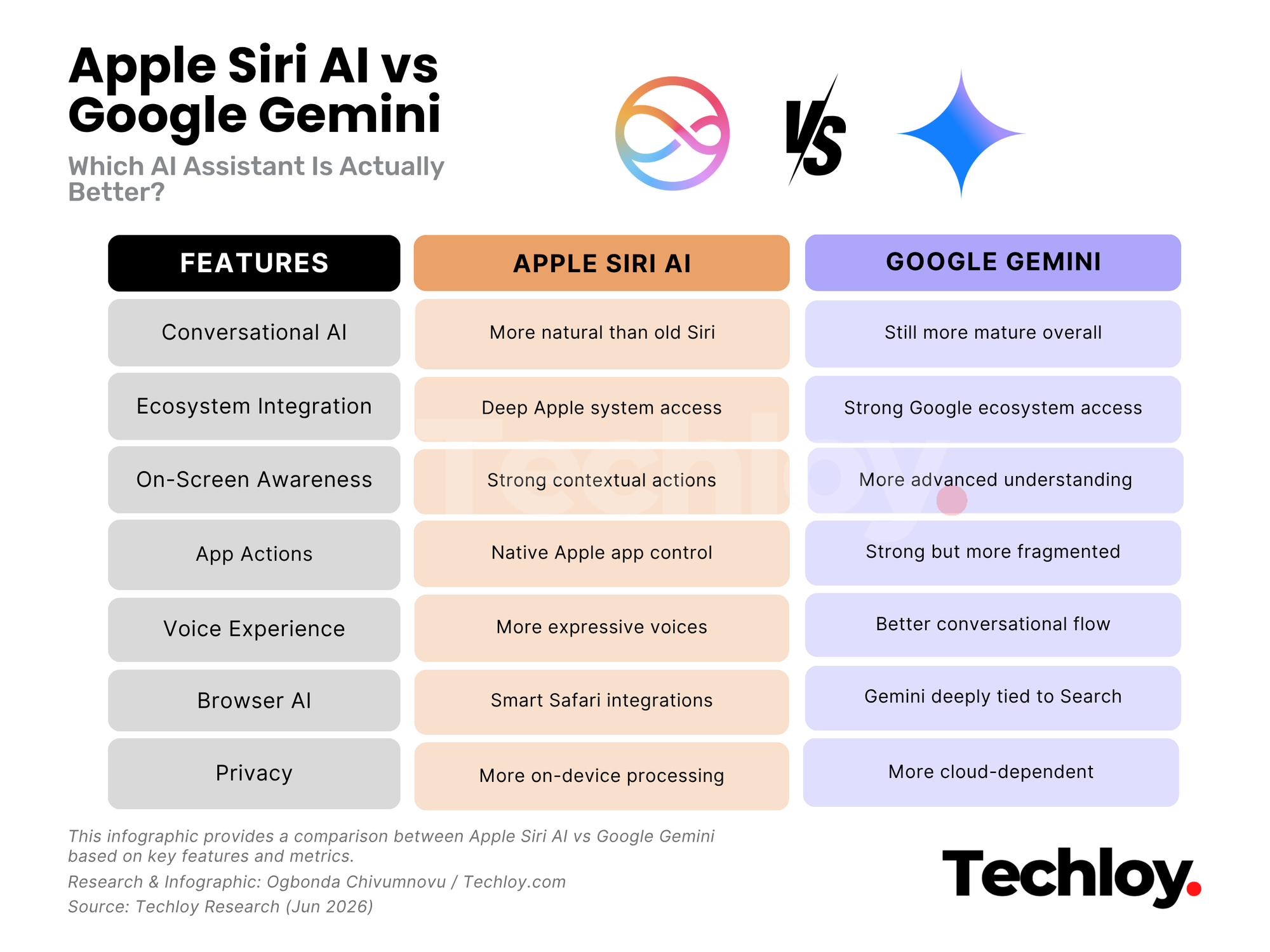
This is the category Apple absolutely had to improve. Old Siri often felt rigid. You had to phrase commands carefully, and even then, responses could feel limited compared to ChatGPT or Gemini. Siri AI changes that significantly.
Apple says Siri AI can now understand conversational context, screen content, app activity, and follow-up questions. It can also perform actions like editing photos, searching through messages, or sharing files.
But Gemini still feels more mature overall.
Google has spent years refining Gemini across Android, Workspace, Chrome, and Search. It handles long conversations, reasoning, and natural dialogue more fluidly right now.
/2. Ecosystem Integration
This is where Apple becomes extremely dangerous.
Because Apple controls the hardware, operating system, and apps, Siri AI can deeply integrate across iPhone, iPad, Mac, Apple Watch, and Vision Pro in ways Google sometimes cannot fully replicate on Android.
For example, Siri AI can:
- Pull flight details from Messages
- Edit images directly in Photos
- Create reminders from conversations
- Split restaurant bills through Apple Cash
- Control device settings system-wide
Gemini can do many similar things, especially on Pixel phones, but Apple’s ecosystem control gives Siri AI smoother integration.
/3. Voice and Personality
Apple introduced a more expressive Siri voice with sliders for pace and expressiveness. The assistant sounds far more human than older versions.
Still, Gemini currently sounds more conversational and flexible overall. Google’s AI also handles nuance and open-ended responses more naturally.
Apple improved the personality of Siri. Google still feels more fluid.
/4. Camera and Visual Intelligence
Apple’s new Siri mode inside the Camera app is one of the most interesting announcements from WWDC 2026.
You can point your camera at food for nutritional insights, scan bills for payment splitting, or detect schedules and automatically create calendar events.
It feels polished and beginner-friendly.
Gemini and Google Lens, however, remain more powerful overall because they are more open-ended. Google’s visual AI can identify objects, summarise images, answer contextual questions, and interact more freely with visual information.
/5. Productivity Features
Apple Intelligence now powers smarter Messages suggestions, conversational calendar entries, AI-driven Shortcuts, Safari page monitoring, password automation, and photo editing. It feels more stitched into everyday iPhone use than ever before.
But Gemini still holds the edge in productivity. Its deep integration across Gmail, Docs, Chrome, Android, and Search makes it more useful for people working across tools and platforms. For research-heavy or work-first workflows, Google’s system remains more flexible and mature.
/6. Privacy and Security
This is still Apple’s strongest argument. Siri AI leans heavily on on-device processing, meaning more of your data stays on your device instead of being sent to the cloud. Apple kept repeating this privacy-first approach throughout WWDC.
Google, on the other hand, relies more on cloud-based processing because Gemini is more compute-heavy and designed for scale.
For users who care deeply about privacy and tighter control over personal data, Apple’s approach will likely feel more reassuring.
/7. Accessibility Features
Apple gave accessibility a clear spotlight at WWDC 2026, introducing improvements like natural-language voice control, automated subtitles, better VoiceOver environment descriptions, and more contextual assistance.
Google also has strong accessibility tools, especially with Live Caption and AI assistance across Android. But Apple’s tight ecosystem integration makes the experience feel more consistent and easier to use across devices.
/8. Availability and Flexibility
This is where Gemini clearly pulls ahead. It works across Android, web, Chrome, Workspace apps, and even iOS, making it far more accessible regardless of device choice.
Siri AI remains locked inside Apple’s ecosystem, which limits how and where users can access it.
For people who switch between devices or work across platforms, Gemini is simply more flexible.
Conclusion
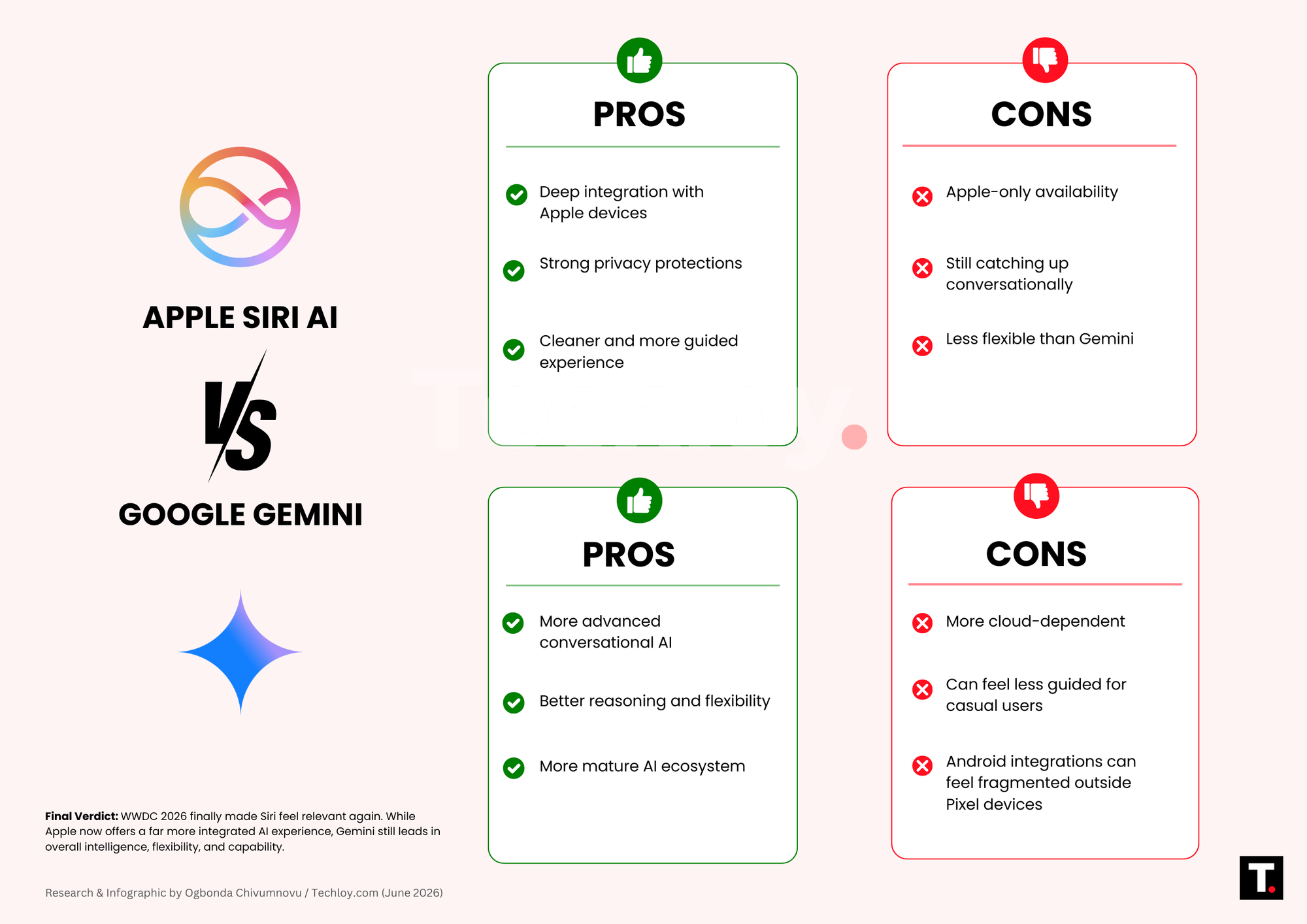
Siri AI finally brings Apple back into the modern AI race, closing a gap that had widened for years between Apple and Google. With deep ecosystem integration, stronger privacy controls, and a more action-oriented assistant experience, Apple has clearly focused on making Siri useful in everyday device interactions rather than just a conversational chatbot.
But Gemini still holds the edge in raw capability, flexibility, and cross-platform intelligence. It is more mature, more powerful in complex reasoning, and better integrated across productivity tools and services beyond a single ecosystem.
 Damilare Odedina