The mobile chipset battle has reached fever pitch in 2025. On one side, we have Qualcomm's Snapdragon 8 Elite Gen 5, promising to be the world's fastest mobile system-on-a-chip. On the other hand, Apple's A19 Pro, launched with the iPhone 17 series, continues the company's tradition of delivering single-core performance and integration with iOS.
For years, Apple dominated the performance charts with single-core superiority, while Qualcomm fought to close the gap. Now, with the Snapdragon 8 Elite Gen 5 featuring third-generation Oryon CPU cores, Qualcomm claims to have finally caught up. But does the reality match the hype? Let's break down how these two silicon chips stack up across every meaningful metric.
 David Adubiina
/1. Manufacturing Process
Both chips are built on TSMC's cutting-edge 3nm process technology, though there's a subtle difference. The Snapdragon 8 Elite Gen 5 uses TSMC's N3P node, while the A19 Pro also utilizes the N3P variant. This puts them on equal footing when it comes to transistor density and efficiency potential, with both benefiting from the most advanced semiconductor manufacturing available today.
/2. CPU Performance: Single-Core
This is where things get fascinating. In Geekbench 6 testing, the A19 Pro scores 3,895 points in single-core performance, while the Snapdragon 8 Elite Gen 5 hits 3,831 points. That's a razor-thin 1.6% difference, essentially statistical noise. The A19 Pro features two performance cores clocked at 4.26 GHz, while the Snapdragon pushes higher with two prime cores at 4.6 GHz. Despite running at lower clock speeds, the A19 Pro matches the Snapdragon's performance, which points to superior architectural efficiency and better performance-per-watt. You'll feel this in instant app launches, fluid scrolling, and snappy responses to single-threaded tasks.
/3. CPU Performance: Multi-Core
On multi-core workloads, the story changes dramatically. The Snapdragon 8 Elite Gen 5 crushes it with a score of 12,208 on Geekbench 6, compared to the A19 Pro's 9,746. That's a 25% advantage for Qualcomm's chip.
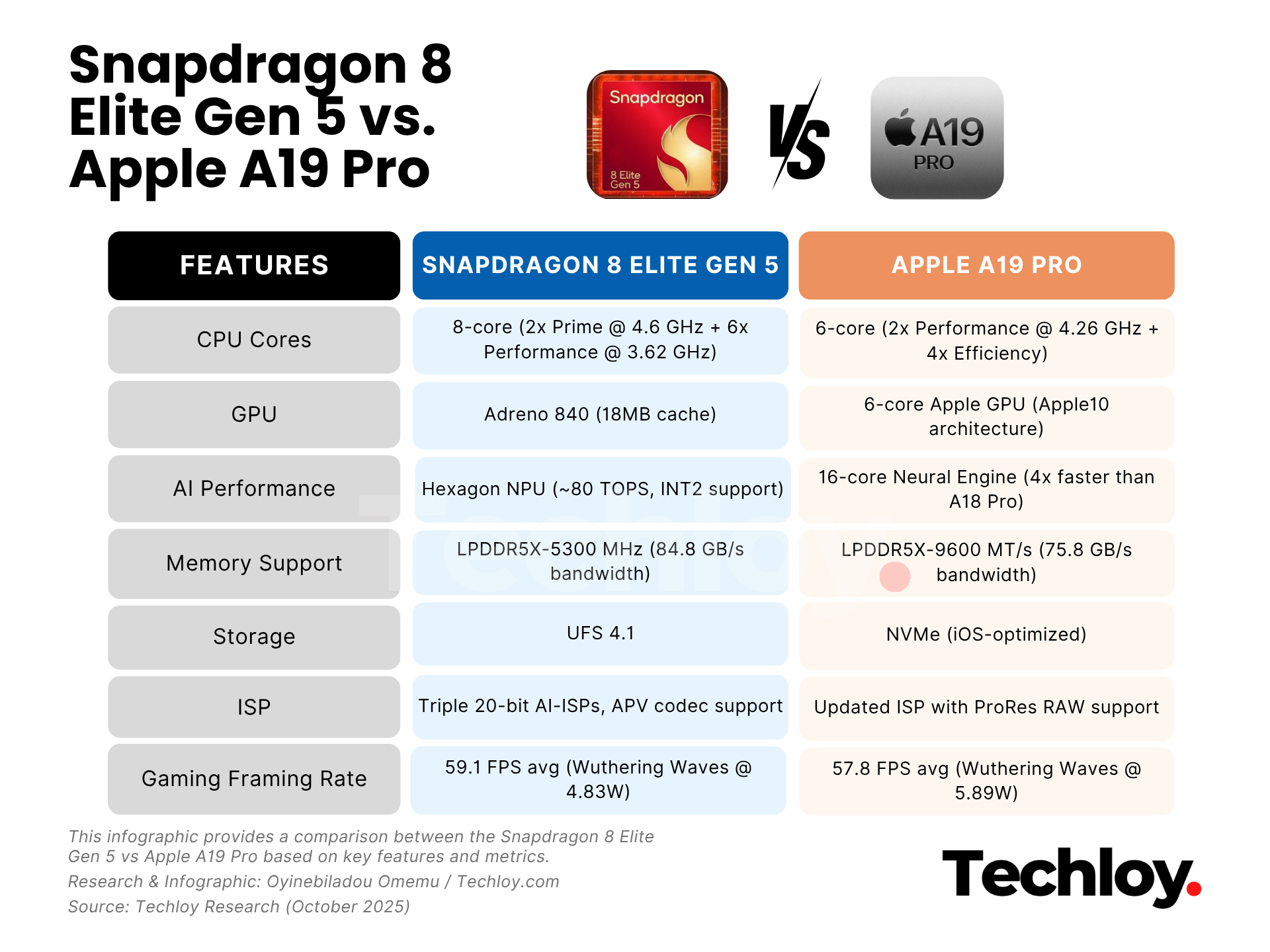
The reason for this is that the Snapdragon packs eight cores (two prime at 4.6 GHz and six performance cores at 3.62 GHz), while Apple sticks with its traditional six-core setup (two performance, four efficiency). This translates to significantly faster video rendering, better multitasking, and stronger performance when juggling multiple demanding apps. If you're editing 4K video on your phone or running AI workloads that leverage multiple cores, the Snapdragon beats it.
/4. GPU Performance
Graphics performance is where the battle intensifies. The A19 Pro features a 6-core GPU (5-core in the iPhone Air variant) based on Apple's new Apple10 architecture, scoring 45,657 points on Geekbench 6 Metal tests. That's a 37% jump over its predecessor and puts it on par with Apple's M2 chip used in MacBooks. The Snapdragon 8 Elite Gen 5 features the Adreno 840 GPU with 18MB of dedicated High Performance Memory cache.
In 3DMark Solar Bay Unlimited, it hit 55.31 fps, while the iPhone 17 Pro Max managed 46.63 fps, a clear win for Qualcomm. However, on Steel Nomad Light Unlimited, the A19 Pro edges ahead with 18.63 fps versus 18.19 fps for the Snapdragon. In gaming tests, the Snapdragon consistently delivers higher frame rates and better power efficiency.
/5. AI and Neural Processing
AI capabilities are critical in 2025. The Snapdragon 8 Elite Gen 5 features a Hexagon NPU that's 37% faster than its predecessor, with support for INT2 precision for better model compression. Qualcomm claims up to 80 TOPS of AI performance.
The A19 Pro counters with a 16-core Neural Engine and Neural Accelerators integrated into each GPU core, delivering up to 4x more AI compute than the A18 Pro. Both chips excel at on-device AI for real-time translation, computational photography, and generative tasks. The Snapdragon offers higher raw throughput, while Apple's tight hardware-software integration means the Neural Engine is deeply optimized for iOS features like Apple Intelligence.
/6. Power Efficiency
This is where Apple traditionally dominates. The A19 Pro draws approximately 12W at peak CPU load, while the Snapdragon 8 Elite Gen 5 pulls around 19W in reference device tests. That's a 58% higher power draw for Qualcomm's chip, though real-world results vary by device implementation. Qualcomm does claim a 35% CPU efficiency improvement over the previous generation and 16% better overall power efficiency.
The A19 Pro benefits from Apple's system-level optimization with iOS 26, reducing waste and maintaining cooler thermals during intensive tasks. The iPhone 17 Pro models also feature a vapor chamber with deionized water for up to 40% better sustained performance.
/7. Memory and Storage
The A19 Pro supports 12GB of LPDDR5X memory at 9600 MT/s, providing up to 75.8 GB/s of bandwidth. It uses NVMe storage tuned specifically for iOS, which helps with app launches and system responsiveness. The Snapdragon 8 Elite Gen 5 supports LPDDR5X-5300 MHz with a maximum bandwidth of 84.8 GB/s, plus UFS 4.1 storage (an upgrade from UFS 4.0).
Android flagships can ship with more RAM configurations (up to 24GB on some devices), while Apple's tighter memory management means it can do more with less. The Snapdragon's higher memory bandwidth gives it an edge in data-intensive tasks.
/8. Camera Capabilities
The Snapdragon 8 Elite Gen 5 is the world's first mobile platform to support the Advanced Professional Video (APV) codec for near-lossless video capture. Its Spectra AI ISP features triple 20-bit AI-ISPs with 4x better dynamic range than the previous generation. It can handle three rear cameras with AI processing and extract photo-quality stills from video.
The A19 Pro features an updated image signal processor with Apple ProRes RAW recording support. Apple's computational photography pipeline remains industry-leading, with exceptional color science and seamless integration with the camera app.
/9. Connectivity
The Snapdragon 8 Elite Gen 5 includes the Snapdragon X85 5G modem with download speeds up to 12.5 Gbps and upload speeds up to 3.7 Gbps. It supports mmWave, sub-6 GHz, and satellite connectivity. The A19 Pro still relies on a Qualcomm modem (an older X75 variant in most regions). Apple's own C1X modem offers 2x performance with 30% better efficiency, but lacks mmWave support and is only used in select models.
/10. Real-World Gaming Performance
In head-to-head gaming tests between the Xiaomi 17 Pro Max (Snapdragon 8 Elite Gen 5) and iPhone 17 Pro Max (A19 Pro), the results favor Qualcomm. In Wuthering Waves, the Xiaomi device maintained 59.1 FPS versus 57.8 FPS for the iPhone, while drawing less power (4.83W vs 5.89W). In Honkai Impact 3rd, the Snapdragon-powered phone averaged 59.6 FPS compared to 58.8 FPS for the A19 Pro, again with better power efficiency (5.30W vs 5.52W).
Conclusion
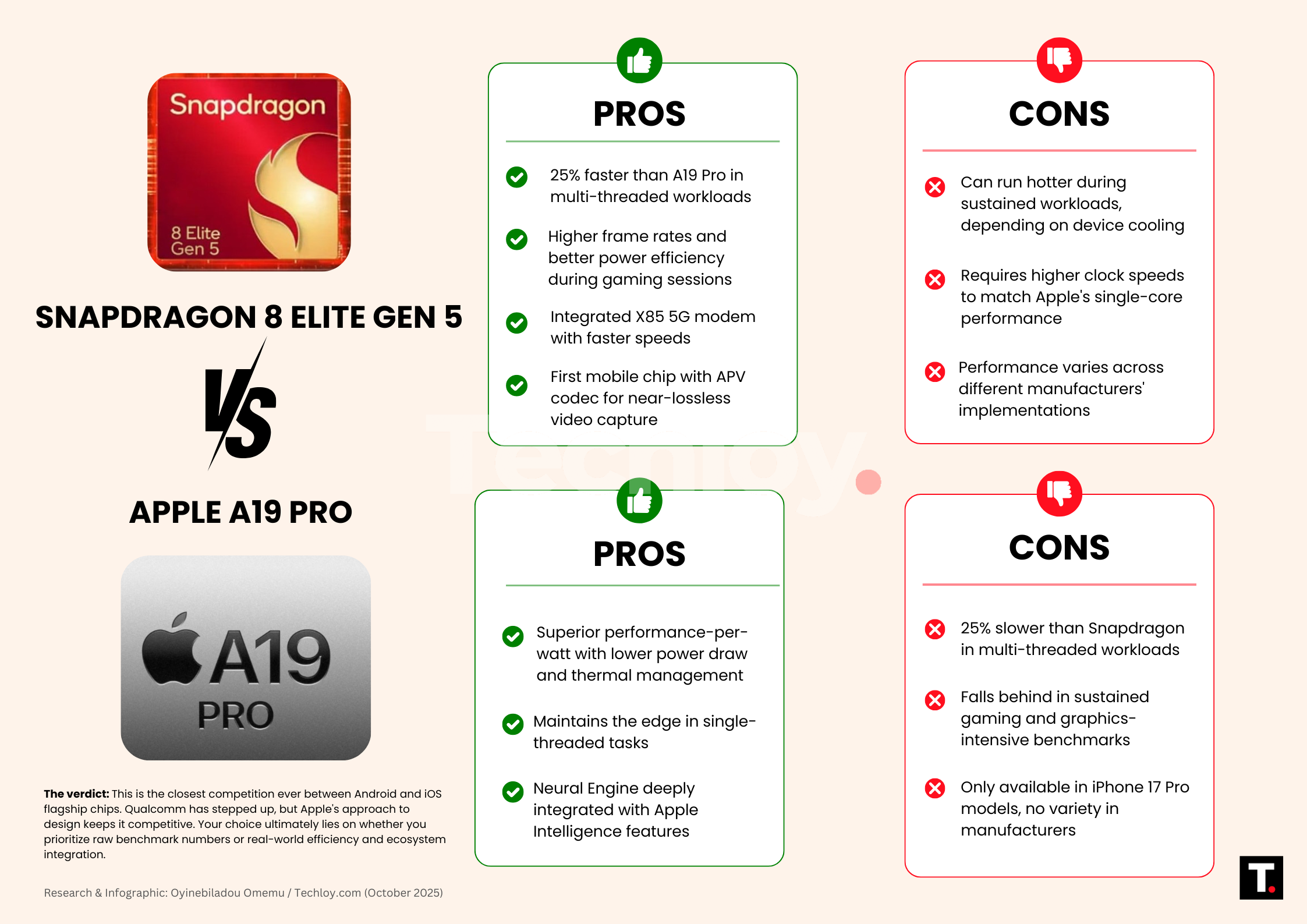
The Snapdragon 8 Elite Gen 5 is the chip to beat if you want maximum multi-core performance, superior gaming frame rates, cutting-edge connectivity, and device variety. Qualcomm has finally closed the single-core gap with Apple, and the multi-core advantage is undeniable. For creators, gamers, and power users who demand raw horsepower, this is the chipset of choice.
The Apple A19 Pro remains efficient, with superior performance-per-watt, better thermal management, and the seamless integration that comes from controlling both hardware and software. Single-core performance still leads (if only barely), and the overall user experience benefits from iOS optimization. For most users who value smoothness, battery life, and long-term software support, the A19 Pro delivers.
 Kelechi Edeh