Almost 800 million people use ChatGPT every week. Most have no idea the tool they rely on was born from a partnership that’s now part of a $134 billion lawsuit, or that the feud between some of its original founders could reshape who controls AI development for the next decade.
Elon Musk and Sam Altman are two of 11 people who co-founded OpenAI in 2015 with a shared mission: build safe artificial intelligence that benefits humanity, not corporate profits.
More than ten years later, their relationship has gone sour. The latest exchange happened Monday night on X. After a post was made on X claimed that ChatGPT was linked to nine deaths, including five suicides, Musk replied saying, “Don’t let your loved ones use ChatGPT.”
Altman fired back hours later, accusing Musk of releasing autopilot on Tesla when “it was far from a safe thing for Tesla to have released.”
Sometimes you complain about ChatGPT being too restrictive, and then in cases like this you claim it's too relaxed. Almost a billion people use it and some of them may be in very fragile mental states. We will continue to do our best to get this right and we feel huge… https://t.co/U6r03nsHzg
— Sam Altman (@sama) January 20, 2026
Here is a complete timeline of how their relationship went sour:
June 2015: The Vision
Sam Altman emailed Elon Musk with a proposal. “The mission would be to create the first general AI and use it for individual empowerment—i.e., the distributed version of the future that seems the safest,” Altman wrote. Small elite team, five-person leadership including both of them, compensation separated from work to avoid conflicts. Musk agreed to all of it.
November 2015: Early Cracks
Musk raised concerns about structure before OpenAI even launched. “The YC stock along with a salary from the nonprofit muddies the alignment of incentives,” he wrote to Altman. “Probably better to have a standard C corp with a parallel nonprofit.” The email would later be used as Musk as evidence that he suspected OpenAI’s nonprofit model wouldn’t last.
November 2015: First Funding
When the founders planned to announce $100 million in funding, Musk pushed back. “We need to go with a much bigger number than $100M to avoid sounding hopeless,” he wrote. “I think we should say that we are starting with a $1B funding commitment… I will cover whatever anyone else doesn’t provide.”
December 2015: Naming and Launch
Greg Brockman another co-founder and current president of OpenAI suggested “Cogito” and “Consider” for the new company. Musk rejected both. “Consider sounds a bit nannyish and self-righteous,” he wrote, then proposed “OpenAI.” By December 11, OpenAI launched publicly as a nonprofit with an announced $1 billion in commitments from Musk, Altman, Peter Thiel, and others. Court documents later revealed most of that billion never materialized. Musk provided nearly all early capital—between $38 million and $44 million by 2018.
2016: Competition Fears
By 2016, worries about competition began to swell inside the company. Musk’s emails showed deep anxiety about Google DeepMind. “Deepmind is causing me extreme mental stress,” he wrote. “If they win, it will be really bad news with their one mind to rule the world philosophy.” He worried DeepMind c0-founder, Demis Hassabis, “could create an AGI dictatorship.”
On January 2, 2016, another OpenAI co-founder, Ilya Sutskever sent Musk an email that would become central to the lawsuit. “As we get closer to building AI, it will make sense to start being less open,” Sutskever wrote. “The Open in openAI means that everyone should benefit from the fruits of AI after it’s built, but it’s totally OK to not share the science…” Musk replied: “Yup.” The exchange suggests OpenAI’s leaders planned from the start to become less transparent as they approached AGI.
2017: The Breaking Point
Computing costs escalated. OpenAI realized it would need billions annually, far more than the nonprofit could raise. By late 2017, the founder began to speak about the need for a for-profit structure. They fought over control.
Musk proposed creating a for-profit with himself as CEO, holding majority equity and initial board control. When negotiations stalled, he withheld promised funding. Reid Hoffman, one of the founders of LinkedIn and a Silicon Valley mainstay stepped in with donations to cover salaries.
Brockman and Sutskever sent Altman an email in September expressing concerns about both Altman’s judgment and Musk’s intentions. Though Musk claimed not to want control of the final AGI, they wrote, “the negotiations revealed that absolute control was crucial to him.” They feared the proposed structure would allow Musk to become “a dictator in the company, should he decide to become one.”
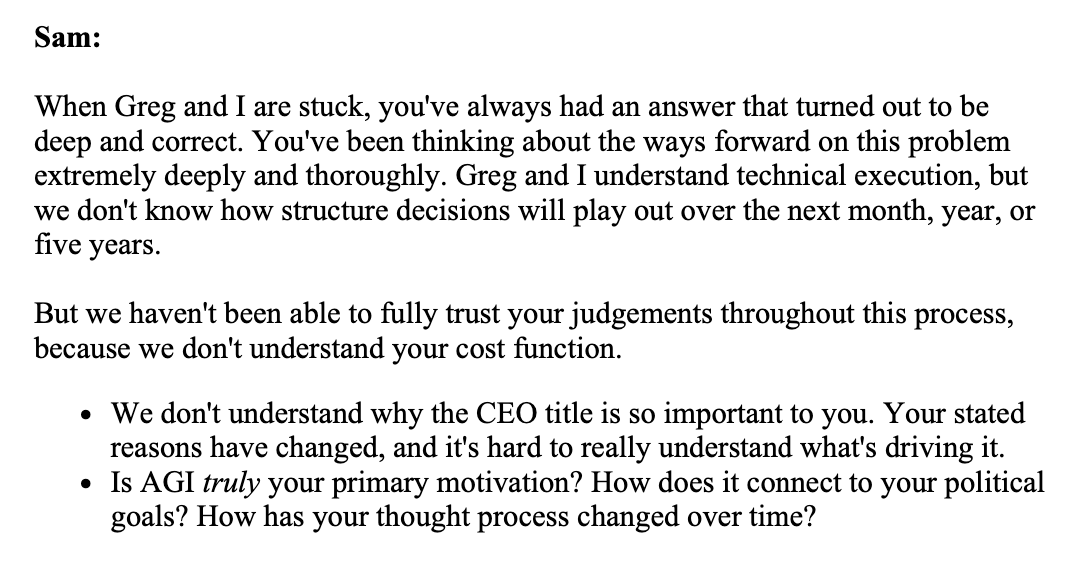
Later that month, Musk registered “Open Artificial Intelligence Technologies, Inc.” as a public benefit corporation—preparing his own AI venture.
After tense back-and-forth, Musk sent the email that ended the partnership. “Guys, I’ve had enough. This is the final straw. Either go do something on your own or continue with OpenAI as a nonprofit. I will no longer fund OpenAI until you have made a firm commitment to stay or I’m just being a fool who is essentially providing free funding for you to create a startup. Discussions are over.”
Brockman later noted in communications that shifting to for-profit without Musk “would be morally bankrupt.”
February 2018: Exit and Warning
In early 2018, Musk suggested OpenAI should “attach to Tesla as its cash cow,” calling it “the only path that could even hope to hold a candle to Google.” When co-founders rejected terms that gave Musk control, he resigned from the board in February. The official reason: potential conflicts with Tesla’s self-driving AI work.
Behind closed doors, Musk told the team OpenAI’s “probability of success was zero” and that he planned to build an AGI competitor within Tesla. “When he left in late February 2018, he told our team he was supportive of us finding our own path to raising billions of dollars,” OpenAI later stated of Musk at the time.
In August, Altman sent Musk drafts of plans to shift OpenAI to for-profit. Musk didn’t respond.
By December, Musk sent a final warning: “Even raising several hundred million won’t be enough. This needs billions per year immediately or forget it.”
2019: The Pivot
OpenAI created a “capped-profit” subsidiary with the nonprofit maintaining control. Microsoft invested $1 billion. Altman became CEO. The structure attracted major funding while theoretically preserving the mission. Musk later alleged this moment betrayed everything OpenAI stood for.
November 2022: ChatGPT Changes Everything
OpenAI released ChatGPT publicly. The chatbot hit 100 million users in under two months. Musk tweeted: “ChatGPT is scary good. We are not far from dangerously strong AI.” Despite concerns, the comment acknowledged OpenAI’s achievement.
Within weeks, Musk began criticizing the shift from open-source to closed models and the deepening Microsoft relationship.
ChatGPT is scary good. We are not far from dangerously strong AI.
— Elon Musk (@elonmusk) December 3, 2022
2023: Private Pain, Public Competition
Early in the year, private emails between the two men showed Altman still trying to salvage the relationship. He called Musk a “hero” but expressed hurt over public attacks. Musk responded that “the fate of civilization is at stake.”
In July, Musk launched xAI as a direct OpenAI competitor. The stated goal: “understand the universe.” The break was now official.
When OpenAI’s board briefly fired Altman in November, then reinstated him after employee revolt, Musk mocked it as the “OpenAI Telenovela” and demanded transparency.
The ratings on the OpenAI Telenovela are off the hook 🤣🤣 https://t.co/IRA9UCSMr8
— Elon Musk (@elonmusk) November 20, 2023
March 2024: The Lawsuit Begins
Musk filed in San Francisco state court, alleging breach of contract and fiduciary duty. He claimed OpenAI abandoned its founding mission and had become a de facto Microsoft subsidiary.
Days later, OpenAI published Musk’s old emails, including his push for for-profit structure and the Tesla merger idea. “We’re sad that it’s come to this with someone whom we’ve deeply admired—someone who inspired us to aim higher, then told us we would fail, started a competitor, and then sued us when we started making meaningful progress towards OpenAI’s mission without him,” the company wrote.
June 2024: Strategic Withdrawal
Musk dropped the lawsuit without explanation. Legal observers were puzzled.
When Apple announced iOS integration with ChatGPT that same month, Musk threatened to ban Apple devices at his companies. “If Apple integrates OpenAI at the OS level, then Apple devices will be banned at my companies,” he wrote. “That is an unacceptable security violation.”
If Apple integrates OpenAI at the OS level, then Apple devices will be banned at my companies. That is an unacceptable security violation.
— Elon Musk (@elonmusk) June 10, 2024
August 2024: Federal Court and Public Barbs
Musk refiled in federal court with stronger allegations: fraud, breach of fiduciary duty, RICO violations. The case accused OpenAI and Microsoft of racketeering and antitrust violations.
October 2024: The Transformation Complete
OpenAI finished recapitalization. The nonprofit retained control, but its for-profit arm—valued at $135 billion with Microsoft’s investment—represented the full transformation Musk had warned against.
November 2024: The Case Survives
U.S. District Judge Yvonne Gonzalez Rogers rejected OpenAI and Microsoft’s third dismissal attempt. She pointed to “ample evidence supporting Musk’s claims” and internal communications showing leadership “saying one thing publicly and planning something completely different privately.” The case would go to trial.
February 2025: The $97.4 Billion Bid
Musk led a consortium offering $97.4 billion to buy OpenAI’s nonprofit. Altman rejected it publicly within an hour: “[N]o thank you but we will buy twitter for $9.74 billion if you want”—implying X was worth a fraction of the $44 billion Musk paid in 2022.
Musk responded with one word: “swindler.”
The exchange got personal. Altman called Musk “not a happy person” operating from “insecurity.” In April, Musk said powerful AI shouldn’t be controlled by someone “not trustworthy” like Altman.
August 2025: App store rankings dispute
On August 11, Musk claimed Apple was manipulating App Store rankings to favour OpenAI. Altman shot back: “This is a remarkable claim given what I have heard alleged that Elon does to manipulate X to benefit himself and his own companies and harm his competitors and people he doesn’t like.”
Musk replied: “You got 3M views on your bullshit post, you liar, far more than I’ve received on many of mine, despite me having 50 times your follower count!”
This is a remarkable claim given what I have heard alleged that Elon does to manipulate X to benefit himself and his own companies and harm his competitors and people he doesn't like. https://t.co/HlgzO4c2iC
— Sam Altman (@sama) August 12, 2025
Altman challenged: “Will you sign an affidavit that you have never directed changes to the X algorithm in a way that has hurt your competitors or helped your own companies? i will apologize if so.”
By September, Altman said in interviews he once admired Musk but now views him differently. In November, they fought over a Tesla Roadster refund, with Musk accusing Altman of “stealing a nonprofit.”
January 2026: Trial Set, Stakes Clear
On January 8, Judge Rogers scheduled trial for March 30, 2026. “Part of this is about whether a jury believes the people who will testify and whether they are credible,” she said in court.
Musk is seeking $79 billion to $134 billion in damages. His expert witness calculated that OpenAI earned $65.5 billion to $109.4 billion in wrongful gains while Microsoft gained $13.3 billion to $25.1 billion from their partnership. The logic: just as early startup investors realize gains far exceeding initial investments, Musk’s $38 million plus reputation, network, and strategic guidance entitled him to substantial returns from a company now valued at $500 billion.
OpenAI warned investors to expect “deliberately outlandish, attention-grabbing claims” from Musk. “We believe this case is worth no more than the $38M that Elon donated—though that is not a guarantee,” the company wrote.
On January 17, Musk posted he was eager for trial. “Can’t wait to start the trial. The discovery and testimony will blow your mind.”
January 20: The Safety War
Monday night’s exchange brought safety concerns front and centre.
Musk quoted a post alleging ChatGPT had been linked to nine deaths and warned against using it.
“Don’t let your loved ones use ChatGPT,” Musk posted.
Seven families filed wrongful death lawsuits against OpenAI in November 2025—four addressing ChatGPT’s alleged role in suicides, three claiming it reinforced harmful delusions. Internal estimates show 1.2 million of ChatGPT’s 800 million weekly users discuss suicide with the chatbot each week.
Altman defended OpenAI’s responsibility while pivoting to Autopilot. Tesla’s system has been linked to several crashes, including over two dozen fatal incidents, according to U.S. National Highway Traffic Safety Administration investigations. Many involved drivers who believed Autopilot was fully autonomous.
“Sometimes you complain about ChatGPT being too restrictive, and then in cases like this you claim it's too relaxed. Almost a billion people use it and some of them may be in very fragile mental states. We will continue to do our best to get this right and we feel huge responsibility to do the best we can, but these are tragic and complicated situations that deserve to be treated with respect,” Altman said.
Don’t let your loved ones use ChatGPT https://t.co/730gz9XTJ2
— Elon Musk (@elonmusk) January 20, 2026
Altman also referenced Grok, Musk’s xAI chatbot, which faces regulatory scrutiny in Europe, India, and Malaysia after studies found nearly three-quarters of prompts for nonconsensual sexualized images went to Grok.
“Apparently more than 50 people have died from crashes related to Autopilot. I only ever rode in a car using it once, some time ago, but my first thought was that it was far from a safe thing for Tesla to have released. I won't even start on some of the Grok decisions,” he posted.
The March 30 trial will force both to defend their safety records publicly.
 David Adubiina