


![Top 6 AI Customer Service Solutions for Small Business [2026 rankings] Post image](/content/images/size/w2000/format/webp/2025/09/data-src-image-f8161895-023c-44dc-85fc-8fbe93bb5a53-1.png)
According to recent studies, more than half of customers are willing to stop buying from a business after just one poor service experience. So, for small businesses, where every customer interaction matters, adopting AI customer service solutions is the only way to stay competitive.
In this guide, we’ll review the top 6 AI customer service solutions for small business in 2026, breaking down their features, pros, cons, and best use cases so you can find the right solution for your needs!
Compare the Best AI Customer Service Solutions For Small Business
Before we move onto the details, take a look at how each platform compares side by side.
Based on our evaluation of pricing, features, integrations, and real customer feedback, Text App took the first place in our ranking as the best AI customer service solution for small business in 2026.
1. Text App
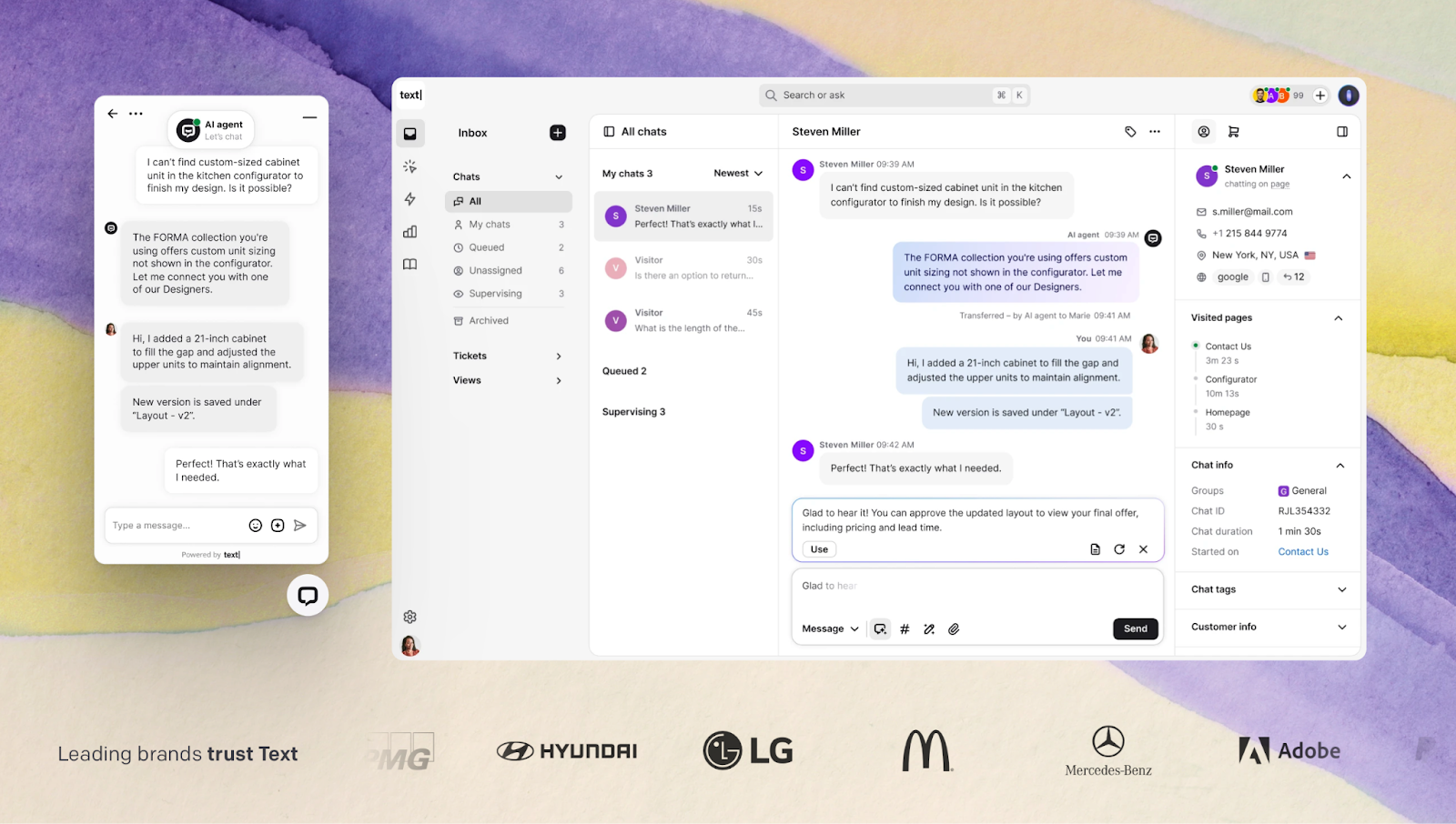
Text App is an all-in-one AI customer service platform designed for small businesses, combining live chat, email ticketing, social channels, and AI agents into one workspace. Its "Text Intelligence" system uses customer history and company policies to automate tasks such as refunds, returns, and billing updates while handing off complex cases to human agents with full context. In 2025, Text App is widely trusted by small businesses as an AI customer service software that reduces response times and improves customer satisfaction.
Key features:
- Unified inbox across chat, email, and social
- AI trained on business knowledge base and customer data
- Instant resolutions for refunds, returns, and upgrades
- Seamless handoff to human support with full history
Pros:
- Fast resolutions, often in seconds
- Consistent answers aligned with business policies
- Affordable pricing with free trial
Cons:
- Complex issues still need human expertise
- Initial AI training requires quality internal data
Best for: Instant resolution of common customer requests
2. HelpScout
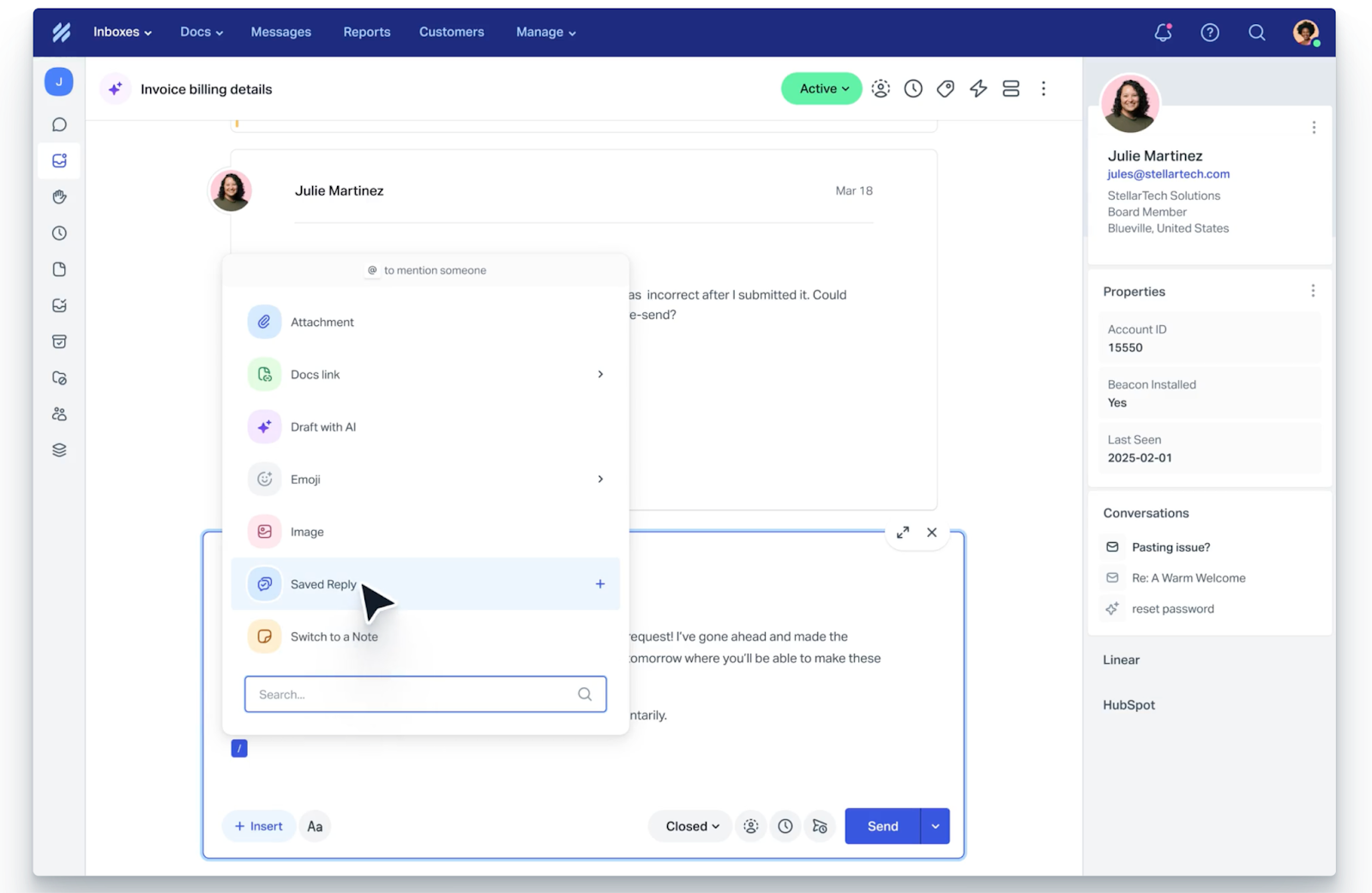
HelpScout is an AI customer service software widely used in 2025 by small and midsize businesses, known for its shared inbox workflows and straightforward email-first design. The platform integrates email, live chat, and a knowledge base under one interface, while its HelpScout’s AI suite automates up to 70% of routine tasks using the company’s Docs content, improving customer service while reducing manual workload.
Key features:
- AI Answers for customer questions based on Docs and added web content
- Shared inboxes with collaboration tools for support operations
- Knowledge base (“Docs”) for self-service customer interactions
Pros:
- Unlimited users across all plans
- Easy onboarding with clean interface
- AI tools to assist agents and reduce tedious tasks
Cons:
- AI training limited to HelpScout content
- Advanced analytics and CRM systems integrations only in higher tiers
Best for: Collaborative email-based support
3. Gorgias
Gorgias is an AI customer service platform developed for ecommerce businesses, with integrations across Shopify, BigCommerce, and Magento. Its AI Agent 2.0 manages more than 60% of customer requests autonomously, handling order inquiries, returns, and subscription updates using real-time customer data.
Key features:
- AI Agent 2.0 for automating routine tasks and analyzing customer sentiment
- Centralized omnichannel inbox for customer interactions across multiple platforms
- Proactive upsell and discount recommendations linked to customer needs
Pros:
- Deep integrations with Shopify and ecommerce CRMs
- Unlimited human agent seats on all paid plans
- Converts support operations into measurable revenue through AI tools
Cons:
- Pricing based on ticket volume and usage spikes
- Limited suitability for non-Shopify environments
Best for: Shopify ecommerce stores
4. Thunai
Thunai centralizes company knowledge through its “Thunai Brain,” connecting CRM systems, documents, videos, and customer feedback. In 2025, it deploys specialized AI agents across chat, voice, and email, supporting more than 150 languages and offering sentiment analysis for customer interactions.
Key features:
- Thunai Brain for centralized customer data and business knowledge
- Specialized AI agents for chat, email, and phone calls
- Multilingual support covering 150+ languages
Pros:
- Strong multilingual coverage
- SOC 2–compliant enterprise security standards
Cons:
- May be excessive for small business owners with limited resources
- Best performance requires a large knowledge base and historical data
Best for: Multilingual, multi-channel enterprises needing workflow automation
5. Zendesk
Zendesk is an AI customer service platform that integrates chat, email, voice, and social channels into a unified workspace. Zendesk supports predictive analytics, multi-language customer experiences, and more than 1,000 integrations, making it suitable for businesses with complex customer demands.
Key features:
- Unified Agent Workspace for all customer interactions
- Generative AI agents for automating routine tasks and drafting replies
- Over 1,000 integrations with CRM systems and productivity tools
Pros:
- Broad integration ecosystem and multi-language support
- Predictive analytics improve service quality and response times
Cons:
- Requires technical expertise for full customization
- Advanced features locked behind higher-tier plans
Best for: Complex issues
6. HubSpot Service Hub
HubSpot Service Hub is embedded within HubSpot’s CRM systems, unifying ticketing, live chat, knowledge base, and customer feedback management. Its AI customer agent automates ticket handling, provides instant responses to customer questions, and escalates complex tasks to a human agent.
Key features:
- AI customer agent for instant responses and ticket automation
- Shared inbox and live chat for centralized customer interactions
- Knowledge base with AI-powered content suggestions
Pros:
- Easy to implement AI with minimal technical expertise
- Strong native integration with HubSpot CRM and marketing tools
Cons:
- Limited reporting and workflow automation on lower tiers
- Onboarding fees apply for advanced tiers
Best for: CRM-centric small businesses
Summing Up
In summary, choosing the right solution depends on your customer interactions, business goals, and budget.
For most small businesses for 2026, Text App stands out as the best option for fast, reliable automation of everyday customer requests.


