For nearly a decade, the UK and Canada have remained two of the default options for tech professionals weighing locations to build their careers abroad.
When people compare “best countries for tech talent mobility,” these two almost always come up, despite the recent tightening of immigration rules and policies.
The UK has positioned itself as a large and stable hub for talent looking to work on globally competitive products and earn salaries that hold their own against other top markets, while Canada is a growing hub with strong demand across startups and large enterprises with competitive pay bands.
Second is that both offer pathways to residency. But while they share many similarities, they do not offer the same opportunities.
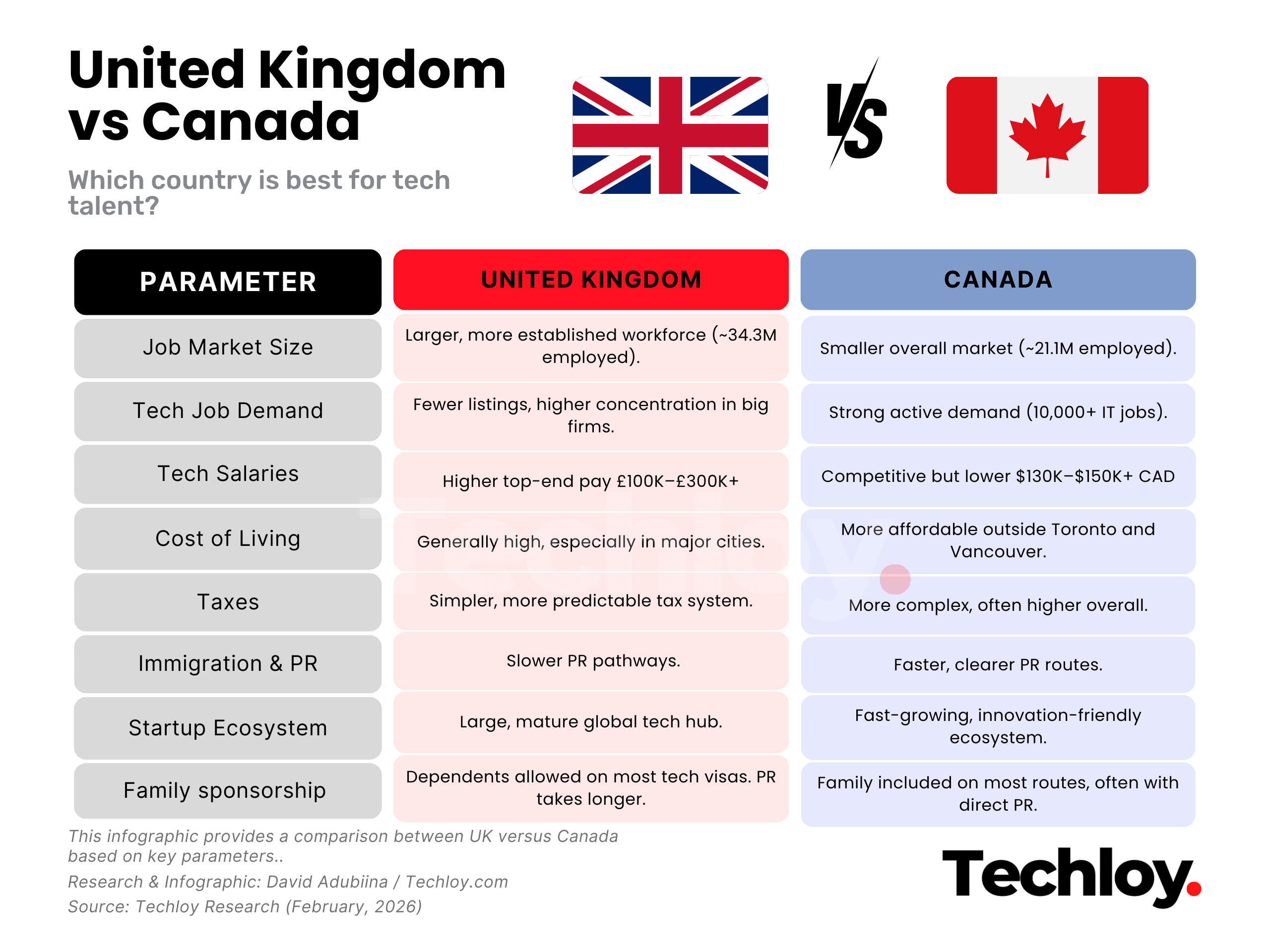
Here is how the UK stacks up against Canada for tech talent:
Which country has the largest job market?
In terms of job market size, both the UK and Canada have established themselves as premier global tech ecosystems, boasting hundreds of artificial intelligence (AI), fintech, and software companies looking for bright talent. The UK, however, has a larger and more established job market than Canada, with roughly 13 million more employed people than Canada.
According to Statista, the UK had approximately 34.3 million employed people in 2025; Canada, by comparison, recorded about 21.12 million employed people. But this presents a huge opportunity for tech talent in Canada. Recent data by Indeed shows that Canada listed over 10,000 IT jobs. In the UK, the number is roughly 3,600 IT jobs, according to IT Jobs Watch.
Which Country Pays the Most For Tech Careers
Understanding salary differences between the two countries can be a deciding factor when choosing where to build a tech career. Glassdoor data shows that software engineers at US tech giants and specialised finance firms in the UK often earn well over £100,000 in total pay, with companies like Meta (£150K+ median), Google (£100K+ median), Amazon, Bloomberg, and Airwallex (£230K–£300K) leading the pack in London.
In Canada, data from 2026 shows that top-paying employers such as Amazon, Google, Microsoft, and Meta frequently offer $130,000–$150,000+ CAD per year, especially in major tech hubs like Toronto and Vancouver and in fully remote roles.
Cost of Living
If getting paid is one side of the coin, the other side is the cost of living. On average, according to the Job Bank, the average monthly cost of living for a single person in Canada ranges from roughly $1,980 to $2,370 and could climb much higher in major cities like Toronto and Vancouver.
In the UK, weekly living expenses are around £662 ($900), which comes to roughly £2,870 ($3,780) per month, according to the Office for National Statistics (ONS).
Tax policies
In the UK, tax starts only after you earn above the personal allowance of £12,570 per year, which is taxed at 0%. Any income above that is taxed progressively, with 20% on earnings from £12,571, 40% on income above £50,271, and 45% on earnings over £125,140.
Canada, on the other hand, runs a progressive, self-assessed tax system made up of both federal and provincial taxes. As of 2025, federal tax rates range from 15% to 33% and are adjusted for inflation. Residents are taxed on their worldwide income, while non-residents are taxed only on income earned in Canada.
Immigration & Visa Policies
Access to work visas and clear paths to permanent residency are big considerations if you are looking to migrate as a tech professional. Canada makes this relatively easier with some of the fastest, most accessible immigration routes for international talent, including two-week work permit processing through the Global Talent Stream (GTS) and targeted permanent residency draws.
Key options include the Global Talent Stream, Express Entry, Startup Visa, and specialised Provincial Nominee Programs (PNPs), all of which come with some form of permanent residency.
The UK also provides strong high-skill immigration routes for tech talent. The Global Talent visa offers a 3–5 year work permit, after which talent can file for an Indefinite Leave to Remain (ILR).
Startup & Innovation Ecosystem
Both the UK and Canada offer thriving startup landscapes, with the UK topping Europe as the continent’s leading tech ecosystem and ranking second worldwide according to Startup Blink. It’s home to over 17,000 VC-backed startups, with total startup investment surpassing $186.06 billion.
Canada ranks as the world’s fifth-largest startup hub and second in North America, with nearly 10,000 companies raising over $70.67 billion in the past decade. These figures show that both countries provide fertile ground for tech talent.
Family Inclusion
Both countries make it possible for tech professionals to move with their families. The difference lies in the number of options available.
UK:
- Global Talent Visa (Digital Technology): Allows spouse and children under 18 with work and study benefits. You can apply for Indefinite Leave to Remain (ILR) after 3 years (if applying as a leader) or 5 years (if applying as a potential leader).
- Skilled Worker Visa: Family included with the requirement that you get a job offer or sponsorship. You can get ILR after 5 years.
- Innovator Founder Visa: Partner and children included. Offers a path to settlement (ILR) after 3 years.
- Scale-up Worker Visa: Allows dependents for individuals with a high-skilled job offer from a qualifying "scale-up" company
Canada:
- Start-up Visa Program: Include spouse and children under 22 with work and study benefits. Mainly requires support from a designated organisation.
- Global Skills Strategy (GSS): Fast-track work permits with family inclusion. Spouse eligible for open work permits, with processing often within 2 weeks.
- Intra-Company Transfer (ICT): Family can join with work and study benefits and a pathway to PR.
- Express Entry (Federal Skilled Worker/CEC): Family included with direct PR, allowing family to live, work, and study anywhere.
- Provincial Nominee Programs (PNPs) – Tech Streams: Provincial tech pathways such as BC PNP Tech and Ontario’s OINP Tech Draws include family members and provide a route to permanent residence.
If you want the highest salaries and the biggest, most established tech ecosystem, the UK comes out as a top pick. But if your priority is an environment with strong talent demand, faster immigration, and clearer PR pathways, Canada is the more advantageous destination.
 David Adubiina