If anything, mobile photography has been at the top of its game this year. OPPO kicked things off in April with the Find X8 Ultra, followed closely by Vivo’s X200 Ultra, both proving how far smartphone cameras have evolved. Sharper details, cleaner night shots, and smarter AI tuning have become the new normal. Gone are the days when zooming in meant watching your photo turn into a blur.
Interestingly, Google Trends data reflects that growing attention. Search interest in “new mobile phone cameras” stayed quiet for months but spiked sharply in August 2025—right when brands like Google and Samsung unveiled their next-gen camera phones with AI-driven imaging. The buzz hasn’t cooled since, signaling how photography has once again become the main battleground in the flagship race.
Now, Vivo and Xiaomi are stepping into that same spotlight with the X300 Pro and 17 Pro Max. Both promise cutting-edge camera hardware and AI-enhanced image processing, yet take very different routes to get there. So if you’re trying to decide which one deserves a spot in your pocket, here’s how they compare.
 Ogbonda Chivumnovu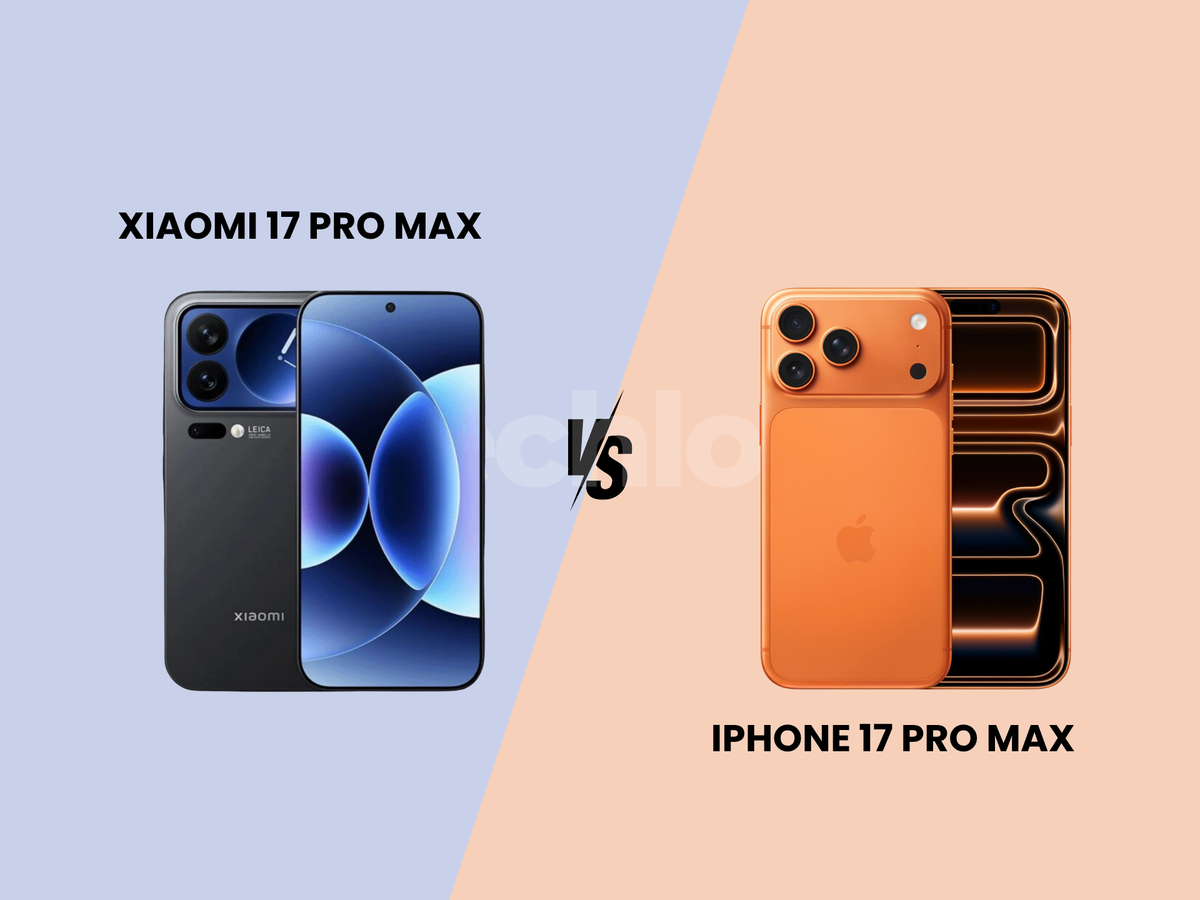
/1. Design & Display
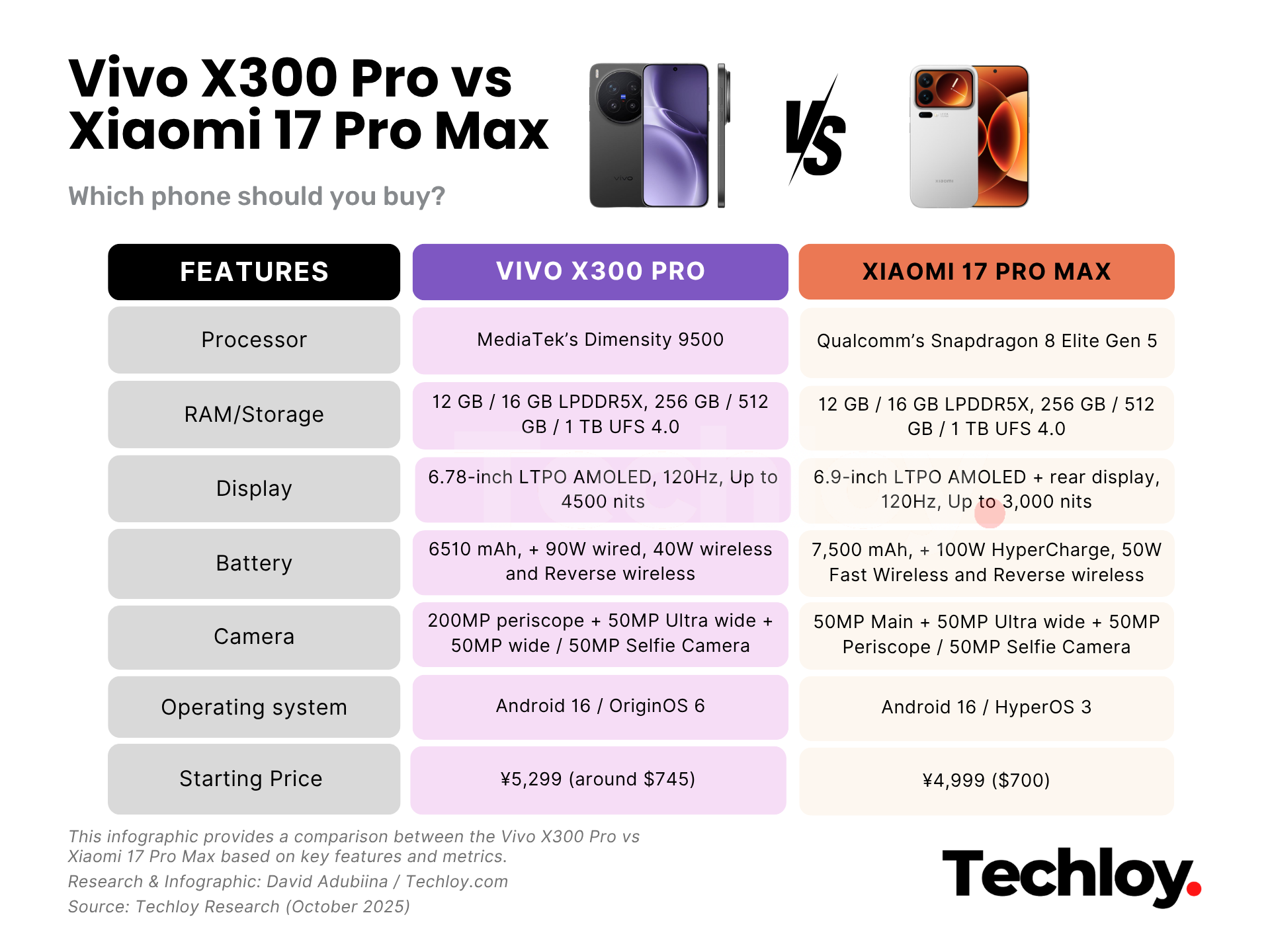
Both phones make strong first impressions, but the Vivo X300 Pro keeps its flagship light (under 8mm) and elegant. Its 6.78-inch AMOLED display delivers sharp visuals, smooth 120Hz refresh, and slim bezels that peak at 4500 nits brightness. The regular X300 is even more compact at 6.31 inches, making it friendlier for one-handed use. Vivo also brings IP68/69 durability and an ultrasonic fingerprint sensor, so it’s not just about looks but the toughness too.
Xiaomi 17 Pro Max, on the other hand, goes big and bold. It packs a massive 6.9-inch LTPO AMOLED display (3200 × 1440), supports Dolby Vision and HDR10+, and peaks at a 3000 nits brightness. The real curveball is on the back — a secondary 2.66-inch display that doubles as a selfie viewfinder, clock screen, and notification hub. It’s heavier at 219g, but the design feels futuristic rather than bulky.
/2. Performance & Software
The power difference between the two is negligible if we are to consider basic use. Both phones can handle everyday tasks with ease with only a but under heavier use. Vivo’s X300 Pro comes with MediaTek’s Dimensity 9500, a chip that finally puts MediaTek shoulder-to-shoulder with Snapdragon’s elite lineup. It’s fast, efficient, and holds its own even in long gaming sessions. It runs on the new OriginOS 6, which feels far more modern and intuitive than the old Funtouch OS. The interface is cleaner, transitions are smoother, and overall performance feels tighter and more responsive.
Xiaomi 17 Pro Max, meanwhile, opts for Qualcomm’s Snapdragon 8 Elite Gen 5—the absolute top-tier Android processor in 2025. Combined with up to 16GB of LPDDR5X RAM and UFS 4.0 storage, it’s tuned for heavy workloads—gaming, editing, or running multiple demanding apps. The massive 5,533 mm² vapor chamber keeps temperatures under control, while Xiaomi’s HyperOS 3 brings smarter AI resource management and improved connectivity across devices in the Xiaomi ecosystem.
/3. Cameras
Vivo’s edge lies in its camera ecosystem. The optional Telephoto Extender Kit and Photography Grip turn it into a semi-professional setup, something Xiaomi doesn’t match yet. The Vivo X300 Pro builds on the success of its predecessors with a 200MP Samsung HPB telephoto sensor (85mm equivalent) and Sony’s newer LYT-828 main sensor, capable of producing crisp, detailed images with impressive low-light performance. It also supports 4K at 120fps and 10-bit Log video, making it a solid option for creators who like control over their footage.
In contrast, Xiaomi 17 Pro Max comes with a familiar but powerful trio: a 50MP main, 50MP ultrawide, and 50MP periscope lens, all tuned by Leica. Images have that signature Leica contrast and depth, with richer tones and dynamic range that feel cinematic. For video, Xiaomi goes even further, supporting 8K recording at 30fps and 4K HDR10+ at 60fps, putting it slightly ahead in flexibility. But then Xiaomi’s biggest camera trick is the rear Magic Back Screen—a 2.66-inch AMOLED panel that doubles as a viewfinder. You can frame selfies, vlogs, or short videos using the main rear cameras, which is a clever touch that gives it extra versatility without relying on the front camera.
/4. Battery & Charging
Vivo X300 Pro features a 6,510mAh silicon-carbon battery (6,040mAh on the X300), which Vivo claims lasts as long as a 7,500mAh cell thanks to efficiency optimizations. Charging is solid: 90W wired and 40W wireless, with an integrated battery grip accessory option.
Xiaomi 17 Pro Max pushes battery endurance to new heights with a 7,500mAh silicon-carbon battery. It easily lasts up to 2 days of mixed use. Charging is blazing fast—100W wired and 50W wireless, plus reverse wireless charging for accessories.
/5. Storage and RAM
Both flagships offer up to 16GB of LPDDR5X RAM and 1TB of UFS 4.0 storage, so performance is never really in question. App switching, file transfers, and gaming all feel snappy and fluid on either device.
/6. Price & Value
Vivo X300 Pro starts at ¥5,299 (around $745), while the base X300 costs ¥4,399 ($620). Add-on photography kits and lenses are sold separately, making it more of a modular camera system.
Xiaomi 17 Pro Max starts slightly higher at ¥4,999 ($700) but scales better in RAM and storage for the price. You’re getting more battery, more display, and more raw performance per dollar.
Conclusion
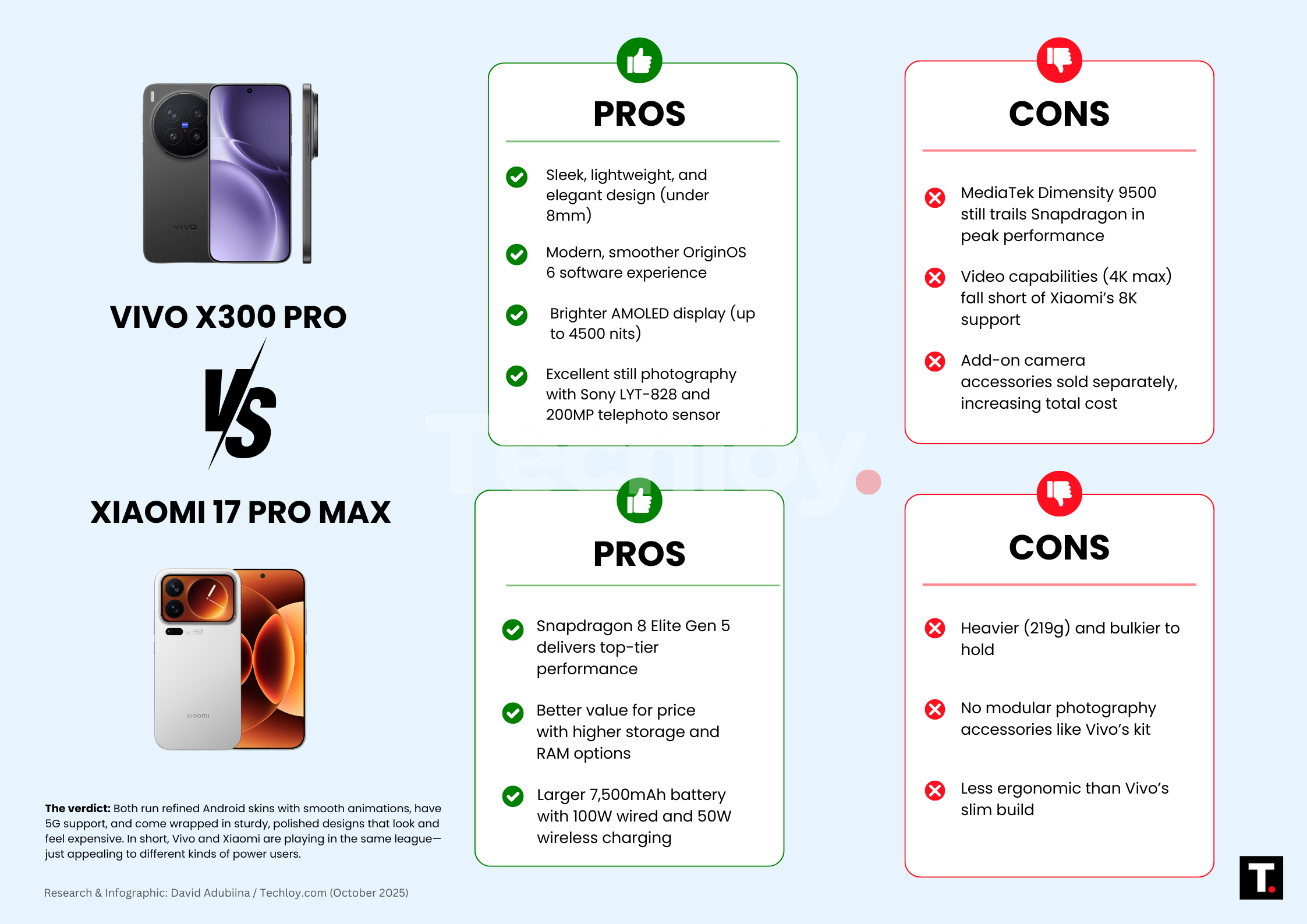
Both the Vivo X300 Pro and Xiaomi 17 Pro Max offer their best when it comes to performance, quality, and flagship-level specs. If you want something sleek, balanced, and built with photographers in mind, the Vivo X300 Pro is the better pick. Its refined design and pro-grade camera setup make it ideal for creators who care about image detail and color accuracy. While it doesn’t hit the same raw power levels as Xiaomi, its efficiency, smooth software, and premium feel make it worth every cent for everyday users and photography enthusiasts alike. But if you want long battery life and a feature-packed experience, Xiaomi’s 17 Pro Max is a pick you might want to consider. The Snapdragon 8 Elite Gen 5 chip and massive 7,500mAh battery give it a futuristic edge that few rivals match. It has a bit more weight, but it makes up for it with all-around capability and top-tier performance. For me, it’s a win for the Xiaomi 17 Pro Max not just for its versatility and power, but for the value it delivers at its price point. What do you think?
 Kelechi Edeh