



Flagship camera phones are no longer just about megapixels. They are becoming complete imaging systems, backed by serious hardware, creator-focused software, and in some cases, physical accessories that make them feel closer to cameras than smartphones.
That is exactly the space where the vivo X300 Ultra and the OPPO Find X9 Pro meet.
Both phones are built around the idea that photography and video are the main reasons people would buy them. But they approach that goal very differently. Vivo leans into sensor size, focal length discipline, and modular photography tools. OPPO balances a versatile camera system with one of the largest batteries ever seen in a flagship and a feature-rich imaging experience powered by Hasselblad colour science.
Here’s how the two ultra-flagships stack up.
 Louis Eriakha
1. Design and Build
The vivo X300 Ultra feels like a device designed around its camera. The large camera module, optional camera cage, and telephoto extenders make it clear that this is meant to double as a serious shooting tool. It looks and feels like a piece of photography gear that happens to be a smartphone.
The OPPO Find X9 Pro, on the other hand, takes a more traditional flagship route. At 224g and 8.25mm thick, it is still substantial, but the design is sleeker and more refined, offering a more premium feel. The use of Gorilla Glass Victus 2 and the titanium-inspired finish gives it durability without leaning too hard into the “camera gadget” aesthetic.
2. Display
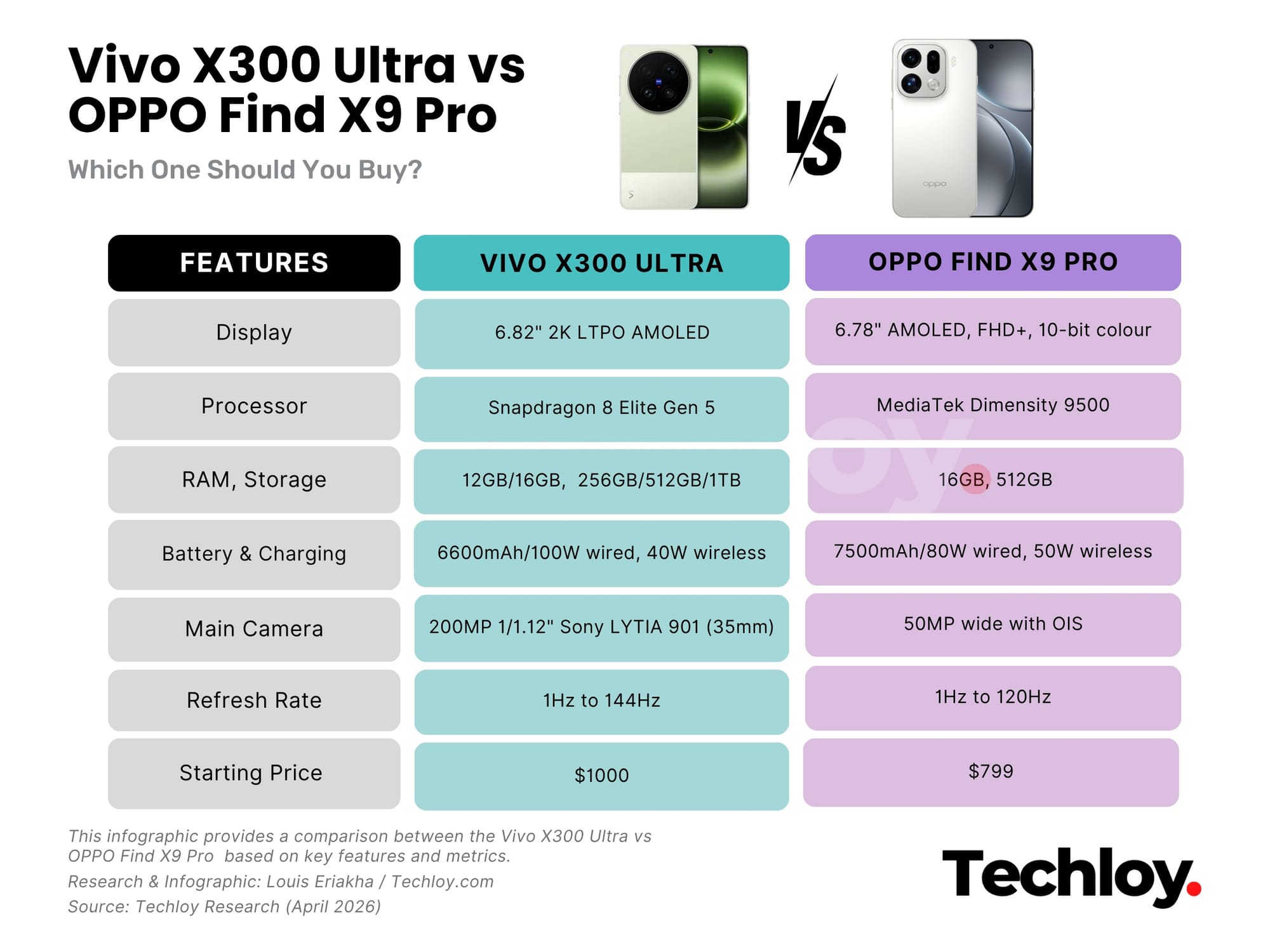
The vivo X300 Ultra features a 6.82-inch 2K LTPO AMOLED display with a 144Hz refresh rate. It is sharper, smoother, and clearly tuned for creators who may want extra resolution when reviewing photos and videos.
The OPPO Find X9 Pro uses a slightly smaller 6.78-inch AMOLED panel with FHD+ resolution and a 120Hz refresh rate. It still supports 10-bit colour and 100% DCI-P3, but it prioritises brightness and efficiency over sheer resolution, peaking at 1800 nits in high brightness mode.
In daily use, both displays will look excellent. The real difference is that Vivo offers more resolution and a faster refresh rate, while OPPO focuses on colour accuracy and power efficiency.
3. Performance
Under the hood, these phones take different silicon paths.
The vivo X300 Ultra runs on the Snapdragon 8 Elite Gen 5 with up to 16GB RAM and 1TB storage. This is Qualcomm’s top-tier chip, built for sustained performance in gaming, video editing, and heavy multitasking.
The OPPO Find X9 Pro uses the MediaTek Dimensity 9500, paired with 16GB LPDDR5X RAM and UFS 4.1 storage. While MediaTek’s flagship chips have become extremely competitive, this is still a different performance profile compared to Qualcomm’s absolute best.
In real-world use, both will be fast. But for raw GPU performance and long-term optimisation across apps and games, the Snapdragon chip gives Vivo a slight edge.
4. Cameras
This is where their philosophies diverge the most.
The vivo X300 Ultra is built around three classic focal lengths: 14mm, 35mm, and 85mm. Its 35mm main camera uses a 200MP 1/1.12-inch Sony LYTIA 901 sensor, while the 85mm periscope pairs a 200MP Samsung HP0 sensor with gimbal-grade stabilisation. With optional teleconverters, plus 3D LUT and ACES log video support, Vivo focuses on large sensors and tools meant for serious post-production work.
The OPPO Find X9 Pro prioritises versatility. It combines a 50MP ultra-wide, 50MP main with OIS, and a 200MP 3x telephoto, enhanced by Hasselblad colour tuning and a wide range of built-in shooting modes. It also supports 4K video at up to 120fps, along with extensive slow-motion and time-lapse options.
OPPO is built for flexibility straight out of the camera. Vivo is built for photographers and videographers who plan to refine their work later.
5. Battery and Charging
This is where OPPO flips the script.
The OPPO Find X9 Pro packs a massive 7500mAh battery with 80W wired charging and 50W wireless charging. This is well beyond typical flagship battery capacity. Here, extreme endurance is the goal.
The vivo X300 Ultra uses a 6600mAh battery with fast wired and wireless charging. It is large, but not on the same level as OPPO’s.
For long trips, heavy video recording, or all-day shooting, OPPO simply lasts longer.
6. Software and Creator Features
Vivo introduces a revamped camera app with 3D LUT import and ACES-compatible log recording. This is aimed squarely at creators who colour-grade footage in professional software.
OPPO counters with Hasselblad-tuned colour science, underwater mode, XPAN mode, document scanner, dual-view video, and a long list of creative shooting modes directly in the camera app.
Vivo assumes you will edit later. OPPO assumes you want great results immediately.
7. Price and Positioning
In China, the vivo X300 Ultra starts around $1,000 and goes up to about $1,300 depending on storage.
OPPO’s Find X9 Pro pricing varies by market, but it starts at about $799, meaning it sits firmly in the ultra-premium territory with high-end materials, massive battery tech, and a versatile camera system.
For many buyers, the decision may come down to whether they value Vivo’s camera-first philosophy or OPPO’s balance of endurance, versatility, and premium design.
Final Thoughts
The vivo X300 Ultra is for users who treat their phone like a camera that can make calls. It is built around sensor size, focal lengths, and professional video output.
The OPPO Find X9 Pro is for users who want a powerhouse flagship with excellent cameras, incredible battery life, and a feature-rich shooting experience without needing extra accessories.


