



Running a business without clear goals can be like steering a ship without a compass for navigation or direction. Ultimately, you know where such a venture ends. That is why, before starting a business, founders or owners spend time coming up with OKRs not for micromanagement but to define and communicate the company's vision, mission, and top-level strategic objectives.
Technically, this raises the question of what OKR is and what it stands for in a business.
What is OKR?

OKR, short for Objectives and Key Results, is a goal-setting framework that helps businesses define and track their objectives and key results. It promotes transparency, alignment, and continuous improvement within a company.
At Techloy, OKRs are one of the things Elizabeth, our HR/Project manager, makes accessible to employees, and this has made every employee accountable.
For a growing establishment like Techloy, this provides focus, fosters engagement, and ensures everyone pulls in the same strategic direction, typically for a specific timeframe, like a quarter.
Components of OKRs

Two components make up every OKR business uses, and they are objectives and key results. Below, we’ll take a closer look at each and show you how to write a simple OKR using the OKR formula.
Objectives
In the OKR framework, objectives are qualitative goals that give you direction. Say you want to write an article. The objective doesn’t spell out every step, but it tells you what you’re aiming for and how to approach. You can think of an objective as the destination on a map. It shows where you’re headed, even though there may be several routes or milestones along the way.
Key Results
Key results help you measure progress towards your objective. They break down the specific outcomes you need to achieve to know you’re on track. Whether you’re an individual or a business, good key results do two important things. First, they clarify what success actually looks like. Second, they give you a clear way to measure progress toward your objective. That is why your key result must be S.M.A.R.T (Specific, Measurable, Achievable, Relevant, and Time-Bound).
For example, if your objective is to write an article, your key results could include completing research, drafting the article, editing it, and publishing it within a set timeframe.
How To Write OKRs
Writing an OKR is easy; however, sticking to it is what makes the difference. A simple way to frame an OKR if you want to make one for yourself or your business is:
We will _____(objective)_____ as measured by _____(key results)______.
Here is an example
We will write and publish a high-quality article as measured by completing research, drafting, editing, and publishing within 48 hours.
How OKRs work in business

/1. Define the Objective (What)
In defining your objectives, you want to start with an ambitious, qualitative statement of what you want to achieve. This should be inspiring and clearly tied to your company’s strategy if you run a business. For example, “Launch a world-class customer support experience.”
/2. Set Key Results (How)
Next, define the specific, measurable outcomes that show whether the objective has been achieved. These are the metrics you track, usually two to five per objective, each with a clear target. Examples include reducing average response time to under 30 minutes or achieving a 90% customer satisfaction score.
/3. Establish Cadence
Company-wide objectives are often set annually, while team OKRs are reviewed and tracked quarterly. To stay focused, many teams hold weekly check-ins to assess progress on their quarterly OKRs.
/4. Align and Cascade
Company-level OKRs set the overall direction. These then cascade down to departments and teams, ensuring everyone is working toward the same strategic goals.
/5. Track and Review
Progress is monitored regularly, often weekly, to see what’s on track and what needs attention. At the end of the quarter, teams score their key results and reflect on what they’ve learned. The goal is to use those insights to set new, meaningful OKRs for the next cycle, not just to maintain existing KPIs.
How does it differ from KPIs

When starting a business, most teams run on initiatives. Everyone is focused on building, shipping, selling, and fixing things as they come up. This works for a while, until the problem shows up. Priorities begin to blur, day-to-day tasks take over, and it becomes harder to tell whether the work being done is actually moving the company forward.
At this point, companies usually introduce KPIs. Key Performance Indicators help track performance by putting numbers behind important parts of the business, such as revenue, customer satisfaction, growth, or engagement. KPIs are useful because they show how the business is doing at any given moment.
The limitation is that KPIs mostly reflect the present state. They tell you what is happening, but not necessarily where you are trying to go or why a particular metric matters right now.
This is where OKRs cover such shortcomings. OKRs shift the focus from monitoring activity to driving outcomes by linking clear objectives to measurable results and tying everyday work back to the company’s mission. Instead of just tracking performance, OKRs give teams direction, purpose, and a shared definition of success.
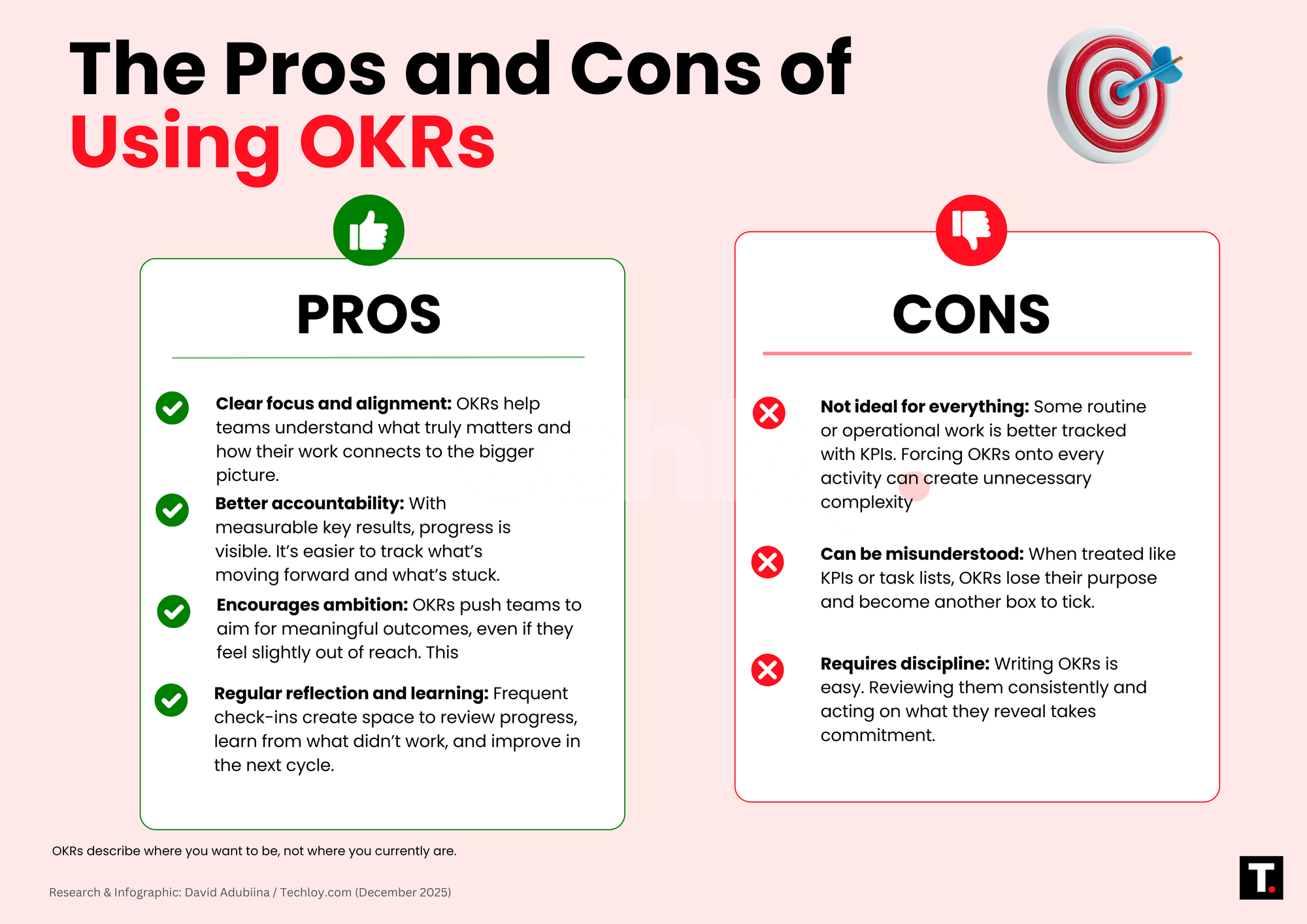
Pros and Cons of Using OKRs
Conclusion
When starting your venture, you don’t have to choose between KPIs and OKRs. It’s often best to use both together to ensure you’re not just measuring results, but actively steering your business in the right direction, keeping your team aligned, accountable, and focused on what truly matters.
 David Adubiina


![Best AI Consulting Firms for Enterprise Transformation [2026 Review] Post feature image](/content/images/size/w1600/format/webp/2026/03/data-src-image-224cb5c4-36e4-4e18-b91d-46f052b1aa42-1.png)
