



For most businesses, generating revenue to stay alive is the goal. However, many miss the key framework that makes this work smoothly, which is Revenue Operations.
Take, for instance, two friends — Charles and David.
Charles runs a growing software company. His sales team is busy chasing deals, marketing is focused on leads, and customer success is scrambling to keep clients happy. On the surface, this looks like what a company's success should look like and entail, but the reality speaks differently; it’s messy, and at a point, this breaks up the company instead of building it.
If marketing celebrates hundreds of new leads, the sales team complains. And if sales closes a deal, customer success gets blindsided when the client expects features that were never discussed. Setups like this only make a business function, not necessarily last. David operates a similar firm, but he tackled it differently by creating a Revenue Operations (RevOps) system in which each team works independently but in a more collaborative and linked manner.
Sales, marketing, and customer success now have the same objectives, use the same data, and adhere to the same procedures. Marketing no longer counts leads; they measure pipeline quality. Sales no longer dumps deals on customer success; they work together to ensure smooth onboarding. For David, revenue is a team sport, not three separate games.
What is RevOps?

If you take a look at the two friends, you will find out they ran their businesses differently, even when they had the same number of employees. This in itself tells you what RevOps is — the alignment of people, processes, and technology across sales, marketing, and customer success.
Think of it as the operating system for revenue, one that connects the dots between every customer touchpoint. Charles didn’t have that alignment. His teams worked in silos, each chasing its own version of success. Marketing chased numbers that didn’t convert. Sales closed deals without thinking about customer fit. Customer success was always reacting instead of being prepared.
David, on the other hand, treated RevOps like the glue that held everything together, with every choice being influenced by consumer data in their reporting system. Marketing focused on generating qualified leads because they shared the same goals as sales.
Beyond the workflow of each team, RevOps unifies the many departments into a single revenue generator, ensuring that everyone is moving in the same direction toward expansion.
Key Revenue Operations Metrics To Consider in Business?

To determine if your RevOps team is effective, it's important to look at the numbers. However, the metrics you choose depend on your business's revenue model. If you run a one-time purchase business, margins are a crucial aspect you want to look at, while subscription-based businesses rely heavily on recurring revenue, renewals, and retention.
Still, there are some general metrics every RevOps team should track to get a full picture of how revenue is flowing:
- Customer acquisition cost (CAC) – what it takes, in real money, to bring in a new customer.
- Annual recurring revenue (ARR) – how much contracted revenue comes in every year from subscriptions.
- Total contract value (TCV) – the full worth of a deal across its entire lifespan.
- Churn rate – the percentage of customers who leave or cancel.
- Renewal rate – how many customers stay and extend their contract.
- Customer lifetime value (CLV) – the total revenue you can expect from a customer before they leave.
- Average revenue per user (ARPU) – the average amount each customer contributes.
- Days sales outstanding (DSO) – how long it takes to actually collect payment after closing a deal.
- Revenue backlog – contracted revenue that hasn’t yet been recognized on the books.
- Customer satisfaction score (CSAT) – a pulse check on how happy customers are with your product or service.
What makes RevOps different is the mindset behind tracking these numbers. It’s not just about celebrating “won” deals and moving on. It's crucial to realize that clients must be consistently acquired and kept, particularly for recurring revenue models. Metrics such as CSAT and adoption rate (the number of new users who actively begin using the product) provide insight into customer engagement and retention.
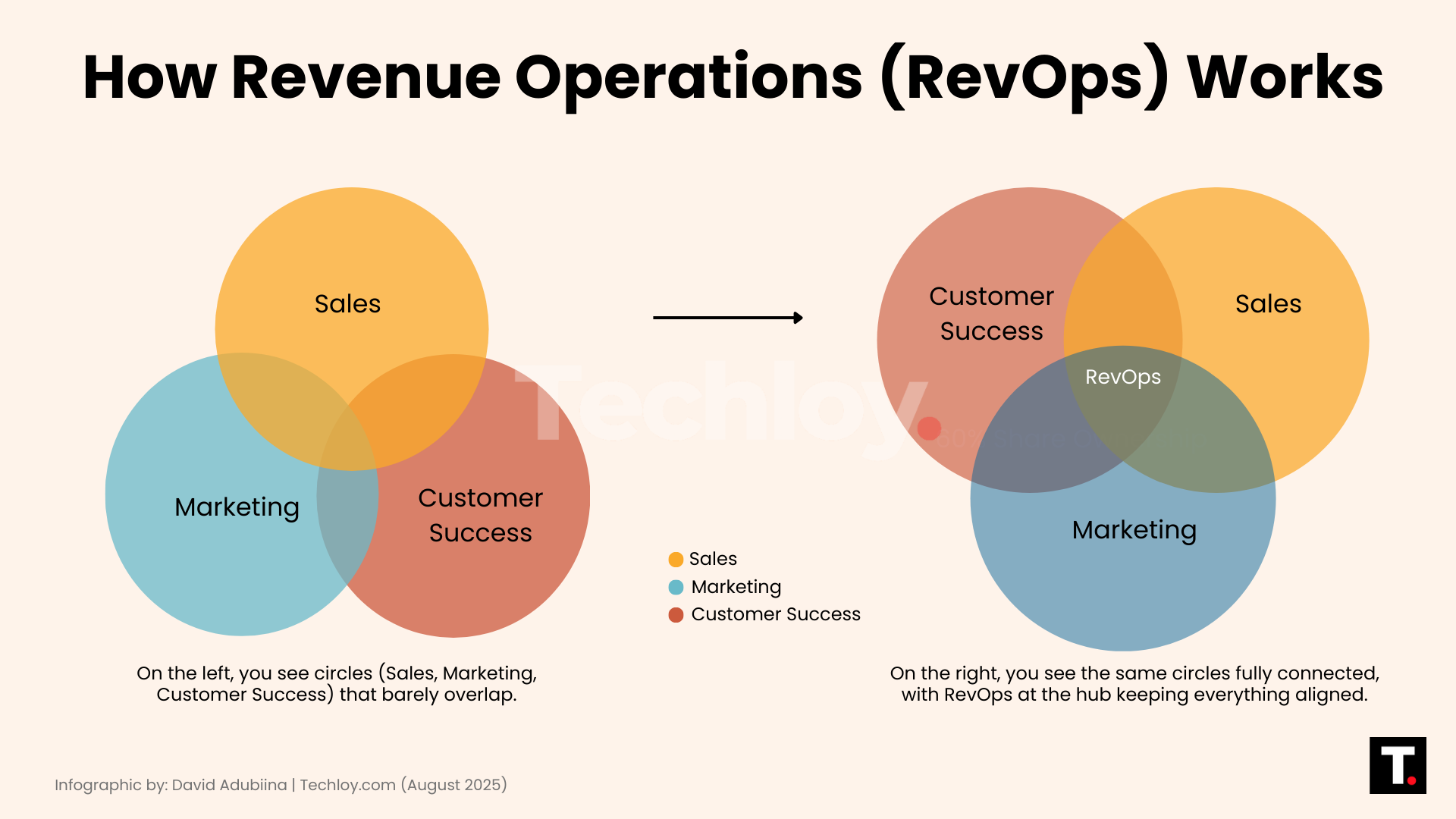
Here's How RevOps Works in Business
Pulling different teams into one revenue engine takes more than good intentions. It usually means building a clear framework, sticking to it, and being patient while the pieces fall into place. When it works, the difference shows up in a few key ways:
1. Unified data: RevOps links all systems and makes customer data actionable and accessible across departments, eliminating the need for dispersed dashboards.
2. Standardized procedures: The entire process, from the initial lead to renewal, is planned out to ensure that nothing is overlooked.
3. Integrated tools: The tech stack actually works together instead of against itself. This removes the chances of conflict.
4. Shared accountability: In this case, marketing, sales, and customer success aren’t judged separately. They’re all measured against the same revenue goals.
Challenges with Setting Up a RevOps Team

Setting up a Revenue Operations function sounds great in theory, but in practice, it’s a bit of work. The promise of alignment across sales, marketing, and customer success is real — but so are the hurdles. From my perspective, these are the biggest challenges companies face when trying to make RevOps work:
- Cultural Resistance
The hardest part about RevOps is the people. Teams often feel protective of their way of doing things. For example, sales doesn’t want marketing telling them how to qualify leads, and marketing doesn’t like being held accountable for revenue. Therefore, getting everyone to buy into a shared system requires strong leadership and patience. - Tool Overload and Integration Headaches
Most businesses already have too many platforms in play — CRMs, marketing automation, customer support tools, analytics dashboards. RevOps only works if these tools connect, but untangling duplicates or forcing integrations can be painful and expensive. In my opinion, this is where many companies underestimate the work; cleaning data and consolidating systems usually takes longer than anyone expects. - Finding the Right Talent
RevOps covers the entire revenue cycle, and more so, it looks at how the three departments handle revenue generation. A strong RevOps leader needs to connect these moving parts, align strategy with execution, and make sure the business grows as one system instead of fragmented pieces. - Leadership Buy-In and Patience
RevOps is a long game of processes like rebuilding systems, data, and habits. Without leadership support, teams are likely to fall apart at the first sign of friction. The companies that succeed are the ones that commit to RevOps as a mindset shift, not just a quick project.
 David Adubiina
Conclusion
RevOps works best when it’s built on adaptability, because no single playbook works forever. Companies that thrive usually aren’t the ones with the most successful sales team or the most expensive tools, but the ones that align their data, people, and processes so they can move fast together.
That’s the real difference between David and Charles. David built a system that could adapt, while Charles kept patching cracks. And here’s the truth: if businesses don’t train people who can think across functions and invest in technology that makes data usable, they’ll stay stuck or probably fold up. But if they do, RevOps stops being a support role and becomes the engine that drives lasting growth.


