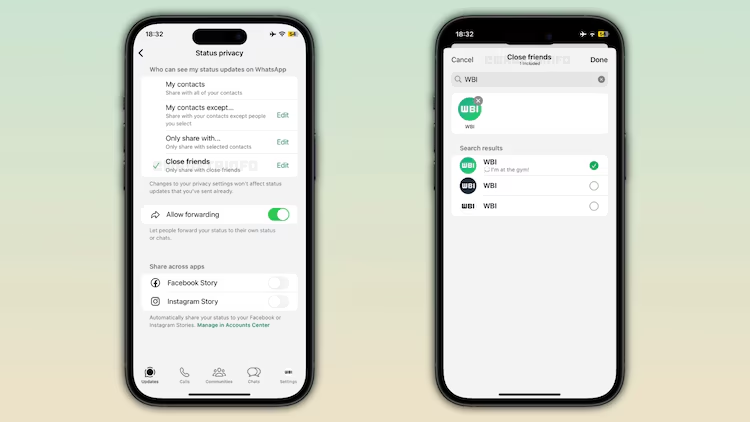
It seems Meta wants to make WhatsApp feel a little more like Instagram. The messaging platform with over 3 billion users appears to be beta testing a new feature for iOS that closely resembles the “Close Friends” option we've seen for Instagram Stories, which lets you share posts with just a handpicked circle instead of your entire list.
WABetaInfo was the first to spot this update in WhatsApp version 25.23.10.80, showing an option to add “Close Friends” to the Status audience menu. That means you’ll be able to create a private group of contacts who get to see certain updates, with an easy way to add or remove people. And from the looks of it, nobody gets a notification when you make changes to your list.
Like normal Status updates, Close Friends' posts will still disappear after 24 hours. The difference is that only the chosen few will see them. To make that clear, WhatsApp is expected to borrow Instagram’s playbook with a visual cue, likely a green ring around the Status, so recipients instantly know it’s part of the exclusive club.
This update comes right after WhatsApp began testing another new tool: an AI-powered Writing Help assistant for iOS, which suggests tone and clarity tweaks while keeping everything processed locally for privacy.
From a product perspective, Close Friends makes sense. WhatsApp sits in a unique spot between private messaging and social sharing, and this gives people an easy way to share more personal or casual updates without broadcasting to everyone.
It could also be especially handy for creators, small businesses, or community organizers who juggle different audiences and need a way to post updates meant only for a select group.
But of course, there’s a tradeoff: splitting your audience could also fragment engagement. Plus, since Instagram, Facebook, and WhatsApp now all offer some kind of audience control, the overlap raises a bigger question—which app should users rely on for what kind of sharing?
For now, the feature is still in development, visible only to a slice of iOS beta testers. No word yet on an Android rollout or a global release date. One thing’s clear, though: Meta is still experimenting with how to give users more granular privacy tools without making things overly complicated.
 Ogbonda Chivumnovu