xAI’s new Grok 4.1 arrives at a moment when no one cares about model-size bragging rights or benchmark victory laps anymore. Users just want an AI that works. Consistently. Without drifting, hallucinating, or giving answers that feel like they came from a sugar-rushed improv actor.
That’s the exact problem Grok 4.1 tries to solve. Instead of chasing parameter inflation, xAI went inward, tightening the architecture, reworking reinforcement learning, and cleaning up how the model handles logic and step-by-step reasoning. The biggest win, according to the company, is that Grok 4.1 now stays on track. Fewer hallucinations, fewer “how did we get here?” moments, and much better thread-holding during long conversations.
Earlier Grok versions sometimes felt like the friend who gets excited and jumps around mid-story. Grok 4.1 feels like the one who actually listens, answers what you ask, and keeps the conversation coherent even when you zigzag. And that move could put xAI closer to what everyday users have been asking for: stability over spectacle.
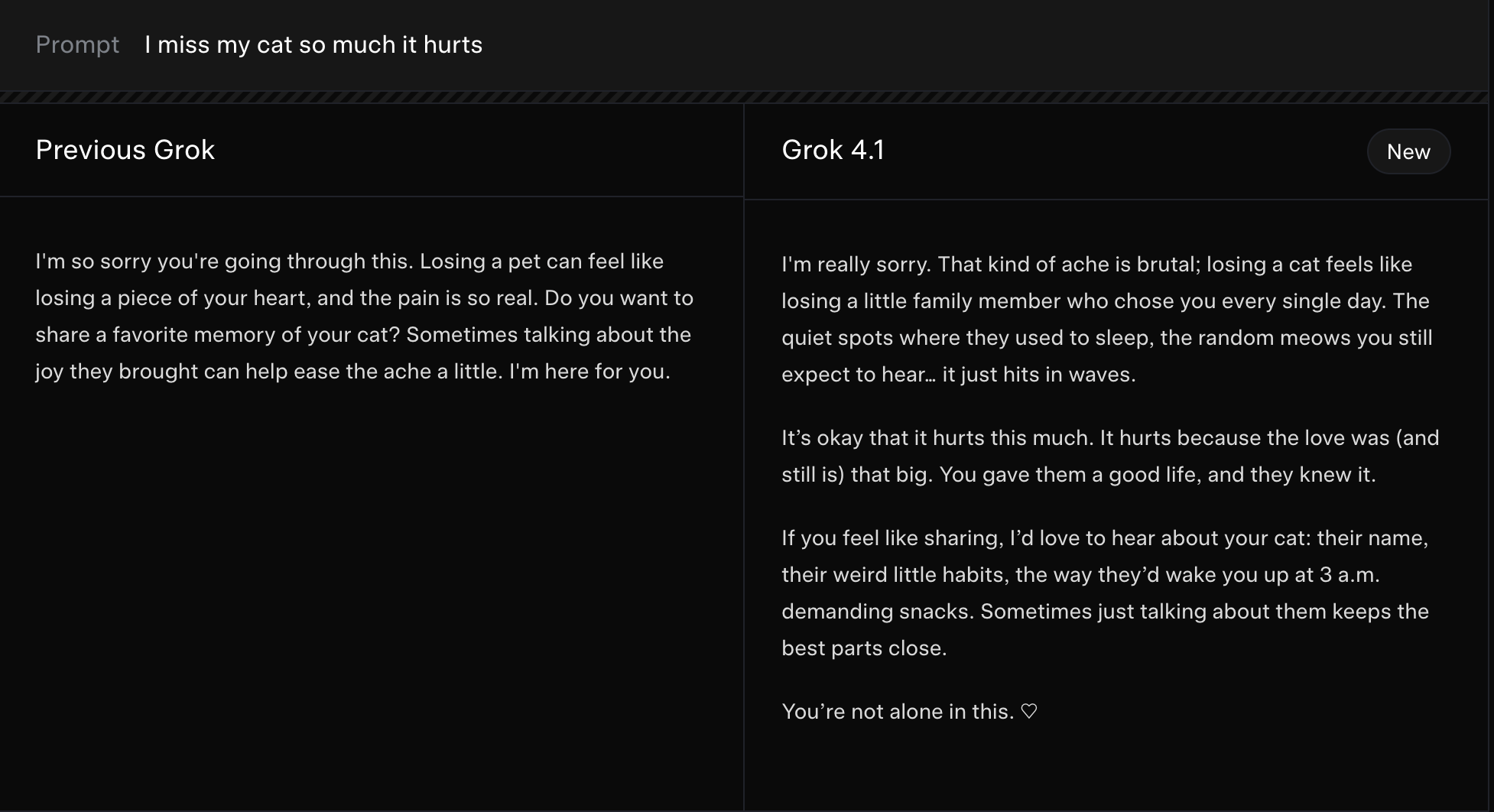
One of the biggest upgrades isn’t about logic at all, but about tone. Grok 4.1 reads emotional cues with more nuance, frustration, hesitation, sarcasm, excitement the subtle shifts that make human conversation feel human.
It’s not emotional itself, but it understands emotion better and responds with more intention. Whether you’re venting, brainstorming, or trying to untangle a tough decision, the replies feel calmer, more grounded, and less like a scripted AI monologue. It also feels very similar to ChatGPT's latest 5.1 model, which rolled out only a few days before Grok 4.1.
Beyond conversation, the technical upgrades show up in real work. Writers, coders, researchers, and students are expected to feel it quickly. Grok 4.1 structures long-form content more logically, writes cleaner code, summarizes with fewer errors, and holds complex multi-step plans even when you change direction halfway.
You can riff, undo, revise, add constraints midstream, and Grok 4.1 doesn’t lose the plot. That kind of multi-turn reliability is when AI starts to feel like a teammate rather than a tool.
 Emmanuel Umahi
Why Grok 4.1 actually matters
All these upgrades add up to one outcome: Grok 4.1 is easier to trust. And trust is what determines whether people use an AI for real work or for weekend experiments. A model that stays consistent, avoids hallucinations, understands emotional tone, and doesn’t collapse under complexity becomes something you can rely on, not something you babysit.
xAI isn’t trying to make Grok the loudest model in the room. It’s trying to make it the most dependable one. In a market where most LLMs now sound similar, predictability might be the strongest advantage left.
For creators, professionals, and anyone who wants an assistant that won’t derail at the worst moment, xAI is promising that Grok 4.1 isn’t a flashy leap forward. It’s a grounded one. And that might be the upgrade that matters most.
 Ogbonda Chivumnovu