X has a growing identity problem. You open the app expecting real people and real conversations, only to stumble into accounts that feel slightly off. The name looks human enough, the profile picture could pass for a real person, but something about the behaviour makes you pause. In the age of generative AI, that hesitation has only grown louder. Now X has rolled out a new “About this account” panel, its attempt to restore a little clarity in a platform that increasingly runs on uncertainty.
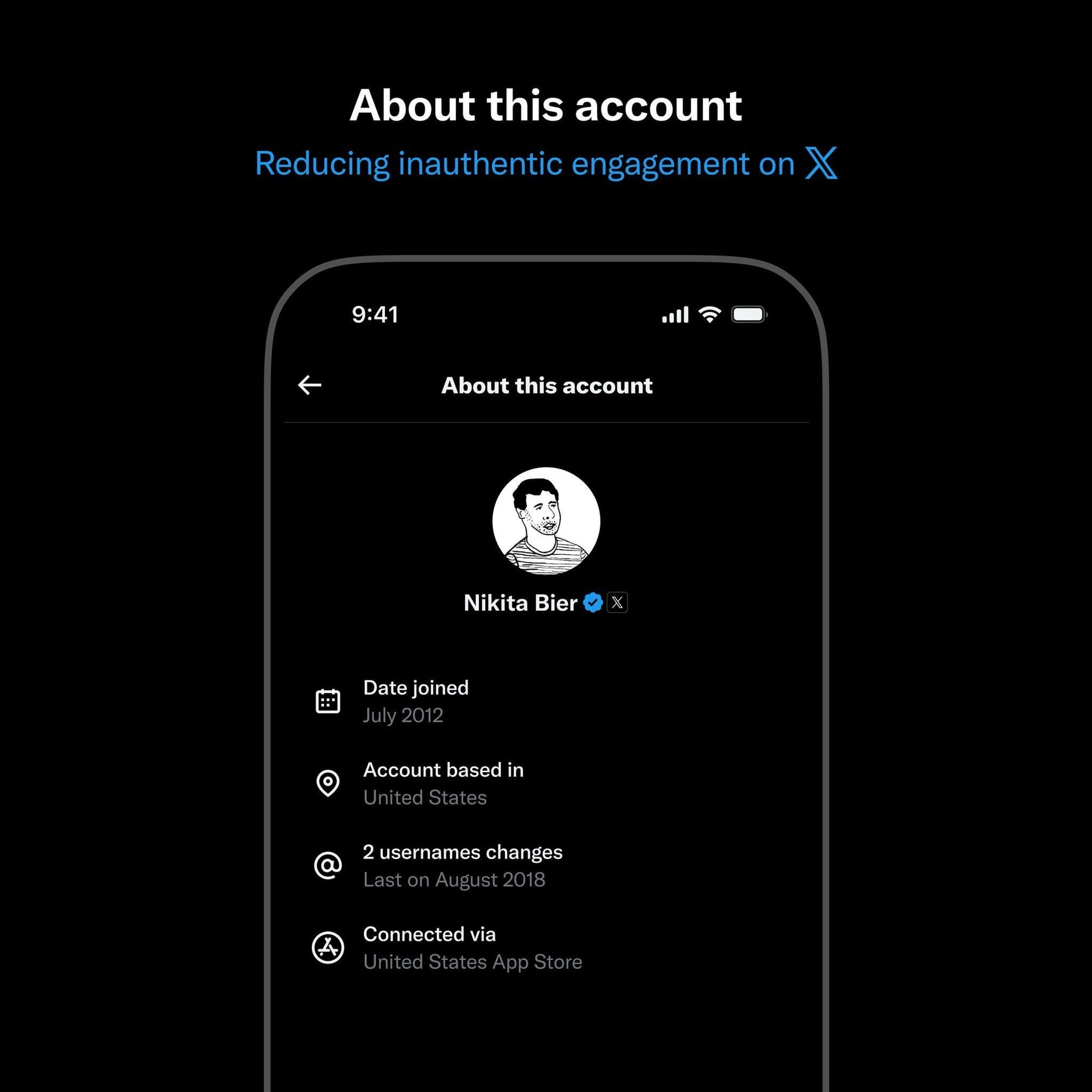
The new panel lives behind a simple tap on the “Joined” date, but the information it reveals is anything but subtle. You can now see where an account is based, how many times the username has changed, the original join date, and even how the user downloaded the app. It’s a small window into a question people silently ask every day on X: “Who am I really talking to?”
It’s not hard to see the motivation. Bots no longer look like bots. AI-assisted campaigns can mimic fluency, tone, and timing in ways that blur the line between genuine engagement and manufactured noise. For X, which has long promised to be the town square of the internet, this erosion of authenticity undermines the whole premise. The new identity panel is the platform’s way of nudging people back toward trust, not by policing speech, but by revealing the history behind the account's speaking.
Before now, X’s head of product, Nikita Bier, had teased the idea in October, testing it on employee accounts before releasing it into the wild. The thinking was straightforward: if people could see small but telling details, an account claiming to be in Florida but registered overseas, or a profile that has cycled through five usernames in two months, they could make more informed judgments about who they’re engaging with. It’s transparency as a defensive tool.
The feature is appearing gradually, and people are spotting it at different times. At the moment, you can view your own data by tapping your “Joined” date. That opens a page with all the key profile signals. You can even decide whether the profile shows your country or just a broader region, a setting designed originally for places where identifying information could carry risks.

There’s also something brewing in the background. A reverse engineer recently surfaced code suggesting that X may eventually display a warning if an account is using a VPN to mask its location. Nothing has launched yet, but the logic fits the same transparency arc.
Instagram has had a similar transparency feature for years. What’s different now is the environment. Social platforms are competing not just on features but on trust, a commodity that becomes harder to maintain as AI-generated behaviour grows more convincing.
Since X has now rolled this out globally, with accuracy checks in place and room to add more context over time, it could signal a shift in how social platforms handle identity in an era where anyone, or any system, can sound convincingly human.
 Emmanuel Umahi