



The hydrogen economy is no longer a future promise — it is a present reality. Electrolyzers, battery storage systems, and fuel cell truck refueling stations are scaling rapidly across the United States. But as hydrogen infrastructure grows, so does the urgency of one foundational challenge: gas detection.
Hydrogen is invisible, odorless, and lighter than air. It pools in roof peaks and structural voids where detectors are rarely placed, and its ignition threshold is low enough that a static spark suffices. By the time a poorly positioned sensor triggers, the window for safe intervention may already be closed.
Sensor Technologies: What Each One Can and Cannot Do
No sensor technology suits every hydrogen application — each trades off range, selectivity, durability, and cost differently, and the wrong choice can leave dangerous gaps in your safety net.
Key Decision Insights for 2026:
- Most facilities benefit from layered detection: Use Electrochemical sensors for sensitive ppm-level early warning (e.g., 500–1,000 ppm to trigger ventilation and alarms), combined with Catalytic Bead sensors as the %LEL safety interlock for explosion prevention. This combination is widely adopted because it balances early detection with reliable LEL monitoring.
- Electrochemical sensors excel at trace leak detection in BESS and electrolyzer applications, offering low-concentration sensitivity, fast response via pump suction sampling, built-in alarms, and reliable signal output — making them practical for both fixed monitoring and portable spot-checking.
- Catalytic bead sensors remain a cost-effective workhorse for indoor LEL monitoring, though they require regular calibration and protection from silicone-based lubricants and sealants common during commissioning.
- Optical and ultrasonic sensors can provide supplemental protection for high-consequence outdoor or complex installations where budget and risk assessment permit. That said, many U.S. hydrogen facilities achieve excellent safety results with proven electrochemical fixed detectors paired with portable units — a practical and cost-effective strategy for most applications.
Practical Tip:
Clearly define your primary goal — early leak detection (ppm) for operational safety and maintenance, or explosion prevention (%LEL) for regulatory compliance and emergency shutdown. A practical and widely used approach is combining fixed hydrogen gas detectors for 24/7 continuous monitoring with portable hydrogen gas detectors for technician use during commissioning, routine inspections, and confined space entry.
What to Clarify Before You Buy
Before finalizing any hydrogen gas detector purchase, a few decisions need to be made on your side first.
- Know whether you need ppm, %LEL, or both. In a BESS enclosure, thermal runaway starts with trace off-gassing — CO and H₂ at concentrations far too low for a combustible gas detector to catch. A ppm-level hydrogen gas detector gives you the early warning; the LEL detector serves as the final hardwired interlock. Most serious hydrogen facilities need both layers, and knowing which one you are buying before you start shopping avoids a costly mismatch later.
- Understand your chemical environment, not just your target gas. Paints, cleaning solvents, and silicone-based lubricants are common in commissioning and maintenance routines. Some electrochemical detectors react to these compounds and generate false alarms — and repeated false alarms are how safety systems get quietly disabled. Knowing what else is in the air at your site, and matching detector selectivity to that environment, is something only you can determine before purchase.
- Map your integration requirements before selecting hardware. A hydrogen gas detector that cannot communicate with your SCADA or safety PLC will need a signal converter — adding cost and a new failure point. Confirm the output protocol your control system actually needs (4–20 mA, Modbus RTU, HART, or relay) and verify UL/CSA or IEC 60079-29-1 certification for hydrogen service. These are your non-negotiables; everything else is comparison shopping.
- Factor in access and maintenance cost, not just unit price. If your detectors are spread across multiple outdoor HRS or BESS sites, quarterly calibration runs mean real travel costs, year after year. A unit with longer calibration intervals or self-diagnostic capability often pays back the price premium within two to three years. Know your site geography and maintenance budget before the purchase decision, not after.
Matching Detection Strategy to Your Application
Green Hydrogen Electrolyzers
Hydrogen is produced continuously here, often in poorly ventilated spaces. Detection must address both chronic low-level leaks and sudden releases: electrochemical detectors for ppm-level early warning (alarm at 500–1,000 ppm to trigger ventilation), backed by catalytic bead sensors as the %LEL backstop (20% LEL warning, 40% LEL for ESD). Mount hydrogen gas detectors high on walls or in ceiling plenum returns near major leak points.
Battery Energy Storage Systems (BESS)
Hydrogen is not stored in BESS — it is released when lithium-ion cells enter thermal runaway. Electrochemical detectors are best here for their trace-level sensitivity; connect outputs directly to ventilation and suppression systems. Portable units are also valuable during technician inspections.
Hydrogen Refueling Stations (HRS)
High pressure, outdoor exposure, and public access make HRS the most demanding deployment. Use fixed electrochemical hydrogen gas detectors at canopy level (1,000 ppm warning, 20% LEL action) supplemented by portable explosion-proof units for maintenance. Ultrasonic and flame detectors can add protection in high-risk zones, but many facilities perform reliably with electrochemical systems alone. Wind dispersion makes placement critical — CFD modeling is recommended.
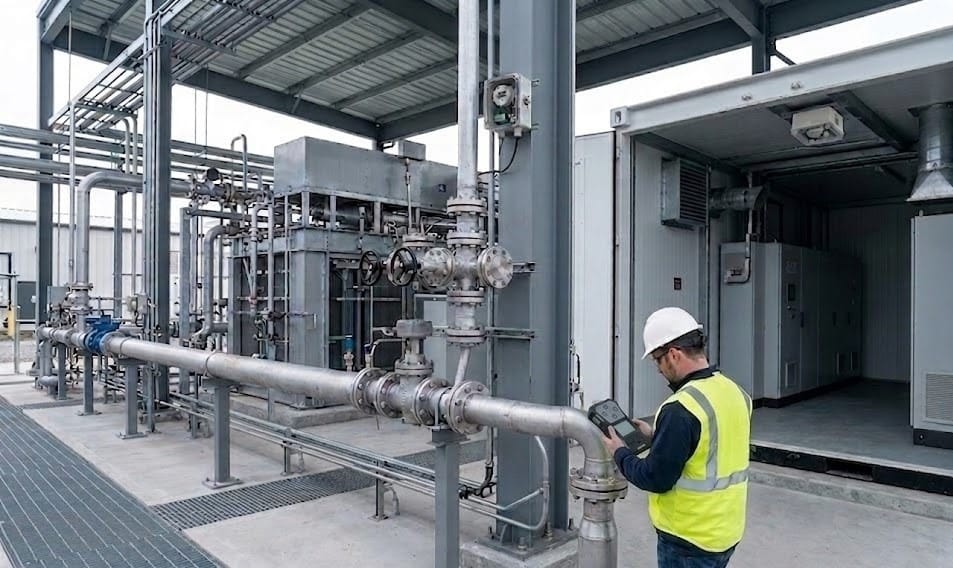
Detector Placement: The Decisions That Matter Most
Even the best hydrogen gas detector fails if mounted incorrectly. Drawing on our deployment experience across U.S. infrastructure, the Gas Dog field team emphasizes that hydrogen’s strong buoyancy requires a strategic balance between high-point placement, airflow patterns, and localized dead zones.
Practical Placement Guidelines:
- Position detectors 1 to 3 feet (30–90 cm) below the ceiling or roof peak to avoid extreme turbulence right at the surface while still catching rising hydrogen.
- Place them near likely leak points (flanges, valves, pressure relief devices, hose connections) but not directly in strong HVAC airflow paths.
- Avoid mounting behind beams, ducts, or equipment that could create gas pockets unreachable by the detector.
- For complex or high-consequence areas (electrolyzers, BESS containers, HRS canopies), commission CFD (Computational Fluid Dynamics) modeling during design phase. The investment typically pays off by optimizing detector quantity and location.
- In mechanically ventilated enclosures, target locations where expected hydrogen concentration stays between 1,000 ppm and 10,000 ppm during a small leak scenario.
When designing the overall system, referencing NFPA 2 (2026) guidance on hydrogen detection helps ensure consistent performance across indoor and outdoor installations.
Conclusion
A single serious incident can set back public confidence, trigger regulatory scrutiny, and slow the broader energy transition. Reliable hydrogen gas detection is what prevents that — not a line item to optimize away, but a strategic investment that pays for itself many times over, in incidents that never happen.


