- Alphabet crushed Q4 earnings expectations with $113.8 billion in revenue, an 18% jump from the prior year.
- Google Cloud drove significant growth with a 48% revenue jump and a massive $240 billion backlog for AI infrastructure and services.
- Alphabet is doubling down on AI infrastructure spending with a planned $175 to $185 billion capital expenditure in 2026 to meet "exceptionally strong" demand.
Alphabet delivered a knockout fourth quarter, crushing earnings expectations with $113.8 billion in revenue, an 18% jump from the prior year. But investors weren’t celebrating. Shares fell 2.5% after hours as CEO Sundar Pichai revealed the company plans to spend up to $185 billion on infrastructure in 2026, nearly double what it invested in 2025.
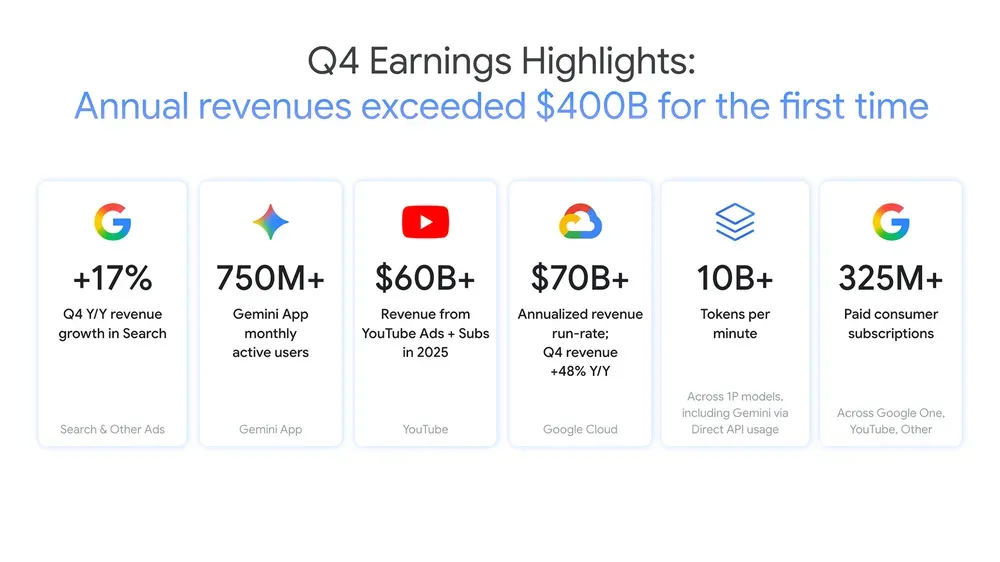
For the full year, Alphabet topped $400 billion in revenue for the first time. Net income climbed 30% to $34.5 billion, while earnings per share hit $2.82, beating analyst estimates of $2.63. Yet the real story wasn’t what Alphabet earned—it was what the company intends to spend.
“We expect the demand we are seeing across the board, across our services, what we need to invest for future work for Google DeepMind, as well as for Cloud, I think is exceptionally strong,” Pichai said during the earnings call. “And so I do expect to go through the year in a supply-constrained way.”
MORE INSIGHTS ON THIS TOPIC:
- Alphabet Q3 2025 Earnings Beat Expectations as Cloud
- Google's parent company Alphabet joins the $3 trillion valuation club
- Alphabet beats revenue expectations in Q2 2025, raises the stakes with massive AI investment plan
Google Cloud Drives Growth with $240 Billion Backlog
Google Cloud stole the show. Revenue jumped 48% to $17.7 billion, putting the division on track to exceed $70 billion annually. But the forward-looking metrics matter more. Cloud backlog surged to $240 billion, up 55% from the previous quarter and more than double year-ago levels.
That backlog represents enterprise customers locking in long-term contracts for AI infrastructure and services. Operating income more than doubled to $5.3 billion, and operating margin expanded from 17.5% a year ago to 30.1% in Q4. CFO Anat Ashkenazi noted the company has been “supply-constrained” even while rapidly expanding capacity, and expects that constraint to persist through 2026.
The numbers behind the AI surge are striking. Gemini, Alphabet’s flagship AI model, now processes over 10 billion tokens per minute through its API, up from 7 billion last quarter. The Gemini app reached 750 million monthly active users, adding 100 million users in Q4 alone.
In December 2025, nearly 350 Cloud customers each processed more than 100 billion tokens, roughly equivalent to 75 million pages of text per customer. Alphabet sold over 8 million paid seats of Gemini Enterprise to more than 2,800 companies, including Airbus and Honeywell.
Revenue from products built on generative AI models grew nearly 400% year-over-year in Q4. Pichai said the company “lowered Gemini serving unit costs by 78% over 2025 through model optimisations, efficiency and utilisation improvements.”
The combination of explosive revenue growth paired with dramatically falling costs explains why Alphabet is willing to double down on infrastructure spending.
Apple Taps Google as Preferred Cloud Provider
During the call, both Pichai and Chief Business Officer Philipp Schindler referenced the Apple partnership announced in January. “We are collaborating with Apple as their preferred cloud provider and to develop the next generation of Apple Foundation Models, based on Gemini technology,” Pichai said.
The multi-year collaboration positions Alphabet deeper inside Apple’s ecosystem and validates Google’s AI infrastructure at the highest level. Apple plans to use the partnership to power future Apple Intelligence features, including a more personalised Siri coming this year.
YouTube Misses Expectations, but Subscriptions Climb
YouTube advertising revenue came in at $11.38 billion, up 9% but below analyst expectations of $11.84 billion. Ashkenazi attributed part of the miss to lapping strong U.S. election spending from Q4 2024, which created a tough comparison.
Still, YouTube’s combined ads and subscriptions revenue surpassed $60 billion for the full year. Across all consumer services, Alphabet now has over 325 million paid subscriptions.
Search and Other advertising revenue grew 17% to $63.1 billion, with retail showing particularly strong performance. The results suggest Alphabet’s core advertising business remains healthy even as the company pivots toward AI-powered products.
The $185 Billion Question
Alphabet’s planned capital expenditure of $175 billion to $185 billion in 2026 dwarfs what competitors spent in recent years. To put it in perspective, it exceeds what Meta, Amazon, and Microsoft each spent on capital expenditures in their entire 2024 fiscal year.
The investment will flow primarily into AI infrastructure: data centres, servers, and networking equipment needed to power Google Cloud, Gemini models, and enterprise AI products. Pichai made it clear this isn’t optional spending—it’s necessary to meet existing demand.
 Ogbonda Chivumnovu