The American software leader, AMD arrived at CES 2026 with hardware built for scale—7,000-pound server racks, chips with 320 billion transistors, and a development platform that runs 200-billion-parameter models in your hand.
CEO Lisa Su opened the conference's keynote on Monday, January 5 in Las Vegas with a clear message: the world needs 10 yottaflops of compute by 2030. That's 10,000 times what existed in 2022. AMD's announcements span data centres, consumer PCs, and everything in between.
Here is every major update that AMD announced at CES 2026:
Helios
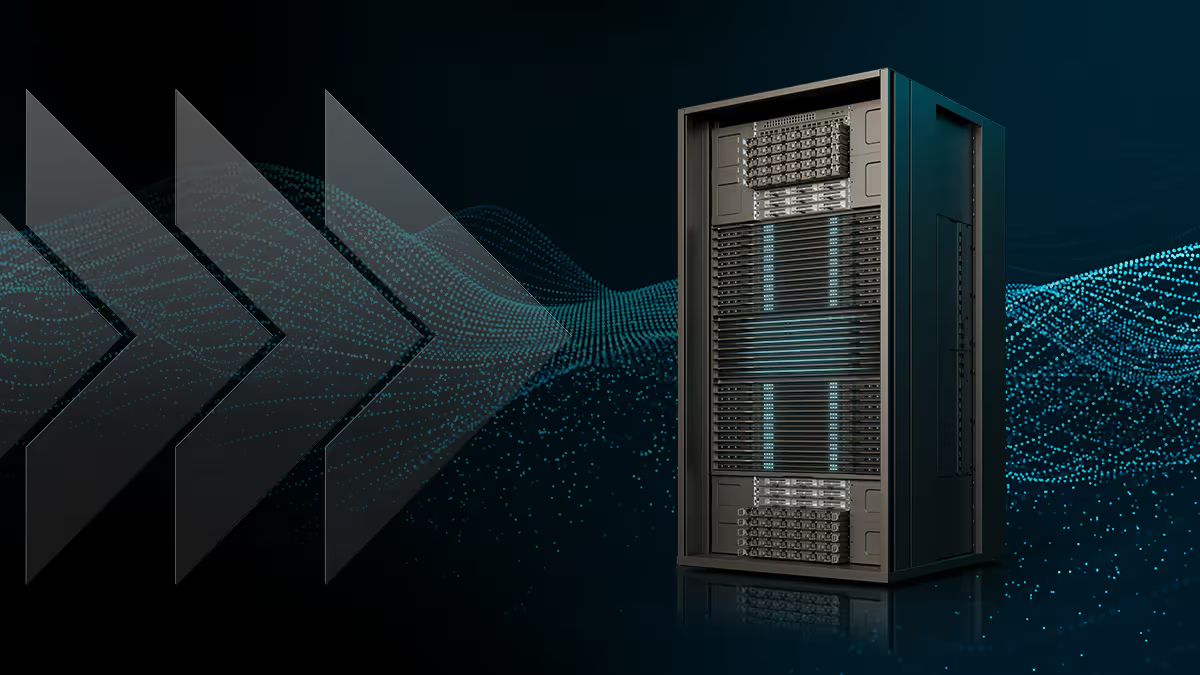
The Helios platform is a double-wide design that weighs nearly 7,000 pounds—literally as much as two compact cars. But the weight isn’t just for show. Inside, you’ll find 72 Instinct MI455X-series accelerators (these are specialized chips designed specifically for AI calculations), 31 terabytes of HBM4 memory (that’s ultra-fast memory that sits right next to the processors for quick access), along with 4,600 CPU cores and 18,000 GPU compute units.
What does all that hardware actually deliver? Up to 2.9 exaflops for AI inference and 1.4 exaflops for AI training. This means Helios can train massive AI models faster and run them for millions of users simultaneously. The rack is entirely liquid-cooled because traditional air cooling wouldn’t be able to handle the heat from all that processing power.
It’s built on the Open Rack Wide standard that AMD developed with Meta and designed to handle trillion-parameter AI models—those are the really large language models like GPT-4 or Claude that can understand and generate human-like text. Helios launches later this year.
Instinct MI455X
The star of the Helios show is the MI455X GPU. Built on 2nm and 3nm processes, it packs 320 billion transistors and 432GB of HBM4 memory. Four of these GPUs sit in each compute tray, driven by AMD's new Venice EPYC CPU.
AMD claims the MI455X delivers up to 10 times the performance of the MI355X that launched just six months ago. That's a huge leap in a short time.
But AMD didn't stop with the MI455X. They also announced:
- MI440X: Designed for enterprise deployments in standard 8-GPU servers
- MI430X: Built for super computing with support for traditional high-performance computing tasks
- MI500 series preview: Coming in 2027, built on CDNA 6 architecture with 2nm process technology and HBM4E memory, promising up to a 1,000x increase in AI performance compared to the MI300X GPUs introduced in 2023
Ryzen AI 400 Series
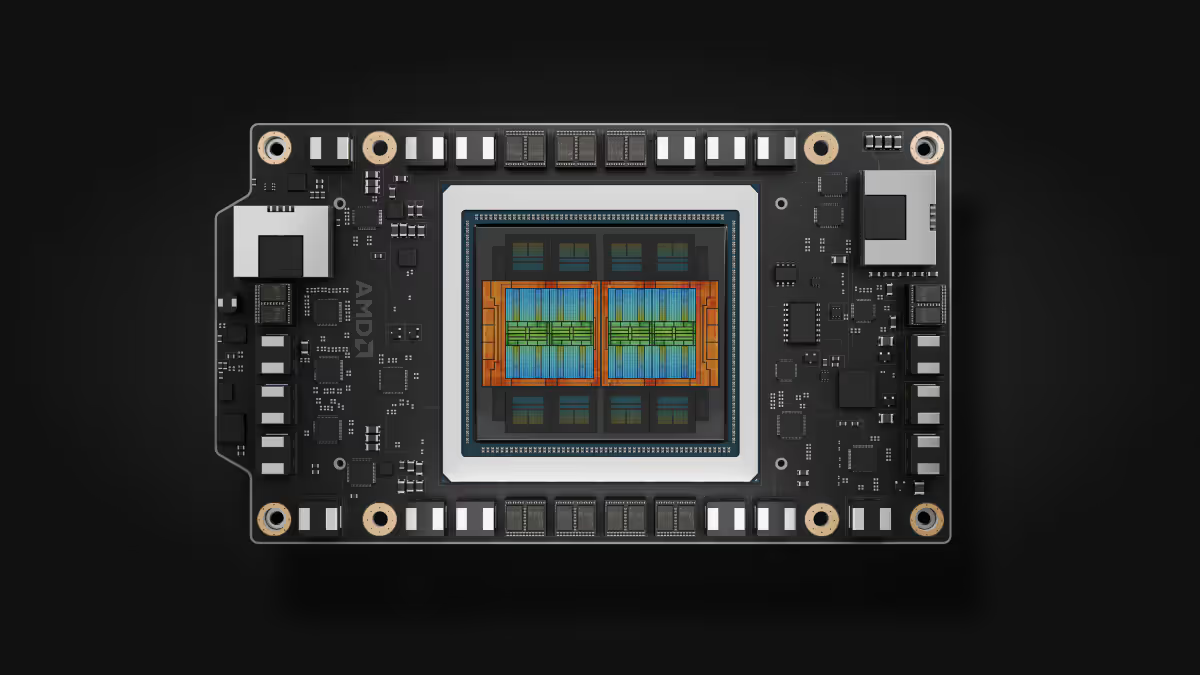
AMD didn't forget about the rest of us. They launched the Ryzen AI 400 series processors with up to 12 Zen 5 CPU cores and an NPU (neural processing unit—a specialized chip just for AI tasks) delivering 60 TOPS. TOPS stands for "trillions of operations per second" and measures how fast the chip can handle AI calculations.
What does 60 TOPS actually mean for you? It means your laptop can run AI features locally—things like real-time video background removal, voice transcription, or AI photo editing—without sending your data to the cloud. Everything happens on your device, which is faster and more private.
These chips ship this month in over 120 laptops and desktops from every major manufacturer, so if you're in the market for a new computer, you'll have plenty of options.
For desktop gamers, AMD announced the Ryzen 7 9850X3D with 104MB of combined cache memory using 3D V-Cache technology (basically extra memory stacked on top of the processor for faster game performance). It can reach speeds up to 5.6GHz, though AMD told press to expect around 2–3% improvement over the already excellent 9800X3D.
Ryzen AI Halo
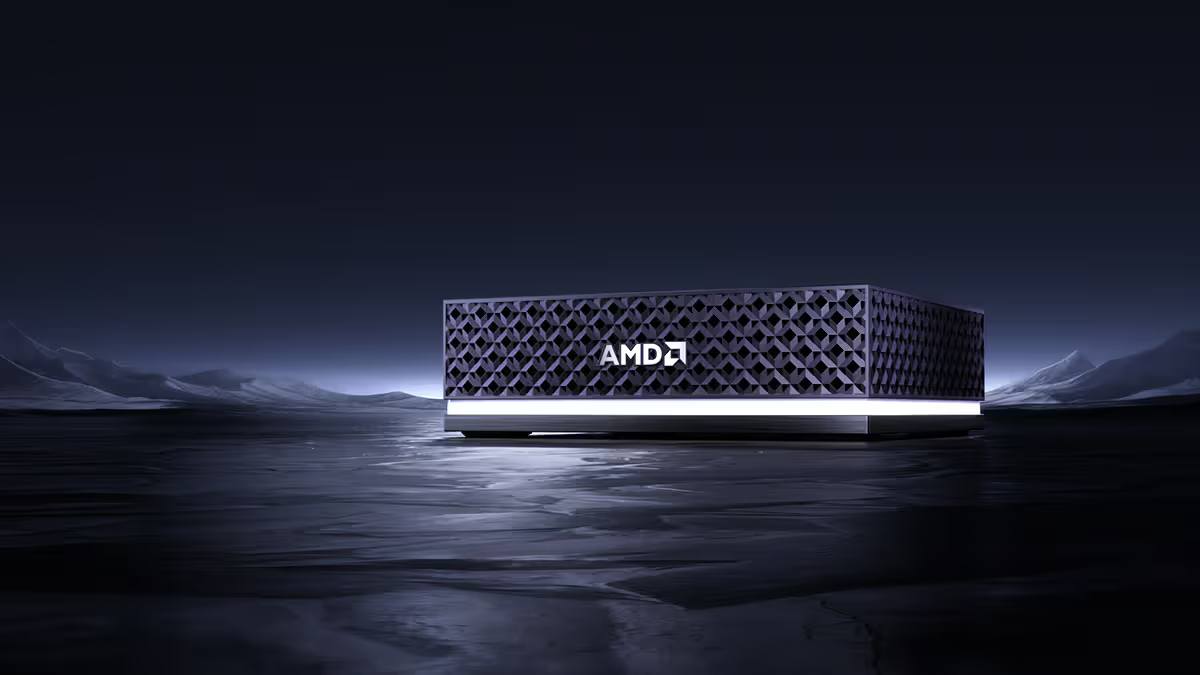
Here's something that actually grabbed attention: Ryzen AI Halo, a compact mini-PC that can run AI models with up to 200 billion parameters locally. Parameters are essentially the "knowledge" an AI model has—the more parameters, the more capable the model. For reference, GPT-3.5 has 175 billion parameters.
Think about that for a second—models that would normally require massive cloud infrastructure and server farms, running on a device you can hold in one hand.
Built with Ryzen AI Max processors, Halo features up to 128GB of unified memory (meaning the CPU, GPU, and NPU all share the same pool of memory for faster data access), up to 60 teraflops of graphics performance, and support for both Windows and Linux. It ships preloaded with AMD's ROCm software stack and hundreds of AI models, so developers can start building immediately without spending days on setup.
It launches in the second quarter of 2026. Pricing hasn't been announced yet, but AMD is positioning this as an affordable alternative to enterprise AI development systems.
EPYC Venice
Su showed the next-generation EPYC "Venice" CPU for the first time. Built on 2nm process technology with up to 256 Zen 6 cores, Venice doubles memory and GPU bandwidth from the previous generation to feed MI455X GPUs at full speed even at rack scale.
Partnership Announcements Across AI Workloads
To prove Helios isn't just a fancy prototype, OpenAI president Greg Brockman joined Su on stage to discuss their partnership. OpenAI announced a 6-gigawatt infrastructure deal with AMD back in October 2025. For perspective, a gigawatt is enough electricity to power about 700,000 homes, so this is a massive deployment.
The first 1-gigawatt deployment of MI450 series GPUs begins in the second half of 2026. When one of the biggest AI companies in the world is putting billions behind your hardware, you know it's not just hype.
AMD also brought several partners on stage to show where their hardware is actually being used:
- Luma AI now runs 60% of its video generation inference on AMD hardware. Luma AI is the company behind Dream Machine, a tool that creates video clips from text descriptions.
- Liquid AI announced LFM 2.5, a 1.2-billion-parameter model that delivers instruction-following capabilities better than some larger models, and previewed LFM3 for real-time audiovisual interaction coming later in 2026. This means AI that can simultaneously process what you're saying, what it's seeing through a camera, and respond naturally—all happening in real time.
- World Labs, led by AI researcher Fei-Fei Li, demonstrated spatial intelligence models turning images into navigable 3D environments in real time. Imagine taking a photo of a room and being able to "walk through" that room in 3D on your screen.
- In healthcare, AMD powers drug discovery at Absci and AstraZeneca (where AI helps predict which drug compounds might work), genomics research at Illumina (analyzing DNA sequences), and even Blue Origin's lunar lander flight computers.
AI Education Initiatives
AMD announced a $150 million commitment to AI education initiatives. During the keynote, three high school students were awarded $20,000 educational grants each for building an AI robotic barista during AMD's hackathon with Hack Club.
 Ogbonda Chivumnovu