



An artist can imagine in detail what they would like a small wooden chair to look like. But designing and producing a 3D model of this requires both time and expertise.
Tools such as Meshy, Tripo AI, Luma Genie, and Rodin are AI-based systems which can design 3D models based on text and/or image inputs, and many can also apply AI-assisted texturing and automatically rig models. Again, in addition to the fast production of models, the key benefit comes from their ability to design for use.
What Makes AI 3D Generators Different from Traditional 3D Modelling?
Traditionally, 3D models can be designed, manipulated, and textured. Despite the high level of design freedom that programmes like Blender provide, skills in this area still need to be developed.
AI generators are also an alternative design tool which utilise AI to generate 3D models either from text or image sources. This therefore allows even those with little or no expertise in 3D modelling to test out this technology. No single tool suits everyone, as the right choice depends on the project.
Most of these tools offer a basic version, which often includes monthly credits. However, there are usually some functionality restrictions.
Various tools exist for 3D AI generation:
- Meshy AI –Specializes in text-to-3D and image-to-3D, with AI texturing and auto-rigging. It exports to many file types, useful for games and 3D printing.
- Tripo AI –Specializes in text-to-3D and single/multi-image to 3D. It has good quad/mesh output ideal for games and for fast asset development.
- Luma Genie –Specializes in text-led 3D generation and provides browser viewability of generated objects so that users can review and develop ideas and for building simple environments.
- Rodin (Hyper3D) –Specializes in high-fidelity output with good mesh topology. This is often used within character design and production.
From Words and Pictures to Three-Dimensional Models
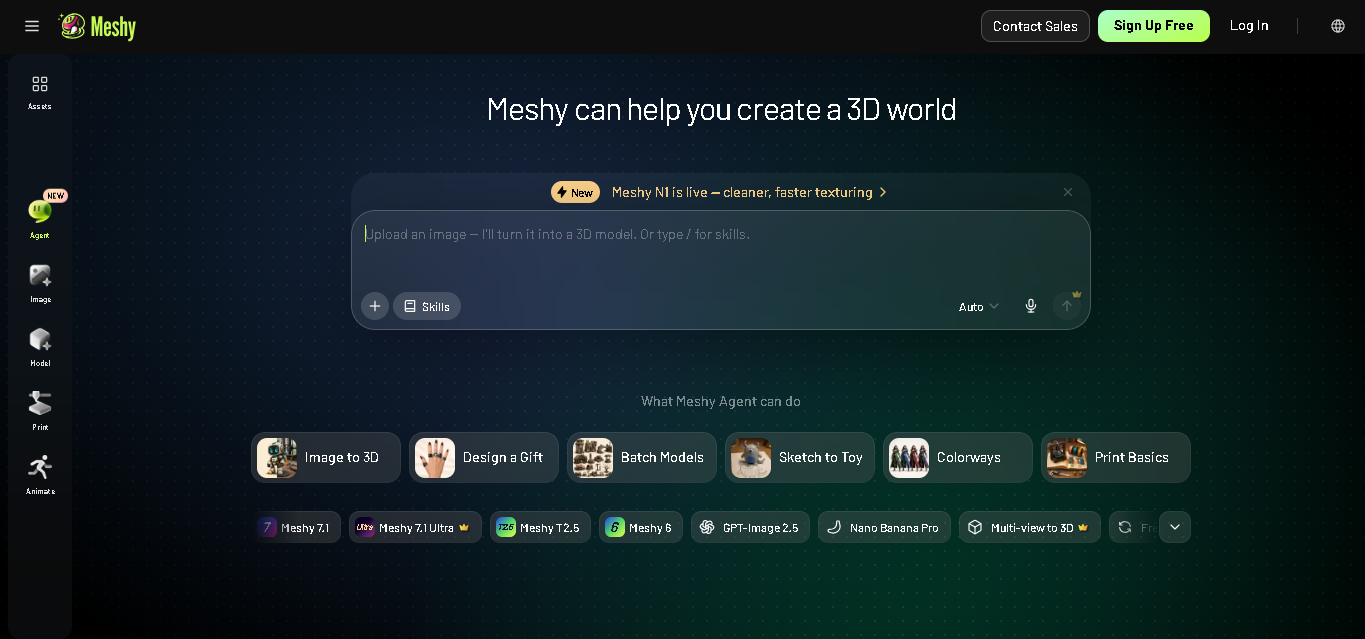
These tools have an adaptable method for producing 3D models. A user can both type and/or upload an image to utilize.
Creating Models with Text to 3D
Users type a basic text-based instruction that tells the tool what they would like it to produce in 3D format.
For instance, a student may wish to design a sci-fi scene and so ask for a futuristic power source, specifying that it should have a round base, metal body, with blue lights, and an industrial style.
Usually, more specific instructions will lead to a more accurate outcome compared to generalized ones such as "create a futuristic machine."
Creating 3D Objects from Reference Images
These tools enable people to add images and then create 3D models based upon them.
For example, someone could design a desk lamp including a curved base and round light shade. This image could then be used to demonstrate the design, and would not necessarily need to come with a detailed description.
Alongside adding individual images, some tools, such as Meshy and Tripo AI, also allow several images to be inputted, and this can further inform a model’s geometry.
AI Texturing and Auto-Rigging
Although forming the base is an aspect of 3D design, AI texturing features enable someone to add material and further detail to create realistic wood, metal, rock, and/or cloth-like items.
Furthermore, auto-rigging, available on some platforms, is a further function which facilitates setting up 3D figures for animation purposes.
Where AI-Generated 3D Models Can Be Used
Game Development and Prototyping
Game creators often require a wide range of items such as furniture, structures, transport, and adornment. Artificial intelligence can create basic versions of these, which can then be used within a game world.
3D Printing and Education
Many tools can export to file types including STL and 3MF – both beneficial in 3D printing. Teachers may then analyse a model for issues relating to size, wall depth and shape. Manufactured artifacts can also be utilised by teachers to illustrate shape and structure.
Product Concepts and Digital Design
Product design can be done in order for an individual to investigate a product’s shape and style.
Export Options for Different Uses
Creating every model from scratch is not always necessary. Meshy also provides a community library where users can explore existing digital assets.
This can be a great resource to free 3D model library and also help to spark design ideas.
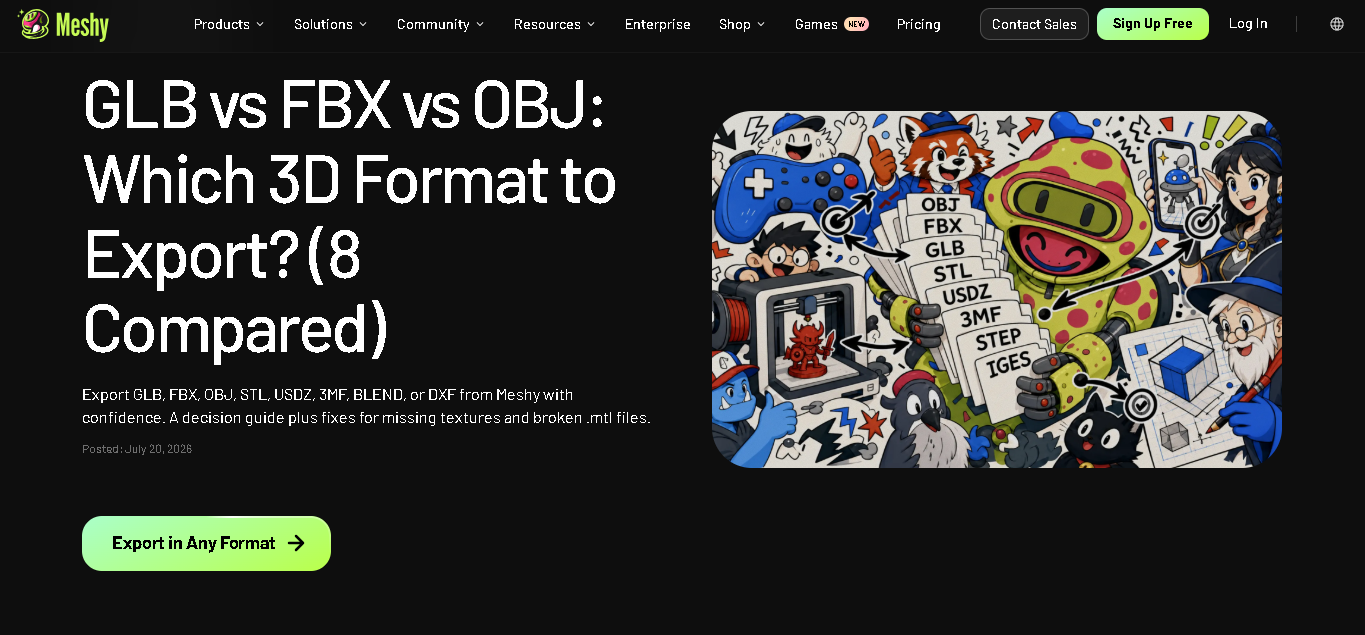
As mentioned, these tools can also export in various file types for differing uses:
- GLB and GLTF: Useful for web-based 3D experiences.
- FBX: Commonly used in animation and game development.
- OBJ: Widely supported for exchanging 3D geometry.
- STL: Commonly used in 3D printing.
- 3MF: Supports additional information for printing workflows.
- USDZ: Used in compatible augmented-reality applications.
Further to this, a web browser interface is often available to convert, view, and fix models.
Frequently Asked Questions
- Can I use AI 3D generators without knowledge of 3D modelling?
Yes. Models can be created using text and/or image prompts. Manual modelling is not necessary.
2. Are there free AI 3D generator options?
Yes. Many tools offer a free tier with a set number of credits per month, but with download and functionality restrictions.
3. Can these tools convert images into 3D?
Yes. The ‘Image-to-3D’ functionality enables these tools to create 3D objects based on images. Furthermore, some platforms offer APIs which allow for batch image processing.
4. What file types can be exported?
Depending on the tool, common formats include those listed above.
5. Can these tools be embedded into software?
Yes. APIs are available for allowed creation and manipulation features on several platforms by using a qualifying paid plan.
A Practical Way to Get Started with AI-Powered 3D Modelling
As artificial intelligence is becoming increasingly involved within the 3D design industry, there are still areas which may require significant human involvement – such as complex character design, product design and even game asset design.
Tools such as Meshy, Tripo AI, Luma Genie and Rodin allow users to combine key areas of the 3D design journey. They include text and image generation, artificial intelligence-based texturing, auto-rigging, and exporting.