



Samsung’s latest Samsung Galaxy Unpacked wasn’t just about new smartphones. Alongside the usual flagship phone announcements, the company also introduced two new wireless earbuds, with the Samsung Galaxy Buds4 Pro positioned as its most premium in-ear option yet.
But Samsung isn’t alone in refreshing its audio lineup this year. 2026 is already shaping up to be a competitive year for high-end wireless earbuds, with Sony unveiling the Sony WF-1000XM6 as the latest entry in its long-running 1000X series.
Both models promise smarter noise cancellation, richer sound quality, and tighter ecosystem integration. The real question, though, is what those improvements actually mean in daily use, and which pair makes more sense depending on how (and where) you listen.
Let’s break it down by category.
1) Noise Cancellation and Everyday Isolation
Noise cancellation is often the deciding factor in this price range, and both earbuds take it seriously, though in slightly different ways.
Sony says the WF-1000XM6 improves noise cancelling by about 25% over its predecessor, with a particular focus on mid-to-high frequency sounds. That matters because that is the kind of noise you typically hear in cafés, offices, or public transport: chatter, clinking cups, and engine hum.
The earbuds use multiple microphones, a dedicated noise-cancelling processor (QN3e), and adaptive optimisation that adjusts in real time depending on how they sit in your ears. Sony also puts a lot of emphasis on the ear tip seal, since a better physical fit directly improves isolation.
Samsung’s Galaxy Buds4 Pro, meanwhile, features Adaptive Active Noise Cancellation 2.0 and adaptive noise control. Instead of focusing heavily on hardware processors in its messaging, Samsung leans into intelligent audio adjustments, automatically balancing ANC and ambient sound depending on your environment.
In practice, that means the buds can decide when to let some sound in, rather than blocking everything out.
2) Sound Quality and Audio Processing
Both earbuds aim for high-resolution audio, but they approach it differently.
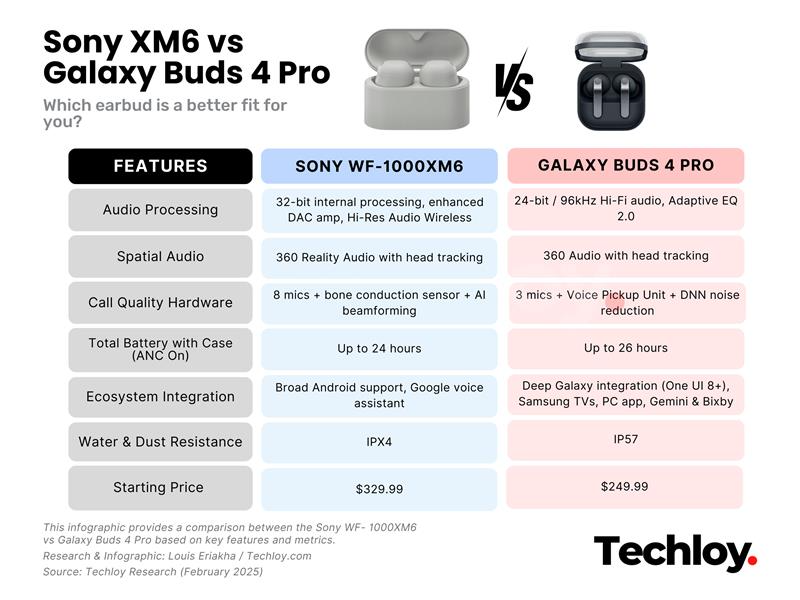
Sony uses dual processors, 32-bit internal processing, and a newly designed driver unit that separates dome and edge materials for better bass depth and clearer highs. It also supports Hi-Res Audio Wireless, DSEE Extreme upscaling, and a 10-band EQ through Sony’s companion app. This suggests a strong focus on detailed tuning and giving users control over their sound profile.
Samsung lists 24-bit / 96kHz Hi-Fi playback, a 2-way speaker system with a dedicated woofer and tweeter, and features like Adaptive EQ 2.0 and 360 Audio with head tracking. The split driver design mirrors what you’d find in larger headphones — one driver for bass, another for treble — which can create better separation in theory.
3) Call Quality and Microphones
Call clarity is another area where both brands compete aggressively.
Sony equips each earbud with 4 microphones and a bone conduction sensor to better isolate your voice. An AI beamforming algorithm focuses specifically on capturing speech even in noisy surroundings. That combination, mics plus bone conduction, is meant to ensure your voice cuts through background chatter.
Samsung uses three microphones per earbud alongside a Voice Pickup Unit and DNN-based noise reduction. It also advertises Super Wideband Call (16kHz), which can improve clarity when supported.
4) Battery Life and Charging
Battery life is where the numbers start to diverge more clearly.
Sony rates the WF-1000XM6 at up to 8 hours on a single charge with ANC on, and up to 24 hours with the case. That’s solid for everyday use, and wireless charging is supported via Qi.
Samsung’s Galaxy Buds4 Pro lists 6 hours with ANC on (7 hours off), and up to 26 hours total with the case when ANC is enabled. The case itself has a larger battery capacity than Sony’s, which explains the slightly longer total runtime.
5) Connectivity, Compatibility and Ecosystem
Both earbuds are ready for LE Audio and next-generation Bluetooth standards, though Samsung lists Bluetooth 6.1 support. Sony mentions larger antennas and improved connection reliability over its previous model.
Where they differ most is ecosystem depth. Samsung tightly integrates with Galaxy phones running One UI 8 or later, Galaxy Wearable app features, Samsung TVs, and PC apps. It also supports seamless multi-device switching and works with Gemini and Bixby.
6) Design, Comfort and Durability
Sony says the WF-1000XM6 is slimmer than its predecessor and redesigned to follow the natural curves of the ear. It also includes newly designed ear tips aimed at improving seal and comfort during long listening sessions, and an IPX4 rating.
Samsung’s Galaxy Buds 4 Pro carries an IP57 rating, meaning it’s protected against dust and can survive temporary water immersion. Sony’s provided details here focus more on comfort.
So Which One Should You Pick?
If you already live in the Samsung ecosystem and want something a bit more durable, compatible with your devices, the Galaxy Buds 4 Pro are probably the ones for you.
The Sony WF-1000XM6, on the other hand (I still sorely despise the Sony naming scheme), is great for those who don't mind splurging a bit more for better noise cancellation and the ability to tune their sound a bit more.
Nevertheless, both are premium earbuds built around intelligent audio processing and high-end sound. The better choice ultimately depends less on raw specs and more on how, and where, you plan to use them.


