



Last Tuesday I asked ChatGPT for a quick update to send my team. Four paragraphs came back. I read them, thought "fine, it's all true", and sent exactly none of it.
Why? It sounded like someone else. Someone polite and slightly nervous who has never once said no in a meeting. Not me. (I say no a lot.) My manager would have read it and wondered if I was ill.
So I rewrote it by hand, and that rewrite taught me more than the prompt ever did. This is what I've pieced together since: how to take an AI-assisted draft and end up with something your colleagues would swear you wrote.
Why AI drafts sound "off"
It's the sameness. Every sentence is about eighteen words long. Every paragraph has three points. Nothing is rude, nothing is funny, and nobody is ever wrong. The examples are "a growing startup" or "a busy professional", people you've never met and wouldn't much want to.
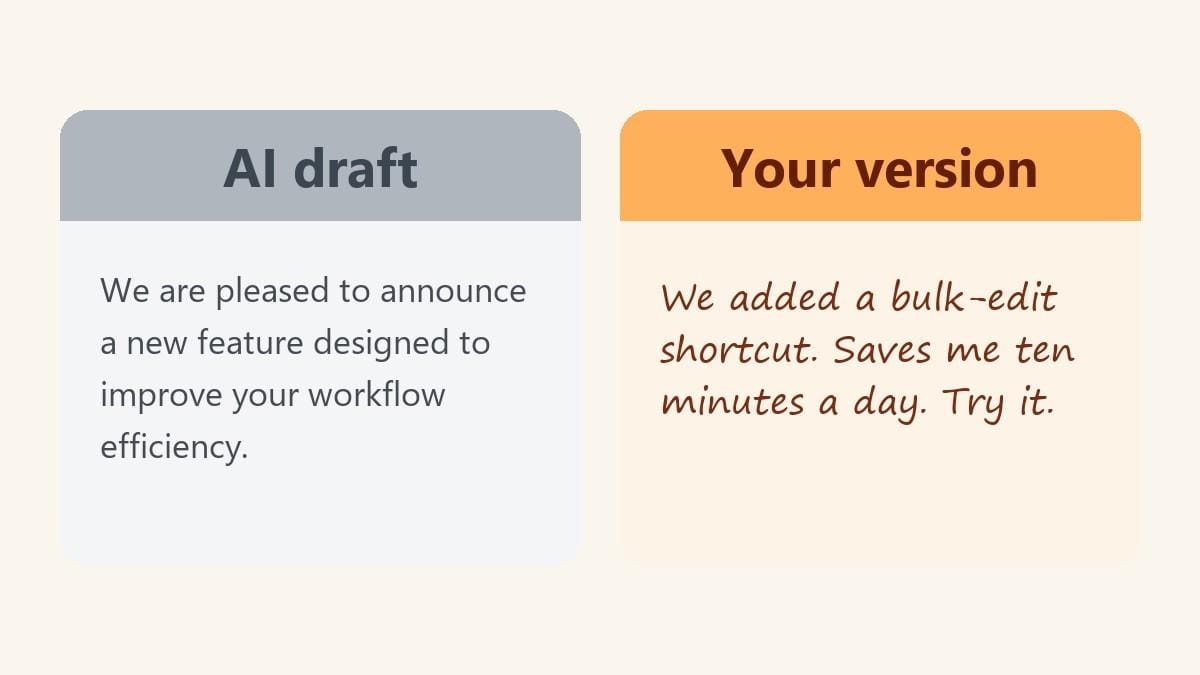
Here's one from a product update. The draft said: "We are pleased to announce a new feature designed to improve your workflow efficiency." Mine said: "We added a bulk-edit shortcut. Saves me ten minutes a day. Try it."
Same news. The first reads like four people approved it. The second reads like I typed it.
Then there are the endings. Every section closes with a line that sums the section up. Real writers sometimes just stop. Or trail off. Or end on a slightly random thought, because that's where the thought ended.
Start with your own input, not a blank prompt
Typing "write a blog post about remote work" gets you a post about remote work. Fine. It's also the same post everyone else got this week.
What helps is dumping the mess in first. Half-finished notes, the voice memo you recorded in the car, the angry email you didn't send. Paste in something you wrote last year that you still like. Say what you really think, bluntly, even if it's unfashionable. I often start with "my actual opinion is" and go from there.
Tell it who's reading, too. "A founder with ten minutes before a call" gets you a different draft from "readers".
I tried this on a client proposal last month. First attempt, cold prompt: forgettable. Second attempt, with two of my old proposals pasted in and a note saying "we always lead with the price, never bury it": about 70% usable. Not perfect. Much closer.
None of this is clever. It just means the model starts from you instead of from the average of the internet.
Edit for voice, line by line
Now the editing, which is most of the work. My list is short:
- Kill the throat-clearing at the start of paragraphs.
- Break the rhythm. Long, long, short.
- Swap in an example from your own week.
- One opinion per section. Take a side.
- Read it aloud, properly, to an empty room if you have to.
Reading aloud feels daft for about thirty seconds. Then you hit a sentence you'd never say, and you stop and fix it. I haven't found a tool that does that as well as my own mouth.
A before and after. Before: "Customer feedback was reviewed and several themes were identified." After: "I read forty support tickets on Monday. Thirty were about the same login bug. Embarrassing."
If a draft still reads stiff after all that, a rewriting tool such as Ryne's AI humanizer can smooth the phrasing, but treat it as a starting point and put your own edits back on top. It won't know about the login bug.
Add what only you know
This is the bit I care about most. A model hasn't been in your Monday meeting. It doesn't know your client hates bullet points, or that your manager says "let's circle back" about everything.
You do, so use it. Drop in a real number: our reply rate went from 6% to 14% after we stopped opening with "I hope this finds you well". Add a mistake you made, ideally an annoying one. Add something local, like a deadline that always collides with a public holiday, or a supplier everyone in your city knows to avoid.
Cold emails are the easiest test. The generic version: "I help businesses improve their outreach." The real one: "I sent 200 cold emails in March and got four replies. Two were out-of-office."
I've also had the opposite problem, where I kept a detail in because it was true, even though it was boring. Cut those. True isn't the same as interesting.
That second cold-email line is a bit sad. It's also the one you'd read to the end.
A quick final check before you publish
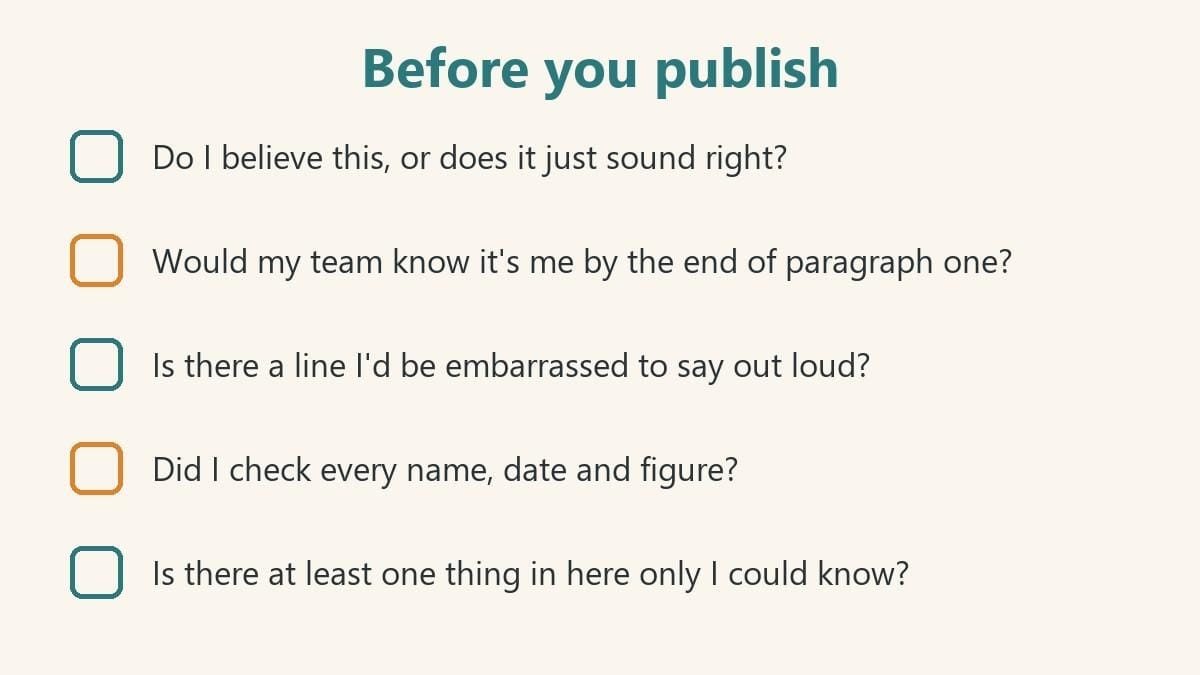
Give it one last read and ask:
- Do I believe this, or does it just sound right?
- Would my team know it's me by the end of paragraph one?
- Is there a line I'd be embarrassed to say out loud?
- Did I check every name, date and figure? Models invent them with total confidence.
- Is there at least one thing in here only I could know?
Any no, and you go back to that part. Usually five minutes, maybe ten.
The short version
A first draft is cheap now. Voice isn't, and it's still yours to supply. Next time, pick one paragraph, replace the example with something that really happened to you this week, and read it out loud.


