Startups across Latin America raised a combined $49 million this week, based on disclosed rounds tracked by Techloy. Fintech attracted the largest share of capital, while AI-native platforms across insurance and enterprise software continued to draw investor interest.
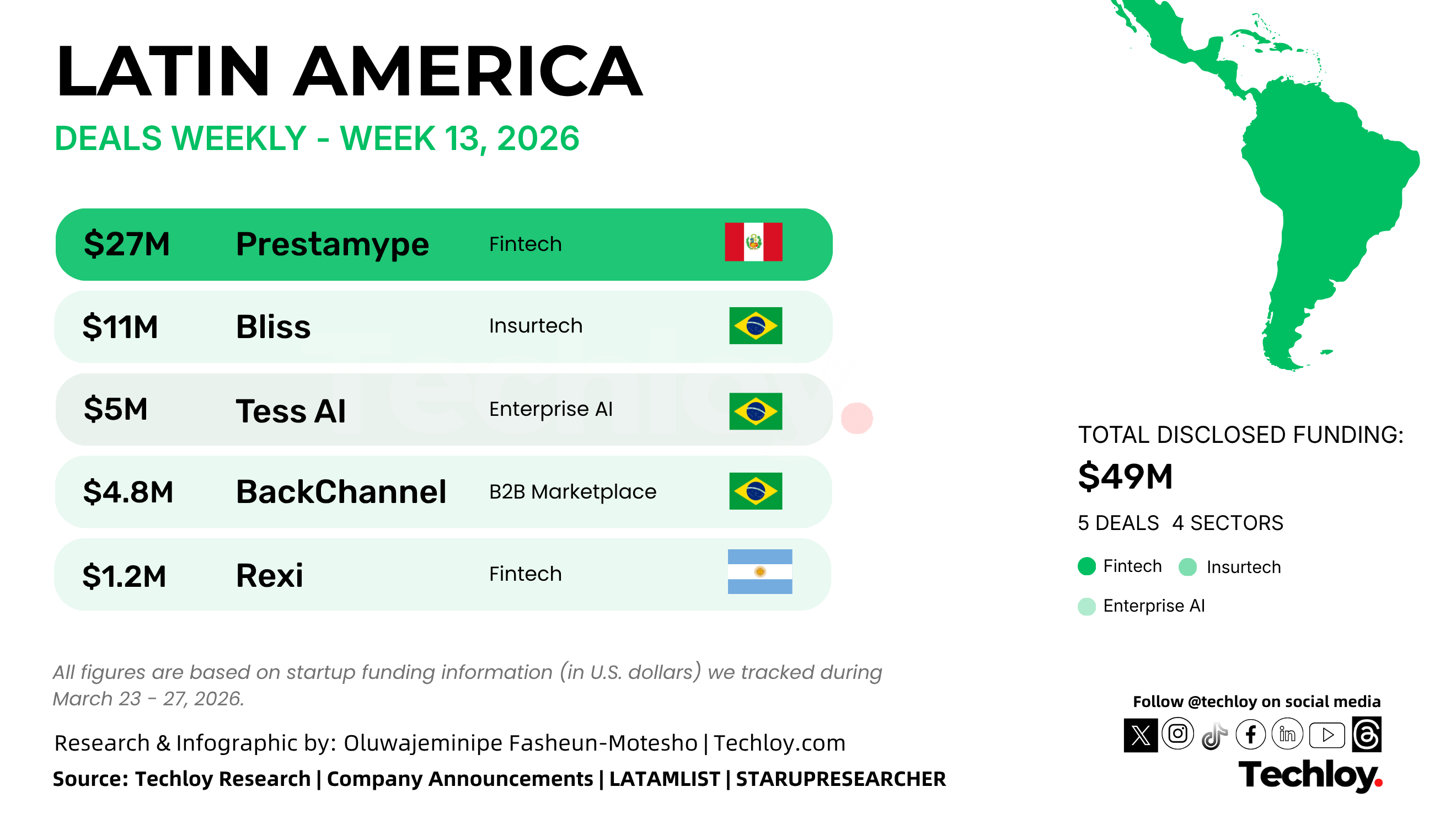
The Week’s Largest Startup Funding Rounds
Here are the biggest disclosed startup funding rounds across Latin America, ranked from largest to smallest.
/1. Prestamype, $27M, Fintech, Peru
Peruvian fintech Prestamype secured $27 million in equity and debt financing. The round includes a $2 million bridge investment from ALIVE Ventures, Oikocredit, and Salkantay Ventures, alongside a $25 million credit line from Lendable.
Prestamype provides digital financial solutions to micro, small, and medium-sized enterprises in Peru, focusing on loans and factoring. It also operates Cambio Seguro, a digital currency exchange platform.
The bridge funding will support the creation of a fund management company, allowing Prestamype to raise capital from retail and institutional investors. The credit line will finance mortgage-backed loans through a trust structure with Peru’s development bank Cofide. In 2025, the company reached $319 million in factoring disbursements, up from $121 million in 2024. Since 2017, it has disbursed more than $650 million to Peruvian SMEs.
/2. Bliss, $11M, Insurtech, Brazil
Brazilian insurtech Bliss raised $11 million in a Series A round co-led by Kfund and Grupo Bradesco, with participation from Actyus and Clocktower Ventures.
Bliss distributes health insurance plans to small and medium-sized businesses through an AI-powered platform. Its AI agent, Fátima, automates quoting, product comparison, and policy issuance, reducing back-office work for brokers. The company will use the funding to expand geographically and improve its technology. Bliss reached breakeven at the end of last year.
/3. Tess AI, $5M, Enterprise AI, Brazil
Tess AI raised $5 million in seed funding led by Hi Ventures and co-led by DYDX Capital, with participation from Honeystone Ventures. The company is relocating its headquarters to San Francisco to support global expansion.
Tess AI operates an enterprise AI agent platform that integrates more than 250 specialized AI models. Its no-code system allows employees to build autonomous agents capable of executing complex, multi-step tasks across business functions. The funding will accelerate international growth and strengthen its enterprise offering as it challenges traditional SaaS models with pay-for-impact AI agents.
/4. BackChannel, $4.8M, B2B Marketplace, Brazil
Brazilian B2B marketplace BackChannel raised a $4.8 million seed round led by Sunna Ventures, with participation from Positive Ventures, Cathay Latam, Preface Ventures, Norte Ventures, Accion Ventures, Savia Ventures, Ignia VC, and Morro Ventures.
BackChannel connects brands and distributors with retailers to sell excess inventory. Its platform supports pricing, negotiation, and product recommendations through software tools.
The company will use the funds to expand commercial operations, enhance its technology, and launch a credit product. Founded in 2024, BackChannel has facilitated the purchase of more than 300,000 items and serves over 1,000 active buyers and 100 sellers.
/5. Rexi, $1.2M, Fintech Infrastructure, Argentina
Argentine fintech Rexi raised $1.2 million in a pre-seed round backed by several US venture capital funds.
Rexi builds an AI-native finance platform for fintechs, banks, and payment companies. Its software centralizes bank reconciliation and uses AI agents to match transactions, consolidate data, and resolve discrepancies quickly. The company will use the funding to strengthen its product and scale its technical and commercial teams ahead of regional expansion. Its founders previously held roles at Mercado Libre, FJ Labs, Pomelo, and Naranja X.
Conclusion
This week’s funding rounds reflect sustained investor confidence in fintech infrastructure and AI-native platforms. Across lending, insurance distribution, enterprise automation, and B2B commerce, startups are building technology layers designed to increase efficiency and unlock new revenue streams across Latin America.
 Jemi Motesho