



The 2026 laptop market brings two very different approaches to high-end computing. On one side is Apple’s latest MacBook Pro powered by its M5 chip, built to deliver strong performance for demanding workloads, including AI-related tasks. On the other is Framework’s Laptop 13 Pro, which continues the company’s focus on modularity and repairability while aiming to match the expectations of a premium device.
Both laptops are designed for professionals, but they reflect contrasting ideas about how a modern laptop should be built and owned. One prioritises tight hardware–software integration in a sealed design, while the other centres on openness, user repair, and long-term flexibility.
Here’s how they compare.
1) Display and Visual Fidelity
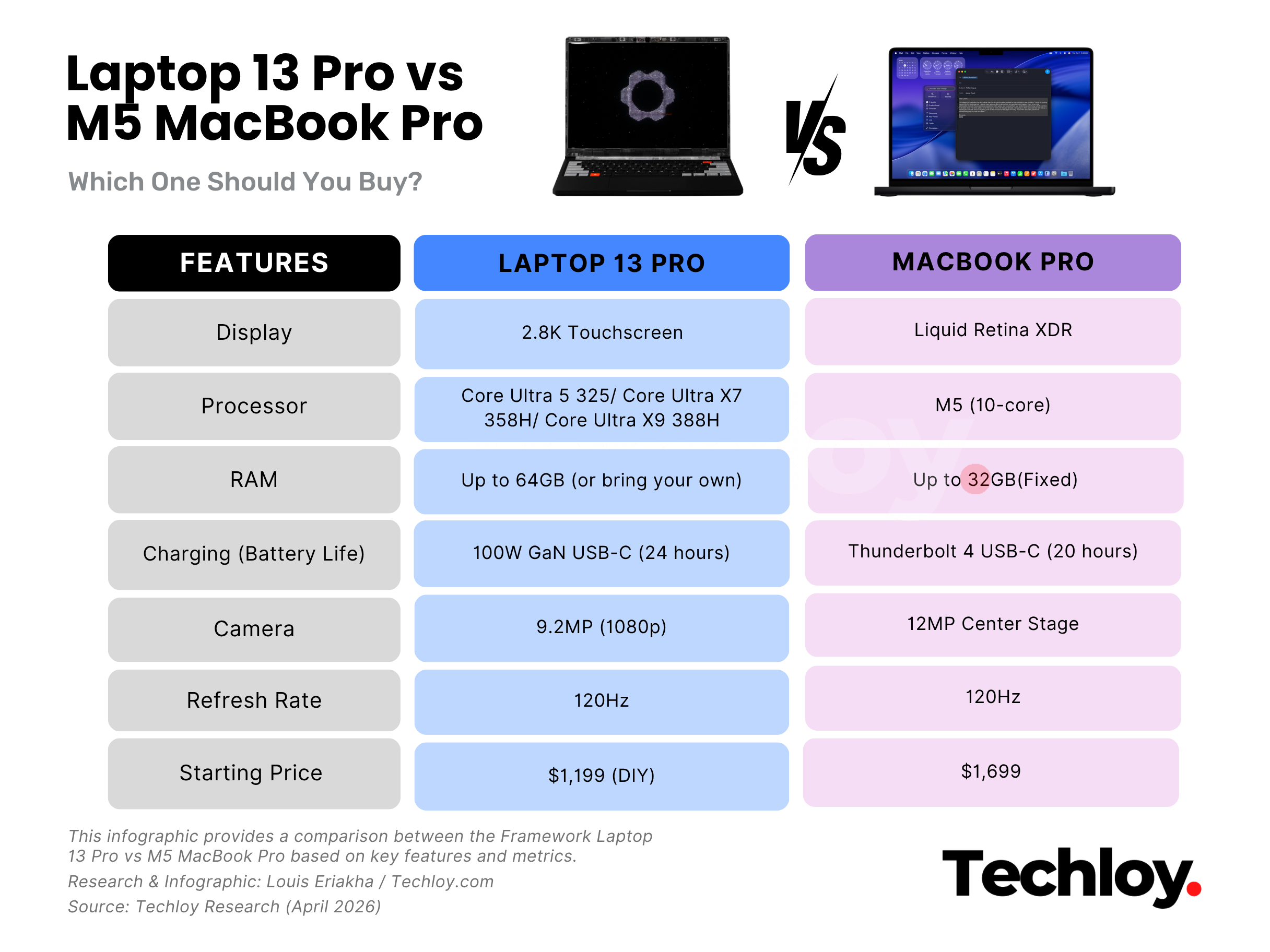
The MacBook Pro M5 continues to set the gold standard with its Liquid Retina XDR display. It hits a staggering 1,600 nits peak brightness for HDR content and offers a new nano-texture option to kill reflections. With ProMotion (120Hz) and a 1,000,000:1 contrast ratio, it’s a creative’s dream.
Framework, however, has closed the gap significantly. The Laptop 13 Pro features a new 2.8K (2880 x 1920) display. And while its 700 nits can't match Apple’s peak HDR, it introduces a feature Apple still refuses to provide: in-cell touch support. Plus, its 3:2 aspect ratio offers more vertical real estate for coders and writers.
2) Performance
This is where the numbers get wild. The Apple M5 Pro/Max chips utilize a new "Fusion Architecture" with a dedicated Neural Accelerator in every core. Apple claims it delivers 4x the AI performance of the M4, specifically optimized for running massive Large Language Models (LLMs) locally.
Framework counters with Intel’s Core Ultra Series 3 (Panther Lake) on the 18A process. The top-tier Ultra X9 388H offers 16 cores and a 50 TOPS NPU. While the M5 Pro likely maintains the lead in single-core "snappiness" and video rendering, Framework’s move to LPCAMM2 memory allows for 7467 MT/s speeds in an upgradeable format, a feat previously thought impossible for modular laptops.
3) Portability and Build Quality
Apple has stuck to its iconic unibody design, weighing in at 3.4 to 3.6 pounds for the 14-inch model. It is, as always, a rock-solid slab of aluminum that feels indestructible.
Framework has moved to a fully CNC-machined 6063 aluminum chassis for the Pro model, bringing a level of rigidity that matches the Mac. Remarkably, it’s lighter than the MacBook Pro, weighing just 1.4kg (approx. 3.1 lbs). It also introduces a "Graphite" anodization that looks every bit as "Pro" as Apple’s Space Black.
4) Battery Life and Charging
The MacBook Pro M5 is a marathon runner, claiming up to 24 hours of video streaming and 16 hours of wireless web usage. It still features MagSafe 3 for safety and supports fast charging with a 96W+ adapter.
Framework has fought back against the "Intel battery drain" reputation. By packing a massive 74.45Wh battery and using ultra-efficient Low Power Efficient cores, they are finally claiming 20 hours of real-world use. They also ship a 100W GaN charger that is barely larger than their old 60W brick.
5) Customization and IO
This is where the comparison becomes a slaughter. The MacBook Pro M5 has a fixed set of ports: three Thunderbolt 5 ports, HDMI, and an SDXC slot. If you want more, you buy a dongle. If you want more RAM later, you buy a new laptop.
The Framework Laptop 13 Pro is built on Expansion Cards. You want four USB-C ports? Done. You want an Ethernet port, a microSD slot, and a dedicated 1TB storage expansion? Slide them in. More importantly, the LPCAMM2 RAM and PCIe 5.0 SSD are fully user-replaceable.
6) Price and Availability
Apple has kept its premium pricing steady. The MacBook Pro M5 starts at $1,699 for the 14-inch model, though it now helpfully starts with 1TB of storage. It’s available right now at major retailers and Apple Stores globally.
Framework targets a slightly more accessible entry point. The Laptop 13 Pro DIY Edition starts at $1,199 (with your own OS and RAM), while the Pre-built professional configurations start at $1,499. Pre-orders are open now on Framework's website, with the first wave of shipments scheduled for June 2026.


