2026 was supposed to be the year of the big Google Pixel "10" milestone, but for the budget-conscious A-series, the features remain almost the same.
Do you stick with the tried-and-tested Pixel 9a from last year, or opt for the "new" Pixel 10a, which went to market this week?
Those who expected a massive overhaul to celebrate a decade of Pixels, by now would have found reality humbling. At first glance, it feels like Google simply took the Pixel 9a, refreshed the paint with a few new colourways like Berry and Fog, and called it a day.
However, beneath the surface (and inside the settings menu), a few software tweaks and durability upgrades aim to justify the new model.
In this guide, we’ll break down the categories to see if the Pixel 10a is a meaningful step forward or just a colourful encore.
 Oluwaseun Bamisile
/1. Display
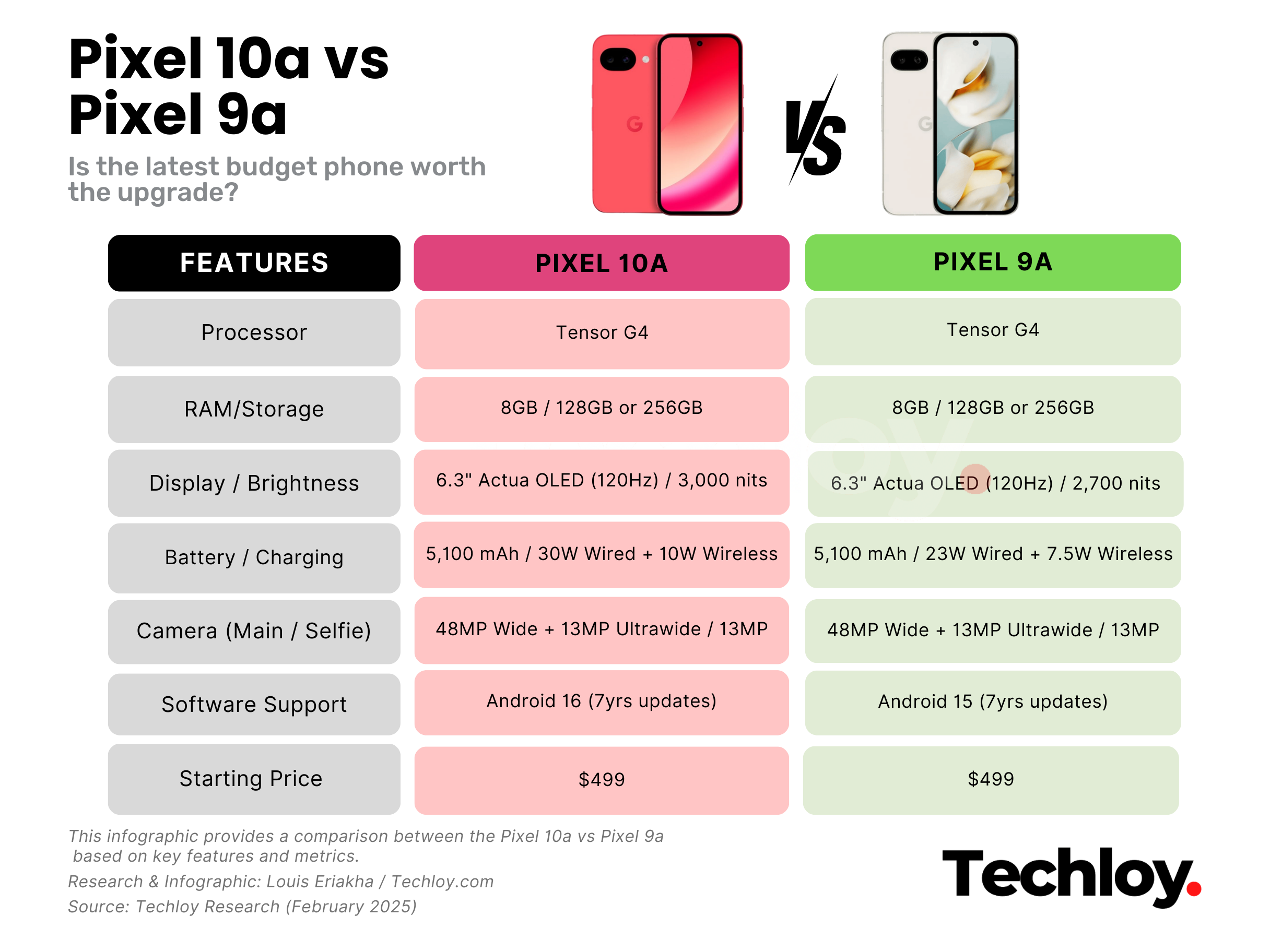
The Pixel 10a features a 6.3-inch Actua display that looks identical to its predecessor but packs a hidden punch. It now reaches a peak brightness of 3,000 nits, up from the 2,700 nits on the 9a. This makes it significantly easier to use under the harsh midday sun. More importantly, Google finally upgraded the glass to Corning Gorilla Glass 7i, which is much tougher against scratches and drops than the ageing Gorilla Glass 3 found on the older model.
The Pixel 9a still holds its own with a 120Hz refresh rate and a very capable 6.3-inch OLED panel. While it isn’t quite as bright, it’s still one of the best screens in its price bracket. Unless you spend a lot of time outdoors or have a habit of dropping your phone, the difference in daily use is minimal.
/2. Performance
In a surprising move that left some fans underwhelmed, the Pixel 10a does not move to the next-generation Tensor G5 chip. Instead, it uses the Tensor G4, the same silicon found in the Pixel 9a. While Google claims it has been "re-tuned" for better thermal efficiency and AI processing, the raw power for gaming and multitasking remains essentially the same.
The Pixel 9a offers the exact same 8GB of RAM and base 128GB of storage. Because both phones share the same "brain," you won’t notice a speed difference when opening apps or scrolling through social media. Both are snappy for everyday tasks, but will still struggle compared to flagships when it comes to heavy video editing or high-end gaming.
/3. Battery and Charging
The Pixel 10a retains the 5,100mAh battery capacity of the 9a, which is already excellent for a phone of this size. However, Google addressed one of the biggest complaints from last year: charging speed. The 10a now supports 30W wired charging (up from 23W) and 10W wireless charging (up from 7.5W). It’s not "warp speed," but it reduces the time you're tethered to a wall.
The Pixel 9a is no slouch in endurance, comfortably lasting over 30 hours on a single charge. However, its slower charging speeds mean you’ll be waiting longer for a top-up. If you charge your phone overnight, this might not matter, but for quick boosts, it feels a generation behind.
/4. Cameras
If you look at the spec sheet, the hardware is identical. Both phones feature a 48MP main sensor and a 13MP ultrawide. However, the Pixel 10a introduces new software tricks like Camera Coach for better framing and Auto Best Take, which uses AI to ensure everyone is smiling in group shots. It also gains Satellite SOS, a life-saving feature for emergency connectivity when you're off the grid.
The Pixel 9a still takes some of the best photos in the mid-range world. Google’s image processing is legendary, and the 9a handles skin tones and low-light shots better than almost anything else at its price point. It lacks the new AI coaching and satellite features, but the actual photos you take will look almost indistinguishable from the newer model.
/5. Software and Longevity
The Pixel 10a ships with Android 16 out of the box. Following Google’s latest commitment, it has promised seven years of OS and security updates, meaning this phone is supported until 2033. It also gets full access to Gemini Live, Google’s conversational AI assistant.
The Pixel 9a launched with Android 15 and is also on a seven-year update schedule. However, because it was released a year earlier, its support cycle will end in 2032. It still receives most of the same Gemini AI features via software updates, so the "software gap" is actually quite narrow.
Conclusion
The choice between the Pixel 10a and the Pixel 9a is less about innovation and more about refinement. The Pixel 10a is the better choice if you value durability (Gorilla Glass 7i), need a screen that can fight off direct sunlight, or want the peace of mind that comes with Satellite SOS and faster charging.
The Pixel 9a remains the "smart" buy for the value-conscious. Since the processor and camera hardware are the same, you’re getting 95% of the experience for what is likely a discounted price now that the new model is out.
If you already own a 9a, there is almost no reason to upgrade. But if you’re coming from an older Pixel 6a or 7a, the Pixel 10a is a polished, reliable entry point into the next seven years of Android.
 Kelechi Edeh