When it comes to work and light gaming on a budget, tablets have become the next-best thing to PCs. They strike a solid middle ground between portable smartphones, but with the larger screen and processing power that lets you multitask without frustration.
However, most high-end tablets will run you well into the ₦500K range or more. But the Redmi Pad 2 and Infinix Xpad 20 are two affordable options that promise decent productivity performance without draining your wallet. Both run Android 15, come with large displays, and claim to handle multitasking well, but one clearly gives more for the money.
Here’s a feature-by-feature breakdown to help you decide which one fits your needs better.
 Kelechi Edeh
1. Performance
If multitasking is your main concern, the chipset and RAM combo matter a lot.
And as such, the Redmi Pad 2 is powered by the MediaTek Helio G100 Ultra, a 6nm chip that's more power-efficient and slightly newer than the Helio G88 in the Xpad 20. It's paired with up to 8GB of RAM and UFS 2.2 storage, which makes switching between apps and handling heavier tasks like video calls or Google Docs in split-screen mode smoother.
Infinix Xpad 20, on the other hand, uses the older Helio G88 (12nm), which is decent for casual use but may show lag when juggling multiple apps. It comes with 4GB to 8GB RAM and 128 to 256GB ROM, which is solid, but the slower chip could bottleneck performance.
Verdict: Redmi Pad 2 pulls ahead in raw performance thanks to its newer, more efficient chip and faster storage. It's better suited for real multitasking.
2. Display and Design
Both tablets come with 11-inch screens, a size that’s just right for working on documents, editing slides, or streaming Netflix.
Right out of the box, Redmi Pad 2 edges out slightly in quality. It features a 2.5K resolution, higher pixel density (274 ppi), and goes up to 500 nits brightness, which means crisper visuals and better outdoor readability. The 90Hz refresh rate also makes scrolling feel smoother.
Meanwhile, the Infinix Xpad 20 matches the 90Hz refresh rate but comes with a lower 1200 x 1920 resolution and just 206 ppi, so images and text won’t look as sharp. Brightness peaks at 440 nits, which is acceptable indoors but a bit dim in direct sunlight.
Verdict: In this category, the Redmi wins on screen quality. Higher resolution and brightness make it a better pick for reading, watching, and working.
3. Productivity Features
For anyone interested in the details, here's where the little things add up.
Out of the box, both tablets run on Android 15, so you get the latest OS features like better app permissions, improved split-screen, and new background optimizations. Redmi adds its HyperOS 2 skin, which is clean and performance-oriented.
Redmi also offers Wi-Fi Direct, Miracast, and Dolby Atmos quad speakers, great for work calls or watching videos. It supports external keyboards via USB-C and Bluetooth.
Infinix keeps things up with OTG support, 4G LTE, Folax voice assistant with ChatGPT, and multi-device collaboration. It also runs Android 15.
Verdict: It’s a close match, but Redmi’s more polished UI and better speaker setup make it feel more work-ready out of the box.
4. Camera
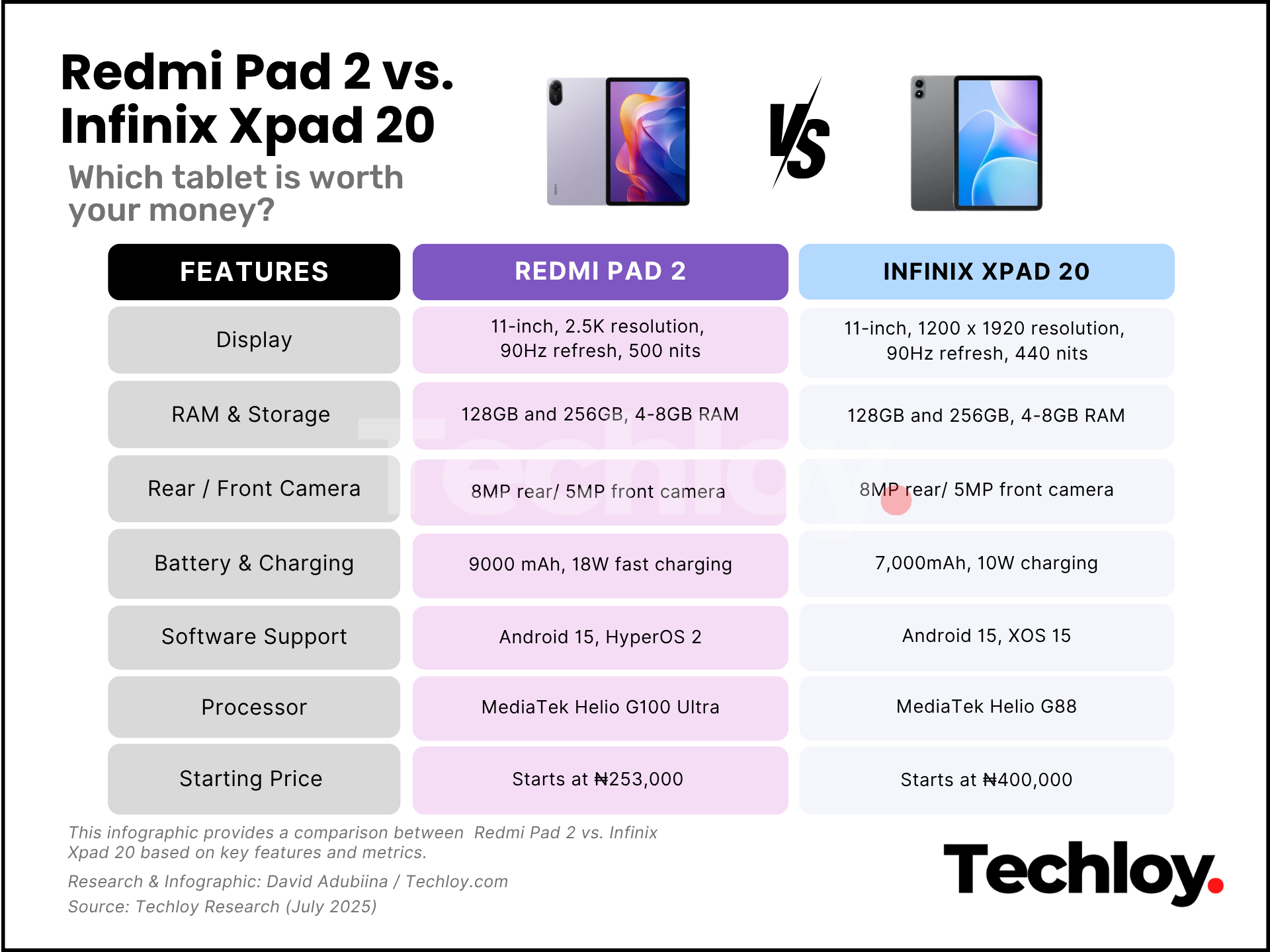
In terms of the camera, the Redmi Pad 2 comes with a basic 8MP rear camera and a 5MP front camera, which are decent if you want to make video calls or snap quick reference photos. For selfie shots, the front camera is placed horizontally, which is perfect for landscape video calls and makes the angle feel more natural on platforms like Google Meet or Zoom. The Infinix Xpad 20 matches this setup with an 8MP rear and 5MP front camera, but the quality is a step below. Colors are slightly duller, and low-light performance is weaker. Also, its front camera positioning isn't as optimized for horizontal calls, so it feels more like a phone stuck in a big frame. Both can record in 1080p at 30fps, but again, don’t expect vlog-level footage. For the average user, video chatting, snapping homework, or joining virtual meetings, the Redmi still comes out slightly ahead in clarity and camera placement.
Verdict: Redmi takes the win for sharper visuals and a front camera placement that makes it better for video conferencing.
5. Storage and RAM
When it comes to running multiple apps or storing files, videos, and games, both tablets give you options, but how they handle memory and speed is different.
The Redmi Pad 2 uses faster UFS 2.2 storage, which gives it an edge in real-world performance. Whether you're opening large apps, copying files, or multitasking, UFS is simply quicker and more responsive than the eMMC 5.1 storage found in the Infinix Xpad 20.
Both tablets offer up to 8GB of RAM and 256GB of internal storage, with microSD card slots in case you need more space.
Verdict: Redmi’s faster storage system gives it another edge in responsiveness and long-term usability.
6. Battery and Charging
Battery life is one of those features that can make or break your tablet experience, and that is why tablets are known for their battery much more than their camera.
For the Redmi Pad 2, it packs a big 9000mAh battery, one of the largest in its category. It comfortably lasts a full day or more with mixed usage like browsing, video playback, and light gaming. On top of that, it supports 18W fast charging, which helps you get back up and running faster.
The Infinix Xpad 20 has a smaller 7000mAh battery, and while it still performs decently for lighter use, it's not quite as power-dense. Charging is also slower at just 10W, which can feel sluggish when you’re in a rush. It does have reverse wired charging, which is a nice bonus if you want to use it as a power bank in emergencies.
Verdict: Redmi leads again with more battery capacity and faster charging, ideal for all-day usage.
7. Pricing and Value
In terms of price-to-performance, the Redmi Pad 2 offers a solid deal. It typically goes for around ₦253,000, depending on the configuration. That gets you a strong display, better processor, larger battery, and faster storage, all at a mid-range price point.
Surprisingly, the Infinix Xpad 20 is actually more expensive, hovering closer to ₦400,000, especially for the higher RAM and storage models. And for that price, you’re getting slower storage, a weaker processor, and less battery life.
Verdict: Redmi Pad 2 offers much better value. You get more features and power for significantly less money.
Final Verdict
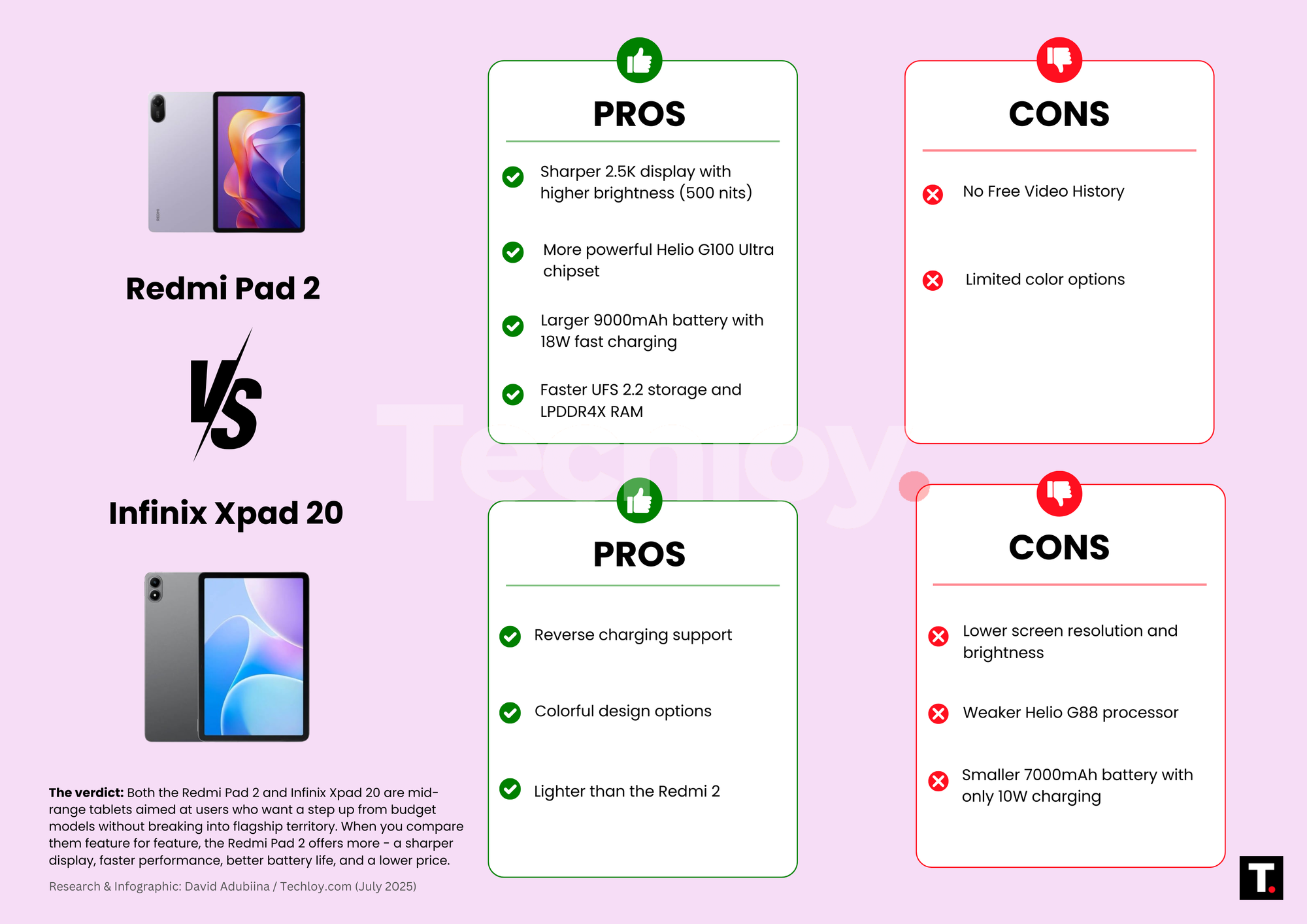
So, if your budget is tight and your tasks are light, the Infinix starts to feel like an odd value proposition. For that amount, you'd expect it to outpace the Redmi in a few areas, but it really doesn’t. Unless you find it on a steep discount or you prefer the brand, the Redmi Pad 2 gives you more for less.
The Infinix Xpad 20 might appeal if you strictly want local support or brand loyalty to Infinix, but at nearly ₦150K more, it’s hard to justify when the Redmi beats it in most areas.
 David Adubiina