



The VR and AR market just got a whole lot more interesting, as Samsung and Google have joined forces to challenge Apple's spatial computing dominance with the Galaxy XR, launching at nearly half the price of the Vision Pro.
Both headsets promise to blur the lines between your physical and digital worlds, but they take distinctly different approaches to get you there. Whether you're a creative professional seeking the ultimate productivity tool, an entertainment enthusiast ready to transform your viewing experience, or simply curious about the future of computing, this comparison will help you decide which premium headset deserves a place on your face.
 Oluwaseun Bamisile
1/ Design & Build
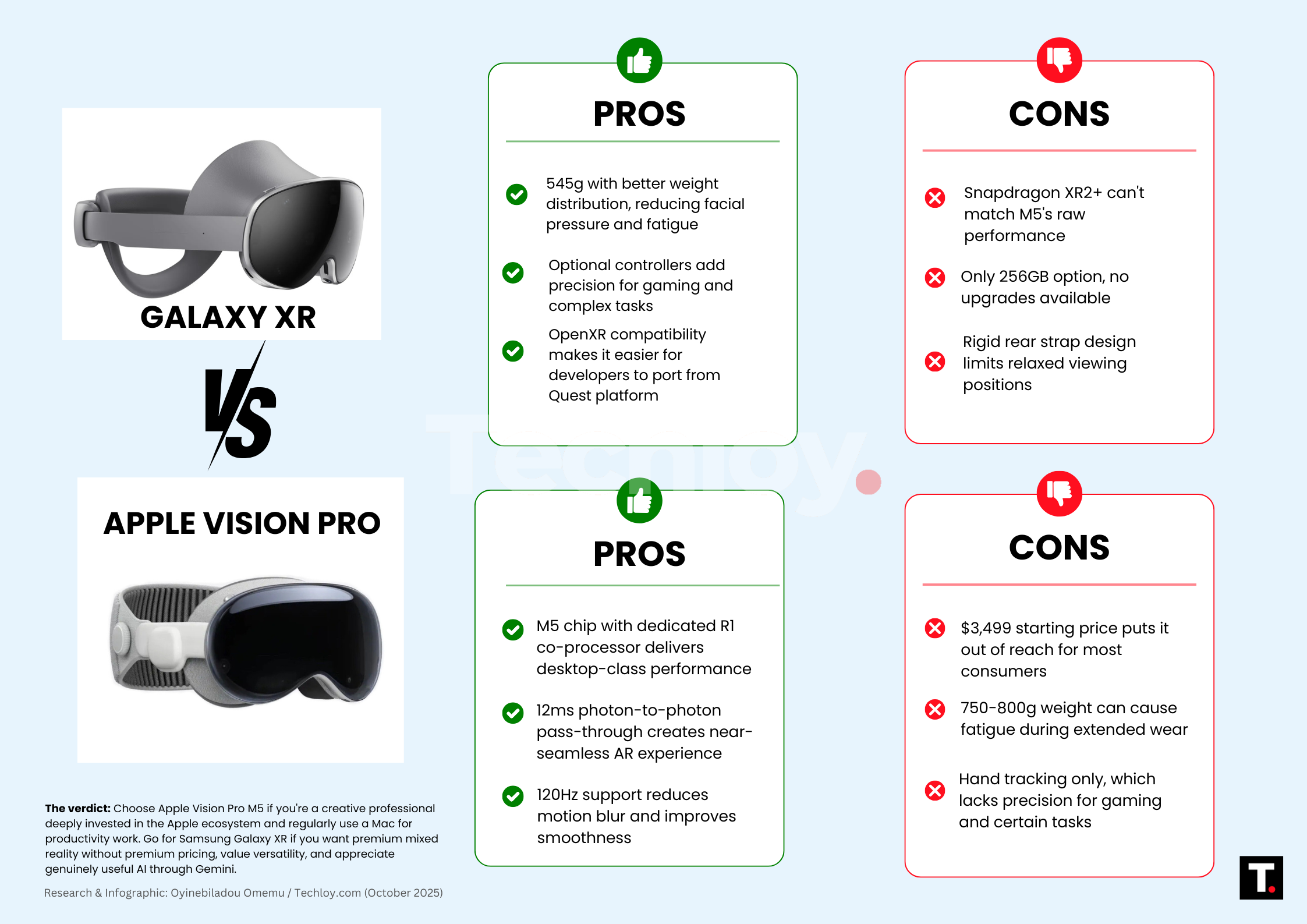
Apple's Vision Pro continues the company's tradition of premium design with a striking ski goggle-inspired design. Constructed from machined aluminum and laminated glass, the headset is fancy, but it weighs between 750 and 800 grams depending on your Light Seal configuration. The external battery connects through a braided cable, and while this distributes some weight, the front-heavy design can feel tiring during extended sessions. It also comes with the Dual Knit Band, featuring tungsten counterweights in the lower strap to better balance that hefty front end.
Samsung's Galaxy XR takes a different approach that borrows design cues from Meta's Quest Pro. It weighs 545 grams with the forehead cushion attached, lighter than Apple's Vision Pro. The headset uses a rigid rear strap with an adjustment dial rather than fabric bands, distributing pressure across your forehead and the back of your head to minimize facial discomfort. The separate battery pack keeps things compact, though unlike Vision Pro, you can't lean back comfortably on a sofa while wearing it. A detachable light shield offers flexibility between awareness and full immersion. While it lacks Apple's premium materials, Samsung prioritized balanced weight distribution and day-long comfort over visual flair.
2/ Display & Visual Performance
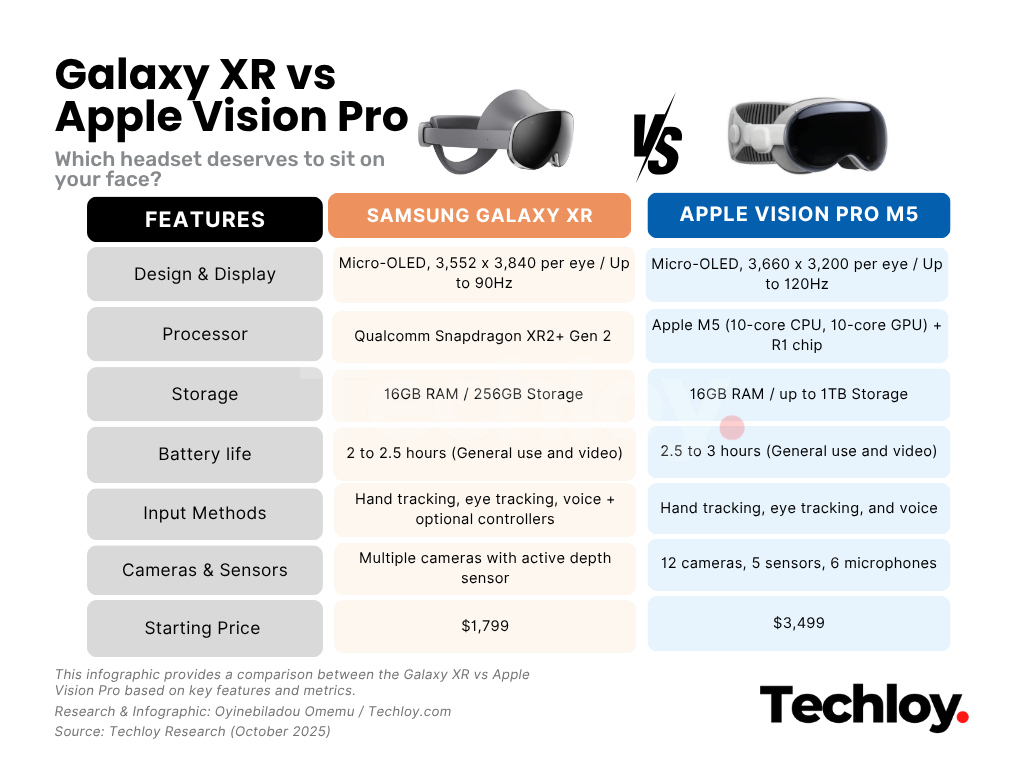
The Vision Pro's display system is a masterclass in optical engineering. Each eye gets a custom micro-OLED panel delivering approximately 3,660 x 3,200 pixels, a 23 million pixels. The three-element lens system creates remarkably sharp visuals with minimal distortion, though the field of view feels slightly narrower than competitors. With the M5 chip, Vision Pro now renders 10% more pixels through improved foveated rendering and supports refresh rates up to 120Hz.
Samsung's Galaxy XR counters with even higher resolution. Dual 4K micro-OLED displays running at 3,552 x 3,840 per eye, a 29 million pixels total, beating Vision Pro. The displays cover 96% of the DCI-P3 color gamut and support refresh rates from 60Hz to 90Hz. With a 109-degree horizontal and 100-degree vertical field of view, you get a slightly wider window into virtual worlds. The pancake lenses deliver excellent clarity, edge-to-edge, and automatic motorized IPD adjustment (54-70mm).
3/ Processing Power & Performance
Apple's Vision Pro M5 packs the company's latest silicon, a 10-core CPU and 10-core GPU built on 3nm technology, with hardware-accelerated ray tracing and mesh shading. The dedicated R1 chip handles sensor processing with an impressive 12-millisecond photon-to-photon latency, creating a near-lagless passthrough experience. With 16GB of unified memory and up to 1TB storage options, there's plenty of headroom for demanding spatial apps and workflows.
Galaxy XR runs on Qualcomm's Snapdragon XR2+ Gen 2 processor, offering 15% higher GPU and 20% higher CPU performance over previous generations. It's paired with 16GB of RAM and 256GB of storage. While it can't match Apple's desktop-class silicon on raw power, it's remarkably capable for standalone VR experiences and runs Android XR apps smoothly.
4/ Operating System & User Interface
Apple's visionOS 26 feels distinctly Apple. It is intuitive and polished. Navigation happens through eye tracking, hand pinches, and voice commands via Siri. Windows float in your space and can be arranged however you like, though there's no Expose-like window management. Mac Virtual Display lets you use your MacBook as a giant floating 4K screen, which remains one of Vision Pro's impressive features. The latest update adds persistent widgets that stick to surfaces in your environment, enhanced Personas that look more lifelike, and spatial photo features powered by AI.
Google's Android XR on Galaxy XR takes a different approach, utilizing the massive Android ecosystem. Thousands of 2D Android apps work right out of the gate through the Google Play Store, and your existing purchases carry over. Google has optimized key apps like Maps, YouTube, Photos, and Circle to search in passthrough mode. Gemini AI sits at the system level, understanding context from what you're seeing and doing to provide genuinely helpful assistance. Samsung's One UI XR skin adds familiar Samsung touches for Galaxy phone users.
5/ Tracking & Input Methods
Apple's Vision Pro employs 12 cameras, 5 sensors, and 6 microphones. Four eye-tracking cameras monitor where you're looking with impressive precision, while six world-facing cameras enable hand tracking. It's gesture-based only, no controllers included or available. When it works, the eye-and-pinch interface feels magical. When it doesn't, you'll miss having physical buttons. The tracking occasionally struggles with fast movements or specific hand positions, and precision tasks can feel frustrating when the system misinterprets your intent.
Samsung's Galaxy XR offers similar hand and eye tracking through its camera array, plus face tracking and an active depth sensor. The key difference is optional controllers for $250 extra, which feature a standard VR layout with dual joysticks, triggers, grip buttons, and face buttons, similar to Meta Quest devices. The controllers use AA batteries and are tracked via IR lights. This dual-input approach gives you options: hand tracking for casual use and productivity, controllers for gaming and precision work.
6/ Battery Life & Connectivity
Apple's Vision Pro M5 provides 2.5 hours of general use or 3 hours of video playback from its 353-gram external battery pack. You can use the headset while charging via USB-C for unlimited sessions. It supports Wi-Fi 6 and Bluetooth 5.3, plus exclusive ultra-low-latency H2-to-H2 connectivity with compatible AirPods. The battery clips to your belt or pocket via a built-in clip, though the braided cable isn't everyone's favorite design choice.
Galaxy XR's 302-gram battery pack delivers 2 hours of general use or 2.5 hours of video playback. Like Apple's headset, you can charge while using it for unlimited runtime. Connectivity gets an upgrade with Wi-Fi 7 and Bluetooth 5.4 support, future-proofing for faster wireless speeds as networks catch up.
7/ Software Ecosystem & Content
Apple's App Store offers over 1 million compatible apps, but truly native spatial apps number in the hundreds rather than thousands. Apple Arcade brings games, Apple TV+ streams immersive content, and there's growing support from creative apps like Adobe's offerings. Spatial photos and videos shot on iPhone 15 Pro or later can be relived in 3D. The ecosystem is curated, high-quality, and somewhat limited compared to more mature VR platforms.
Galaxy XR launches with around 30 native games available at launch, with developers reporting that porting from Meta Quest is relatively straightforward thanks to OpenXR compatibility. Popular titles like Walkabout Mini Golf run beautifully, and Virtual Desktop enables PC VR gaming at the headset's impressive resolution. Beyond gaming, you get Android's vast 2D app library, Adobe's Project Pulsar video editor, sports apps from NFL Pro Era and MLB, and meditation through Calm.
8/ AI & Smart Features
Apple's approach to AI in Vision Pro feels measured and privacy-focused. Siri handles voice commands, and the new spatial photo features use on-device machine learning to add depth to regular photos. The hand and eye tracking employ sophisticated AI models, and foveated rendering intelligently allocates processing power based on where you're looking. It's capable, but not conversational.
Galaxy XR puts Gemini front and center in a way that feels genuinely transformative. The AI understands context from your surroundings. Gemini navigates Google Maps' 3D environments while suggesting restaurants and attractions. It even provides real-time gaming tips.
9/ Price
Apple Vision Pro M5 starts at $3,499 for 256GB, with 512GB and 1TB options pushing the price even higher. That entry fee includes the headset, Dual Knit Band, Light Seal, battery, and polishing cloth. Zeiss prescription lens inserts run $99-$149, the travel case costs $199, and that's before you invest in accessories or apps.
Samsung Galaxy XR starts at $1,799 for 256GB, $1,700 less than Vision Pro. However, the controllers that many will want are $250 extra. The travel case is another $250. Prescription inserts are available through EssilorLuxottica's EyeBuyDirect.
Conclusion
Both the Galaxy XR and Apple Vision Pro represent remarkable achievements in spatial computing, but they follow distinctly different approaches. Apple's Vision Pro offers the superior build quality, more powerful silicon, and that ineffable Apple polish, at a price that puts it out of reach for most people. It's the better choice if you're deeply embedded in Apple's ecosystem, use a Mac daily for creative work, and money isn't a primary concern.
Samsung's Galaxy XR makes the compelling argument that premium mixed reality doesn't require a premium price. With higher-resolution displays, lighter weight, genuinely useful AI integration through Gemini, and the flexibility of optional controllers, it delivers value at $1,799. The Android XR platform may lack Vision Pro's ecosystem maturity, but it compensates with app abundance and easier developer access.


