



Nobody needs convincing that a movie character isn't real. We know someone wrote the script, and yet we worry about what happens to that character.
Now fictional characters have Instagram accounts. They post Reels, announce new projects, collaborate with brands, and collect thousands of little hearts from very real people.
And unlike a film character, a virtual influencer can answer your comment.
So what makes us give our digital hearts to someone who doesn't have a heartbeat?
1. The Feelings Are Fictional. The Likes Aren't.
An AI influencer can announce that they're nervous about an upcoming event, thrilled about a new project, or disappointed by criticism. Someone wrote those words. The character didn't actually experience any of it.
But the person reading the caption might have.
One explanation comes from a finding from the Journal of Retailing and Consumer Services. An analysis of Instagram posts examined 4,142 publications from virtual influencers and 66,813 from human creators. More emotional and positive captions were associated with more likes in both groups, and the relationship was stronger for virtual influencers.
Apparently, knowing an emotion is scripted doesn't automatically stop us from responding to it.
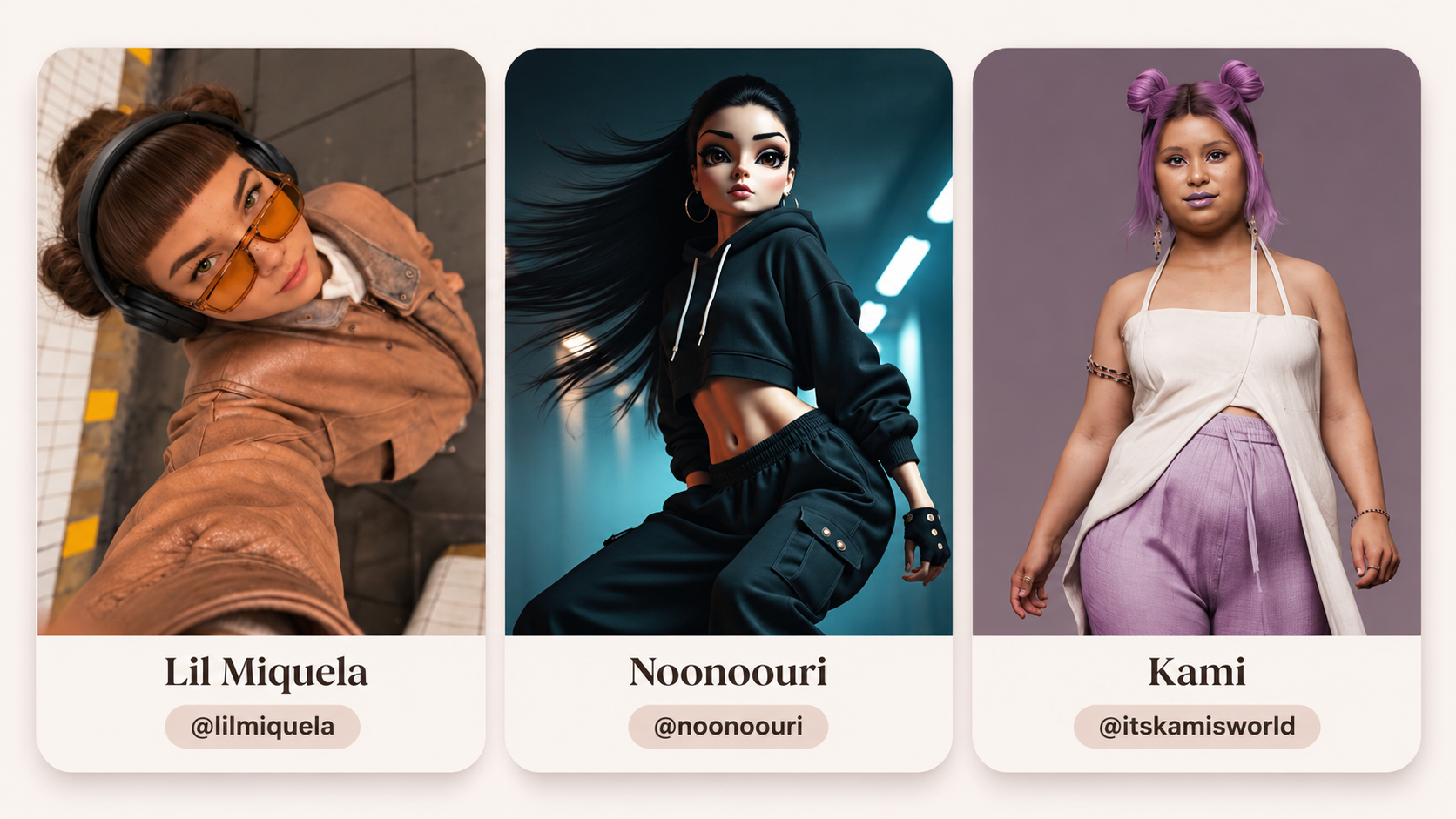
Look at Lil Miquela (@lilmiquela). She's a digital personality whose fictional career has included fashion campaigns, music releases, and collaborations with major brands. Her audience isn't simply looking at a computer-generated face. An ongoing character to follow.
A character preparing for a music release has something to talk about before and after the event. Followers can react to the announcement, comment on the finished song, and wonder what comes next.
The character's excitement is fictional. The anticipation in the comments can be real.
2. Looking Human Isn't Always the Point
You might assume the most successful AI influencer would be the one people could mistake for a real person.
But consider Noonoouri (@noonoouri). With enormous eyes, doll-like proportions, and a world that belongs somewhere between couture fashion and fantasy, Noonoouri makes no serious attempt to pass as an ordinary human Instagram user.
She's a virtual fashion personality with music projects and a creator who has connected the character with causes involving animals, children, and the environment.
A 2026 study explored this idea through four experiments involving 938 participants. When virtual influencers appeared in explicitly virtual backgrounds, audiences showed greater engagement than when the settings looked real. Part of the explanation was simple: people enjoyed the escape from reality.
It's the same reason we don't demand that every animated film look like a documentary.
For creators, this opens considerably more possibilities than endlessly generating portraits of attractive people in luxury apartments. A virtual character could inhabit an impossible city, travel through imaginary landscapes, or have an unmistakable illustration-inspired style. The setting itself can become something followers look forward to seeing.
3. Sometimes We're Liking the Idea Behind the Character
Not every virtual influencer needs a dramatic backstory or a fantasy universe. Some have a reason to exist that matters more than their appearance.
Kami (@itskamisworld) is a particularly interesting example. Created through a collaboration involving Down Syndrome International, Kami was developed with contributions from more than 100 young women with Down syndrome. They helped shape her appearance, voice, and personality.
The project was created to improve representation of people with Down syndrome in digital spaces, where idealized virtual faces have traditionally dominated.
A like on a fashion image might simply mean someone enjoys the outfit. A heart on a post about inclusion can also express support for the message behind it.
The involvement of real women in Kami's creation matters, too. The character may be fictional, but the experiences that helped shape her belong to actual people.
4. Before People Can Love a Character, They Have to Notice It
Here is the uncomfortable answer to the question in the headline. We often respond to a character before we have any reason to care about it, because other people appear to have responded already.
Few of us would say that out loud. But a field experiment on social advertising found that displaying even the first visible like increased the likelihood of other users liking or clicking an ad, and unfamiliar accounts gained the most from it.
Which means the first dozen reactions under a new virtual character do more work than any of the render quality above them.
That is not a comfortable thought for creators, and it is not entirely a comfortable thought for audiences. It does explain why a launch deserves as much thought as the character design. Collaborations with real artists, introductions to relevant communities, and early conversations with followers all give a new account somewhere to start.
Paid engagement belongs to the same category. IGComment, for example, offers real Instagram likes from contributors using their own accounts rather than conventional bots. Creators can use a service like this to add visible activity to selected posts while developing their own promotion strategy.
A visible reaction is not the same as a fan, though. The signals worth watching come afterward: whether people explore the profile, leave thoughtful comments, share a Reel, or return to see how a story develops. A creator can pay to put a heart beneath a post. Giving someone a reason to care about the character behind it takes more imagination.
A Fictional Life, a Real Audience
Perhaps virtual influencers aren't such a strange phenomenon after all. We've always cared about fictional people. Instagram has simply given them a new place to live, somewhere between our friends' holiday photos and the latest brand campaign.
What makes the format fascinating is that the story doesn't have to end when the credits roll. A character can return tomorrow with another Reel, answer a follower's question, or take its fictional life in an unexpected direction.
Its creators write every word. The audience decides whether the next chapter deserves a like.