Chinese YouTuber 小宁子, known online as XNZ, set out to solve a problem most console makers would rather ignore. Platform exclusives force players to juggle multiple devices, cables, and power bricks just to access the games they want. Her response was extreme but precise. She built a single machine that runs a PlayStation 5, Xbox Series X, and the upcoming Nintendo Switch 2 inside one functional chassis.
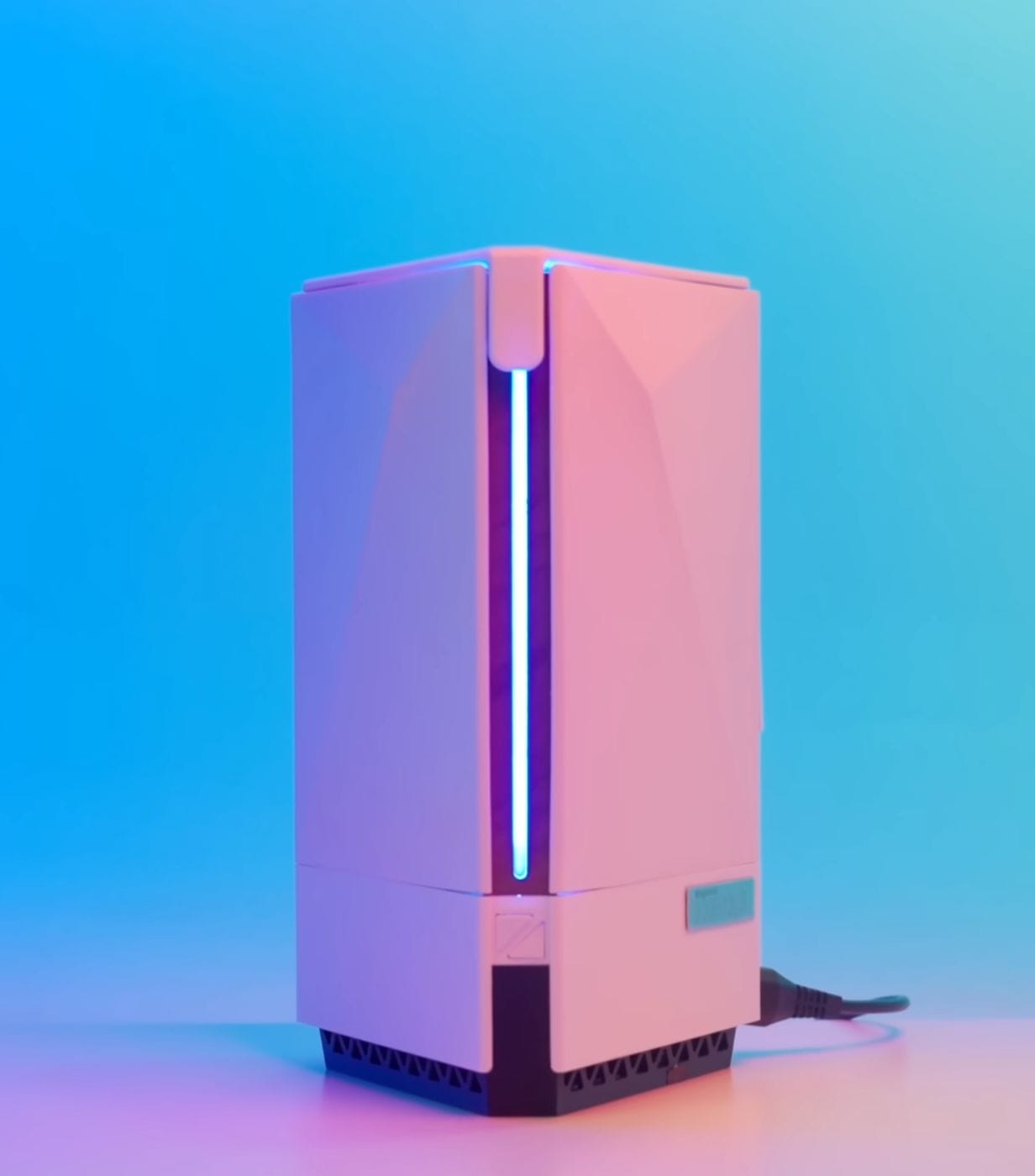
The result is the “Ningtendo PXBOX 5,” a three-in-one console that looks less like a hobbyist experiment and more like something that could sit on a retail shelf. At the core of the project was a constraint. Three high-performance consoles generate enormous heat, draw significant power, and were never designed to coexist. Instead of forcing them into a standard PC case, XNZ took inspiration from Apple’s cylindrical “trashcan” Mac Pro. Its triangular internal structure provided a clean way to mount three systems around a shared cooling solution.
According to XNZ, each console was stripped down to its essential components. Disc drives, stock coolers, and original power supplies were removed, while the motherboards remained intact. Each PCB was mounted to one side of a triangular internal frame, with a single bottom-mounted fan pushing air upward across all three systems, echoing the vertical airflow approach used in the Xbox Series X.
Cooling quickly became the project’s biggest challenge. Early attempts involved 3D-printing a custom triangular heatsink, but scaling that design using CNC milling proved too expensive. That dead end led XNZ in an unexpected direction.
She turned to lost-wax casting, an ancient metalworking technique also known as lost-clay casting. Instead of machining a heatsink from a solid block, XNZ created a disposable plastic mold, coated it with a heat-resistant material, and melted the plastic away to leave a cavity for molten metal. Once cooled, the cast metal formed a single cooler block capable of supporting all three motherboards. Copper plates were added to distribute heat evenly, with the PS5 and Xbox Series X boards mounted directly onto the cooler.
The Switch 2 presented a different problem. As a hybrid handheld, its motherboard could not be mounted the same way. XNZ designed a separate 3D-printed enclosure with a spring-loaded docking mechanism to allow the system to function correctly within the larger build.
Powering three consoles with one supply required equally careful planning. A single 250W GaN power supply was used, based on calculations showing that the PS5 and Xbox Series X would peak at around 225W under full load. This meant the system could only run one console at a time, but it avoided unnecessary bulk and heat. A custom Arduino board handles console selection, allowing users to switch between systems with a single button press. The transition takes roughly three seconds.
The final build features decorative wooden accents, a colour-coded LED strip, and a clearly labeled “Ningtendo PXBOX 5” badge. Both the PS5 and Xbox operate without disc drives, making the system digital-only by necessity rather than choice.
There are limits, though. Only one console can run at a time, and the setup ignores manufacturer warranties entirely. But that’s also the point. The Ningtendo PXBOX 5 isn’t just a technical flex. It’s a quiet critique of how fragmented modern console gaming has become, and how far an individual creator is willing to go to reclaim convenience that the industry no longer prioritizes.
In an era where ecosystems are increasingly locked down, XNZ’s build shows that innovation doesn’t always come from adding more features. Sometimes it comes from refusing to accept the separation in the first place.
 Emmanuel Umahi