- MTV’s shutdown marks the final break between music culture and traditional television, ending a 44-year era.
- Streaming and social platforms now drive music discovery through participation and personalization.
- MTV's original idea now thrives everywhere sound and visuals shape identity.
If you grew up in the late 1990s or early 2000s, you probably remember flipping to MTV after school, waiting for your favorite video, watching VJs hype new artists, or catching TRL like it was a global event. MTV wasn’t background noise; it was a ritual and the place where music met identity.
Now, that ritual is ending. Paramount Global has announced it will shut down MTV’s remaining music channels, MTV Music, MTV 80s, MTV 90s, Club MTV, and MTV Live by December 31, 2025. Only MTV HD will remain, focused mainly on reality shows like Geordie Shore and Naked Dating UK. For many, it feels like the quiet end of something that once defined youth culture.
But MTV’s closure is more than a business move. It captures how technology transformed the way people discover, share, and experience music. What began as a television revolution is now the internet’s daily rhythm.
MORE INSIGHTS ON THIS TOPIC:
- Odumodublvck enters Spotify Nigeria’s all-time Top 10 with ‘Industry Machine’
- Rema’s ‘Rave & Roses’ becomes first African album to hit 3 billion Spotify streams
- What Bad Bunny’s Super Bowl halftime show says about Latin music’s global moment
How MTV lost its beat in the age of YouTube and TikTok
By the mid-2000s, MTV had already lost its cultural monopoly. YouTube gave 2.7 billion users the power to upload, share, and go viral. Spotify and Apple Music replaced radio with personalized discovery, and TikTok, now with 1.6 billion active users, turned short sounds into global sensations.
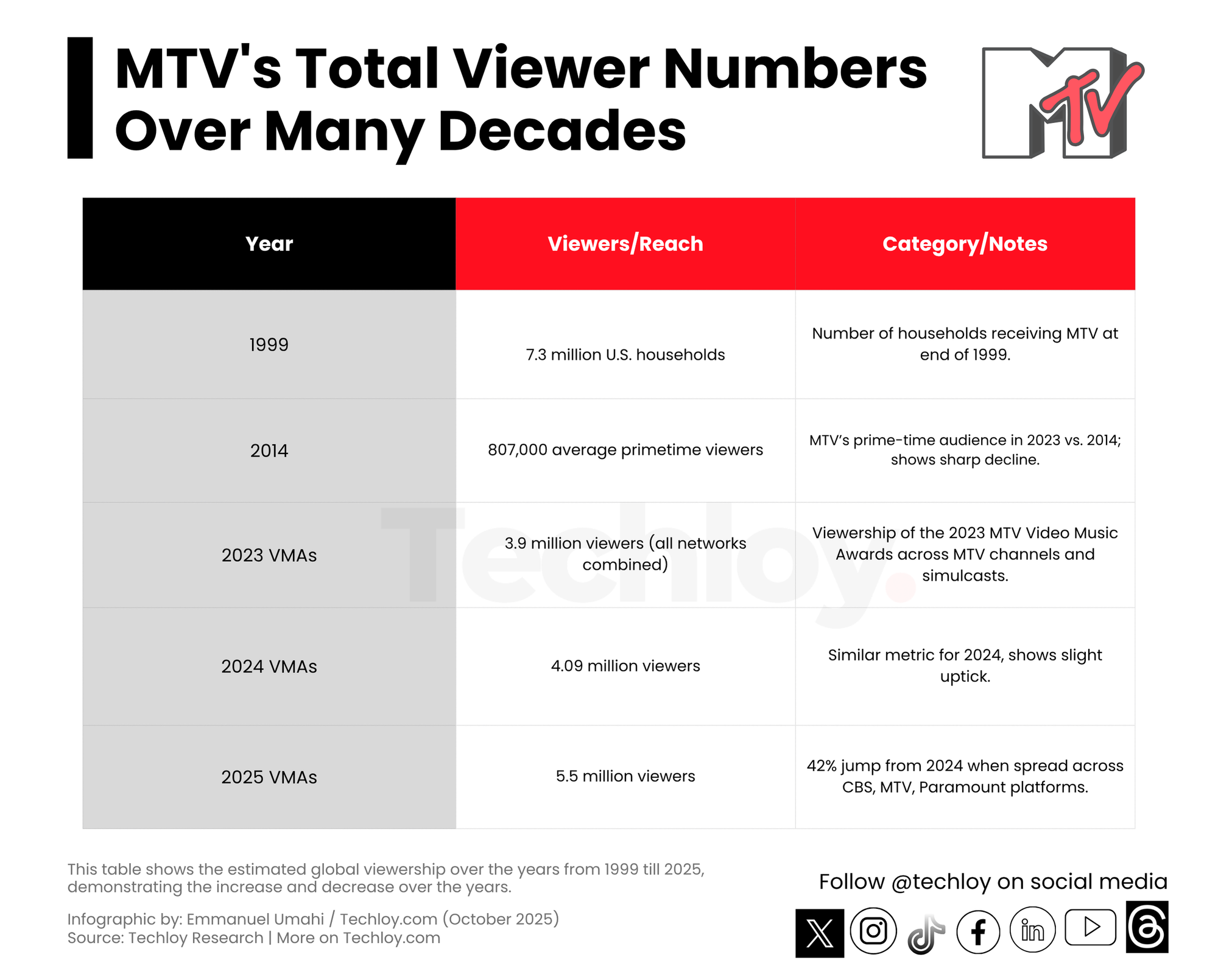
These platforms didn’t just distribute music; they made it participatory. Algorithms replaced VJs, and audiences became curators. MTV’s linear format, once revolutionary, couldn’t compete with on-demand creativity. The network now averages about 256,000 prime-time viewers in the U.S., a fraction of its peak. Even its flagship VMAs, once a global event, draw roughly 5.5 million across platforms.
People didn’t stop caring about music. They stopped waiting for someone else to play it for them.
 Emmanuel Umahi
From Gatekeeper to Bystander
MTV saw the change coming but couldn’t adapt fast enough. In the early 2000s, it pivoted from music to lifestyle programming, replacing videos with reality shows like The Real World, Laguna Beach, and Jersey Shore. It worked for ratings but eroded its identity. The network that once shaped culture began merely reflecting it.
Meanwhile, new platforms blurred the lines between creator and audience. YouTube turned every phone into a stage, and TikTok turned every scroll into a performance. By the time MTV tried to reclaim music relevance through award shows and nostalgia, discovery had already moved elsewhere—to wherever the algorithm decided next.
It’s a story familiar across media. Print giants like Rolling Stone and NME have shifted from tastemaking to storytelling. Even African networks like Soundcity and Trace Naija now compete with algorithms and short-form content that move faster and feel more personal. In an age where viral sounds trend before radio stations can catch up, broadcasters are no longer the gatekeepers. They’re now background noise.
The New Stage for Music Culture

Today, MTV’s spirit lives online. TikTok creators turn songs into shared emotion in seconds. Spotify’s Canvas loops bring back the visual art once tied to music videos. YouTube fan edits and reaction videos have become the new “music television,” but this time, the audience is also the producer.
Where MTV once decided what the world should watch, the world now decides for itself. Fans don’t tune in—they participate. Music discovery has shifted from passive viewing to creative interaction, powered by platforms that make every listener a potential tastemaker.
Conclusion
Ultimately, MTV’s shutdown isn’t an obituary but an evolution. The brand that once curated culture helped invent the visual, participatory internet we now live in. Every short-form video, viral sound, and fan-made remix carries its DNA.
When the final channels go dark on December 31, 2025, it won’t just mark the end of a network. It’ll mark a handoff, from television to technology, from broadcast to belonging. “I saw it on MTV” has become “I found it on TikTok.”
MTV didn’t die because it failed. It died because the world learned its lesson too well: that music is most powerful when it’s seen, shared, and shaped by everyone at once.
 Emmanuel Umahi