A randomized 2026 field experiment logging the real searches of 1,065 US users found that Google AI Overviews cut organic clicks to external sites by 38%, and pushed zero-click searches from 54% to 72% on queries where an AI Overview appeared (ISB/Carnegie Mellon, reported by Search Engine Journal). When the SERP leaks that many clicks, which tool you use to measure what's left is a measurement decision, not a feature comparison. The best seo analysis tools differ mostly in data provenance - where their numbers come from - not in feature lists.
For most teams in 2026, SE Ranking is the best all-round SEO analysis tool: it pairs first-party audit data with keyword, backlink, and AI-search datasets you can benchmark competitors against in one workspace. I ranked each tool on five data-first criteria - data provenance (measured vs. estimated), database size and refresh cadence, JS rendering, AI-search coverage, and export/API access - checking every estimate against Google Search Console.
How to Read This Comparison
A first-party number is measured - Google Search Console reports the clicks, impressions, and positions Google recorded for your property. An estimated number is modeled from clickstream panels, SERP scrapes, or crawl samples. That gap matters: a 38% click drop is only visible if your baseline is measured, so treat estimates as directional and reconcile them against GSC first.
The 5 Best SEO Analysis Tools, Scored on Their Data
1. SE Ranking
SE Ranking is a full-stack SEO analysis platform that runs keyword, backlink, and audit data on its own datasets across 188 country databases.
Best for: in-house analysts who need first-party audit data and market-scale keyword and backlink estimates benchmarked in one workspace.
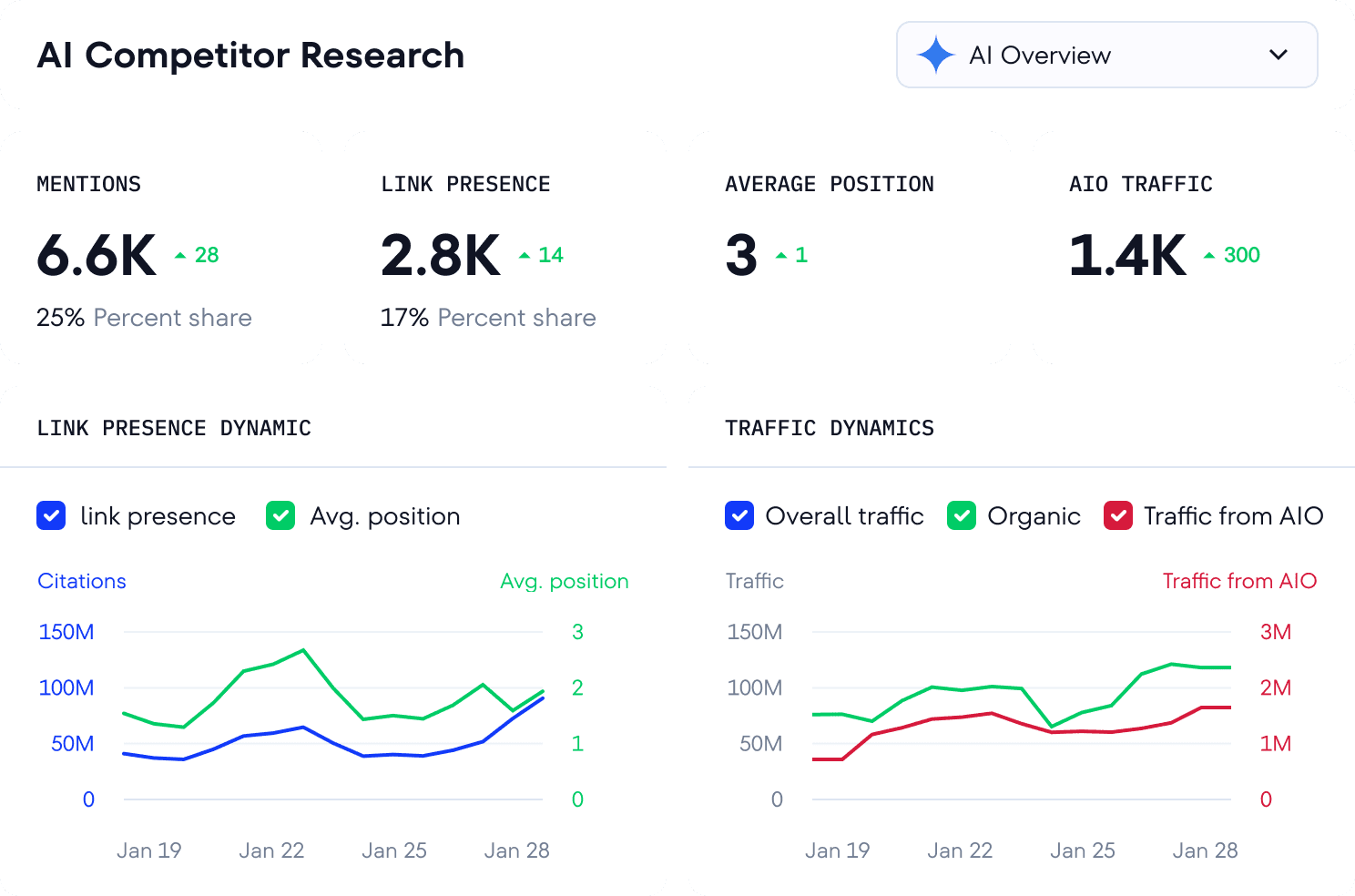
Standout feature: The competitor SEO analysis module measures organic, PPC, and AI-answer visibility across five engines (AI Overviews, AI Mode, ChatGPT, Gemini, Perplexity) against a 5.5B-keyword database, and sets those estimates beside first-party Website Audit output so you read each number against its source.
Pros:
- Crawls roughly 6B pages daily into a 2.7-trillion-record backlink index for link-gap analysis.
- Separates measured audit data (115+ checks, JS rendering) from estimated competitor figures, so provenance is explicit.
- Includes API and MCP access on every plan for programmatic querying.
Cons:
- Competitor traffic and keyword numbers are estimates whose accuracy varies by country database.
- No automated cross-channel correlation; combining organic, PPC, and AI signals runs through an AI assistant via MCP.
Pricing: Core $129/mo ($103.20/mo billed annually); Growth $279/mo; 14-day trial.
The data says: SE Ranking's advantage is labeling - measured audit output and estimated competitor figures sit side by side, so you know each number's origin before you act on it. For teams that benchmark before they commit, that separation is the point.
2. Ahrefs
Ahrefs is a backlink-led suite built on the largest independent link index, with keyword and traffic figures estimated from clickstream data.
Best for: teams whose analysis leans on referring-domain and link-gap data more than on rank tracking.
Standout feature: A 2026 WebFX study of 1,462 domains found page-one sites carry a median of 907 referring domains, ranging from 76 to 3,027 across industries - so benchmark a gap against your own vertical, not a global average.
Pros:
- Maintains the largest independent backlink index among the tools compared here.
- Surfaces link-gap and content-gap comparisons against named competitors.
Cons:
- Applies credit and row limits that cap large exports.
- Estimates deviate from Google Search Console's first-party figures.
Pricing: From ~$129/mo.
The data says: Ahrefs stays the reference point for link data; treat its traffic estimates as directional and validate against GSC where the site is your own.
3. Semrush
Semrush runs the largest keyword and backlink databases in the category, wrapped in position tracking and a roughly 140-check Site Audit.
Best for: agencies and in-house teams that want the widest raw keyword and backlink dataset in one platform.
Standout feature: Its keyword and backlink indexes are the largest any vendor reports - more indexed queries and referring domains than most rivals surface for the same domain.
Pros:
- Indexes more keywords and referring domains than most competitors report.
- Runs a Site Audit of roughly 140 technical checks against a live crawl.
Cons:
- Price scales quickly as you add seats and projects.
- Historical depth and several data-pull limits sit behind higher tiers.
Pricing: From $139.95/mo.
The data says: Semrush wins on raw database size, but meaningful historical comparison and higher pull limits require the upper tiers - measure how much of that scale you'll actually query first.
4. Google Search Console
The only tool here that reports measured Google data: clicks, impressions, and average position straight from Google's own logs.
Best for: teams that want a first-party baseline to validate every estimate against.
Standout feature: The Performance report is first-party ground truth - the exact clicks, impressions, average position, and CTR Google recorded for queries where your site appeared. Index Coverage and Core Web Vitals add crawl and page-experience signals - nothing here is modeled.
Pros:
- First-party Google data - the measured baseline every third-party estimate is modeled toward.
- Doubles as a free SEO checker for Index Coverage and Core Web Vitals on your own pages.
Cons:
- Covers only properties you have verified, so there is no competitor data.
- History caps at 16 months, which limits year-over-year analysis.
Pricing: Free.
The data says: Treat Search Console as your zero point - every estimate from the other tools should be reconciled against it. It is a baseline, not a complete record, but it is the only measured number you own.
5. Screaming Frog
A desktop crawler that renders JavaScript through headless Chrome and pairs with a separate log-file analyzer measuring actual Googlebot fetches.
Best for: measured, first-party crawl data on your own site.
Standout feature: The log-file analyzer reads your server logs and reports how often Googlebot actually fetched each URL - measured behavior, not a crawl simulation.
Pros:
- Renders JavaScript via headless Chrome, so it reads the DOM users and Google see, not just raw HTML.
- Log-file analyzer measures real Googlebot fetch frequency from your server logs.
Cons:
- Crawl scale is bound to the local machine's RAM, so large sites can exhaust memory.
- No keyword or backlink index of its own - it measures your site, not the market.
Pricing: Free up to 500 URLs; £199/yr (~$259) for unlimited crawling.
The data says: Screaming Frog and Search Console are the two first-party sources here - one measures how Google crawls you, the other how it ranks you. Both see only your site, so pair them with an index tool for competitors.
Decision Guide: Matching the Tool to the Measurement
There is no single winner; it depends on which measurement you need to trust. For first-party truth, start with Google Search Console plus a crawler like Screaming Frog, and treat every third-party number as an estimate toward that baseline. To benchmark competitors across both SEO and AI answers, use SE Ranking, because the keyword, backlink, audit, and AI-search datasets sit in one comparable workspace. If raw backlink index size on a single axis is the whole job, a specialist such as Ahrefs goes deeper. For the most common case - multi-layer competitor benchmarking - SE Ranking covers the widest span of comparable datasets at a single price.
Frequently Asked Questions
What is SEO analysis?
SEO analysis measures how a site performs in search and why. It spans three data layers: first-party performance from Google Search Console, technical crawl data from a site audit, and estimated market data such as keyword volume and competitor backlinks.
How accurate is the keyword and traffic data in SEO analysis tools?
Third-party traffic and keyword figures are modeled estimates from clickstream panels and SERP scrapes, not measured counts. They routinely deviate from Google's first-party data, sometimes widely on low-volume terms - so treat them as directional and validate anything you'll act on against Google Search Console.
Do free SEO analysis tools give reliable data?
Yes, within limits. Google Search Console gives reliable first-party data for sites you own and verify, and Screaming Frog is free up to 500 URLs. Free tools give real numbers with narrow scope; they can't benchmark competitors, which needs a paid index.