



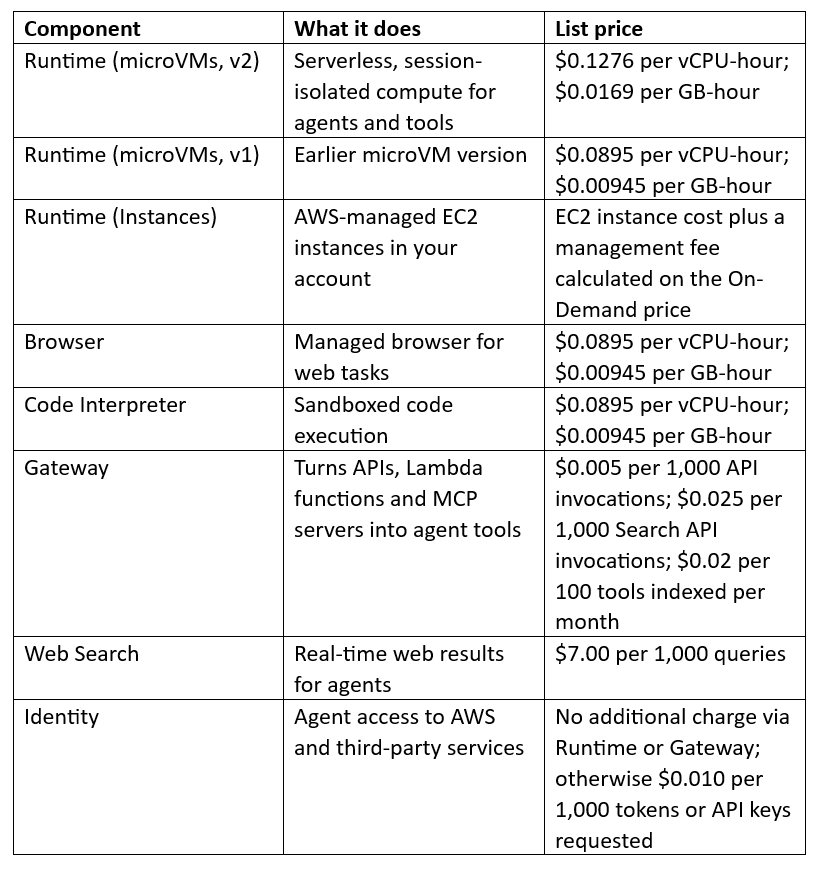
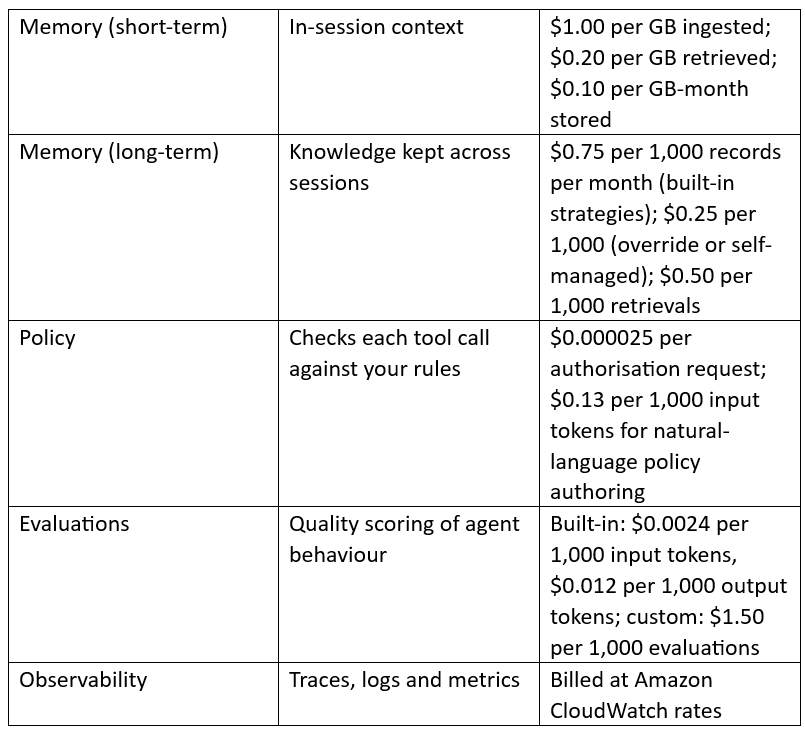
Amazon Bedrock AgentCore has no licence fee and no minimum charge. Each component is billed separately on consumption: Runtime by vCPU-hour and GB-hour, Gateway per API call, Memory per gigabyte or per record, and Identity free when used through Runtime or Gateway. Model inference is not included and is billed separately, per token, by Amazon Bedrock or whichever model provider you use. In practice, the AgentCore layer is often a modest part of an agent's total bill. The larger and less predictable lines tend to be inference, vector search and telemetry.
All prices below are US dollar list prices from the official AgentCore pricing page, checked on 21 October 2026. AWS's worked examples on that page use the US East (N. Virginia) Region. Rates can change, so check the page for your Region before you build a budget.
What is Amazon Bedrock AgentCore?
Amazon Bedrock AgentCore is AWS's managed platform for building, connecting and running AI agents in production. It is modular: each capability can be used on its own or combined with others. AWS describes it as model-agnostic, so it works with foundation models inside or outside Amazon Bedrock, and as framework-agnostic, supporting open-source frameworks such as CrewAI, LangGraph, LlamaIndex, Google ADK, OpenAI Agents SDK and Strands Agents. It supports the Model Context Protocol (MCP) and the Agent-to-Agent (A2A) protocol.
According to AWS, AgentCore is available in multiple AWS Regions, including Europe (London), Europe (Ireland), Europe (Frankfurt), US East (N. Virginia), US East (Ohio) and US West (Oregon).
AgentCore pricing by component
How the billing actually works
Runtime, Browser and Code Interpreter
These three are billed per second on actual consumption, with a one-second minimum and a 128 MB minimum for memory. The key detail for agents is that CPU is not charged while the agent waits for a model response, a tool call or a database query, as long as no other background process is running. AWS notes that agentic workloads typically spend 30 to 70 per cent of their time in this kind of I/O wait. Memory is charged on the peak consumed up to each second, and in Runtime v2, idle memory is reclaimed automatically after 120 seconds.
MicroVM sessions can run for up to eight hours. For longer or heavier jobs, the Instances compute type runs agents on managed EC2 instances for up to 14 days. You pay the EC2 cost, which your Savings Plans and Reserved Instances can cover, plus a management fee. AWS's worked example uses a 12 per cent fee, with a reduced 7.8 per cent for G-series GPU families. The pricing page also lists discounted committed-baseline rates for Runtime v2 ($0.0997 per vCPU-hour and $0.0132 per GB-hour), which it describes as launching by October 2026.
Memory
Short-term memory pricing changed on 6 October 2026. It moved from $0.25 per 1,000 new events to separate charges for ingestion, retrieval and storage per gigabyte. Each event is billed at a minimum of 12 KB and a maximum of 64 KB for ingestion and retrieval, while storage is billed on actual size. For agents that write many small events, the 12 KB floor is the number to model.
What AWS's own examples show
The pricing page includes worked examples that are useful as reference points:
- Runtime: a customer-support agent running 10-minute sessions with 90 per cent I/O wait and 1 vCPU during active processing costs $0.006703 per session, or $6,703 a month at one million sessions. At 10,000 sessions, the same profile would come to about $67.
- Gateway: an HR assistant with 200 indexed tools making 50 million Search calls and 200 million tool invocations a month costs $2,250.04.
- Memory: 100,000 short-term events, 10,000 long-term records and 20,000 retrievals a month cost $18.97.
- Observability: telemetry for the same workload costs $6.50 at the CloudWatch rates used in the example ($0.35 per GB for span ingestion and $0.50 per GB for event logging).
The pattern is clear. At moderate volumes, AgentCore's own components cost tens or hundreds of dollars a month, not thousands. Cost becomes significant through volume, long-running sessions, heavy tool use or features such as Web Search and Evaluations that are charged per query or per token.
The costs that sit outside AgentCore
- Model inference. Tokens sent to and returned by the model are billed by Amazon Bedrock (or by an external model provider) at that model's rates. For agents with high traffic, this is often the largest single line.
- Vector search for retrieval-augmented generation (RAG). If the agent searches internal documents, the vector store is a separate bill. With Amazon OpenSearch Serverless, Classic collections are billed for a minimum of 2 OpenSearch Compute Units (OCUs) for the first collection in an account. At the US East rate of $0.24 per OCU-hour, that is roughly $350 a month before any queries are run. The newer NextGen collections have no minimum and scale to zero after 10 minutes of inactivity. Choosing between the two is worth doing before launch.
- Telemetry, storage and networking. CloudWatch charges for observability data, Amazon ECR or S3 for agent code, standard EC2 rates for data transfer and $0.006 per GB for Gateway data egress to customer-owned VPCs.
Because these layers interact, it helps to see them costed together. A worked total-cost scenario of this kind is set out in Devopsity's guide to Amazon Bedrock AgentCore pricing, which also covers how the components fit together architecturally.
How to estimate your own AgentCore bill
- Estimate monthly sessions, average session length and the share of time spent waiting on I/O.
- Estimate active vCPU and peak memory per session, then apply the Runtime rates.
- Count tool calls, semantic searches and indexed tools for Gateway.
- Count memory events and their typical size against the 12 KB floor, plus long-term records and retrievals.
- Add inference from your chosen model's per-token prices.
- Add the vector store, CloudWatch telemetry and data transfer.
- Recalculate at ten times the traffic to see which lines scale and which stay flat.
Frequently asked questions
Is there a free tier for AgentCore?
There is no AgentCore-specific free tier for most components, but the AgentCore pricing page notes that new AWS customers receive up to $200 in AWS Free Tier credits.
Is AgentCore billed per agent?
No. Billing is per component and per unit of consumption, not per agent. Several lightweight agents can therefore cost less than one heavy agent.
Does AgentCore pricing include the model?
No. Model inference is charged separately, per input, and output token, at the rates for the model you choose.


