Imagine you’re on your commute home, deep into scrolling through playlists, and nothing really feels right. Spotify pops up with a Discover Weekly mix that somehow features your new favorite song, one you didn’t even know was out there. Then, your friend with Amazon Music starts gushing about the details in familiar tracks they had never heard before, all thanks to lossless audio streaming.
That’s the basic tension between Spotify and Amazon Music. Both have more than 100 million tracks, competitive pricing, and the basic features you’ll need. But they each shine in radically different ways. Spotify is the master of music discovery and social features with its 713 million monthly users. Amazon Music has better sound quality thanks to HD and Ultra HD streaming; features it has had since 2019.
So, which one should you choose in 2025?
 Fishon Amos
/1. User Interface and Devices
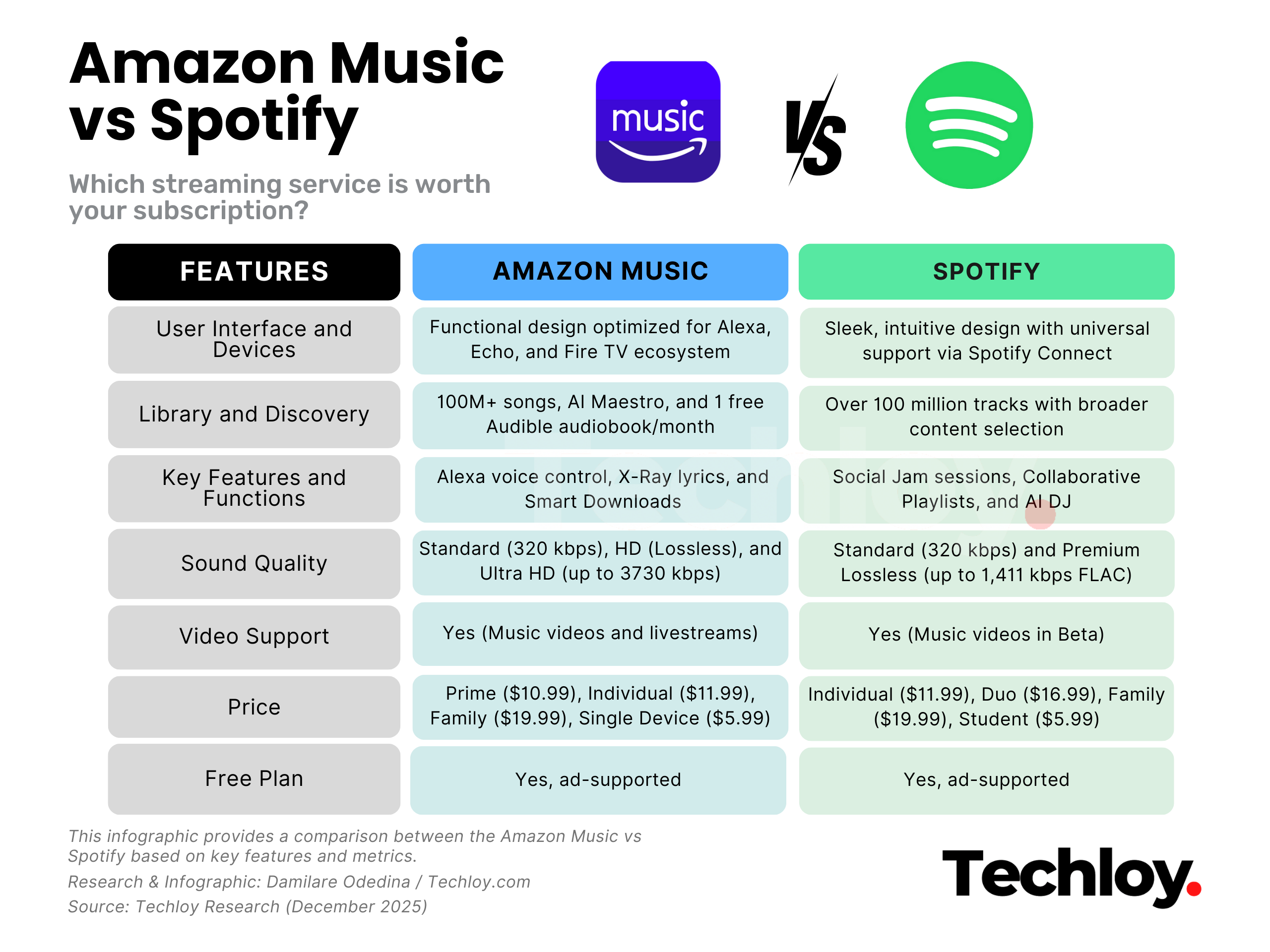
Spotify’s app feels similarly responsive and intuitive across platforms. The interface is clean, navigation makes sense, and bugs are few. Amazon Music, meanwhile, has come a long way, though you’ll sometimes experience some minor quirks when organizing playlists or managing your library, nothing that’s a deal-breaker, just some hiccups that get on your nerves.
Where Spotify truly shines is in device compatibility. Spotify Connect works seamlessly across phones, laptops, smart speakers, gaming consoles, wearables, and car audio systems, with about 379 devices currently supporting the application. You start your song on your phone as you commute, turn to your laptop when you get there, and cast it on your speaker for dinner without dropping a beat.
Amazon Music shines only within Amazon’s ecosystem. Voice control via Alexa is smooth and actually helpful, just say, “Alexa, play workout music,” and you’re set. But step outside Echo devices, and the experience becomes clunky. Amazon Music also doesn’t work with Google Assistant voice commands, which limits flexibility for users with mixed smart home setups.
/2. Library and Discovery
Both services give you access to more than 100 million tracks, so catalog size isn’t a differentiator. What separates them dramatically is how they help you find what to play next.
Spotify’s Discover Weekly feature uses AI and machine learning to create a playlist of 30 songs relevant to your listening habits, and it’s impressively on target. Release Radar drops every Friday with new releases from artists you follow, plus carefully selected deep cuts that somehow fit your taste. Daily Mixes automatically group your favorite songs by genre or mood. The algorithm learns constantly, the more you listen, the better it gets at predicting what you’ll love.
Amazon Music’s AI Maestro creates playlists based on prompts, but where Spotify has spent years refining the process to deliver expertly personalized playlists, Amazon’s feels functional at best. And when Amazon Music rolled out AI Maestro complete with playlist generation and offering users unique mixes, recommendations feel more generic and less attuned to individual tastes.
For content beyond music, Spotify boasts nearly 7 million podcast titles and 350,000 audiobooks. Premium subscribers get 15 hours of audiobook listening monthly from that catalog—enough to sample multiple titles or finish shorter books. Amazon Music Unlimited includes one Audible audiobook per month, which is good if you’re a focused reader tackling long series but less so for sampling.
/3. Features and Functions
This is where the timing becomes important. Spotify introduced lossless audio streaming for Premium subscribers in September across more than 50 markets, featuring 24-bit/44.1 kHz FLAC quality with no additional cost. They also launched Mix tools for blending songs, in-app Messages for sharing tracks with friends, music videos in beta for select regions, etc.
Amazon Music has provided that technological advantage since May 2021, where Amazon folded HD audio into its Unlimited subscription plan, although the technology itself goes back to 2019. All Unlimited subscribers get HD (16-bit/44.1kHz at 850 kbps) and Ultra HD (24-bit/192kHz at up to 3,730 kbps) at no extra cost, plus Dolby Atmos and 360 Reality Audio for supported tracks.
Spotify has long made the social aspect part of the platform with ultra-fast share options, code scanning, real-time jamming features, and collaborative playlist creation. You can see what friends are listening to in real-time, share your statistics publicly, and create group sessions for synchronized listening. Amazon Music feels isolated by comparison—it’s built for personal listening, not social discovery.
Alexa voice integration is the core strength of Amazon. No buttons, no screens, just voice commands. This matters more than people realize, especially when your hands are busy cooking, driving, or working out.
/4. Sound Quality
Amazon Music Unlimited grants access to HD and Ultra HD, ranging from 44.1kHz to 192kHz, above CD quality, with no loss in quality to the original recording. If you are just a casual listener who uses standard earbuds in noisy environments, you probably will not tell much difference from compressed audio. But with decent headphones or a proper sound system, Amazon’s Ultra HD really reveals layers that are flattened by compressed formats: tighter bass response, clearer vocal separation, and subtle instrumental details that usually disappear in the mix.
Spotify’s lossless streaming tops out at 24-bit/44.1 kHz FLAC quality, which meets CD audio standards—a far cry from its earlier 320 kbps cap. If a track is available in non-lossless form, Spotify Premium users can stream it at up to 320kbps, using either the AAC or Ogg Vorbis format. It’s an uptick over what Spotify previously had, though Amazon’s Ultra HD ceiling is still much higher. The change is minor enough that most listeners won’t be bothered, but true audiophiles with high-end equipment will notice.
Both of them boast spatial audio formats, including Dolby Atmos. Amazon has more compatible tracks in its library because the company has been working on this feature for longer.
/5. Price
Amazon Music Unlimited costs $10.99/month for Prime members and $11.99 for non-Prime subscribers. Annual plans run $109 and $119, respectively. Spotify Premium sits at $11.99/month regardless of other subscriptions. Both further offer student plan at $5.99/month, Duo plan at $16.99/month, and Family plan at $19.99/month with similar pricing structures.
The value equation depends entirely on whether you already pay for Amazon Prime ($14.99/month or $139/year). If you do, then you are getting technically superior audio for a dollar less every month. If you don’t, prices are virtually identical, putting your decision on which features and ecosystem matter more.
Final Verdict
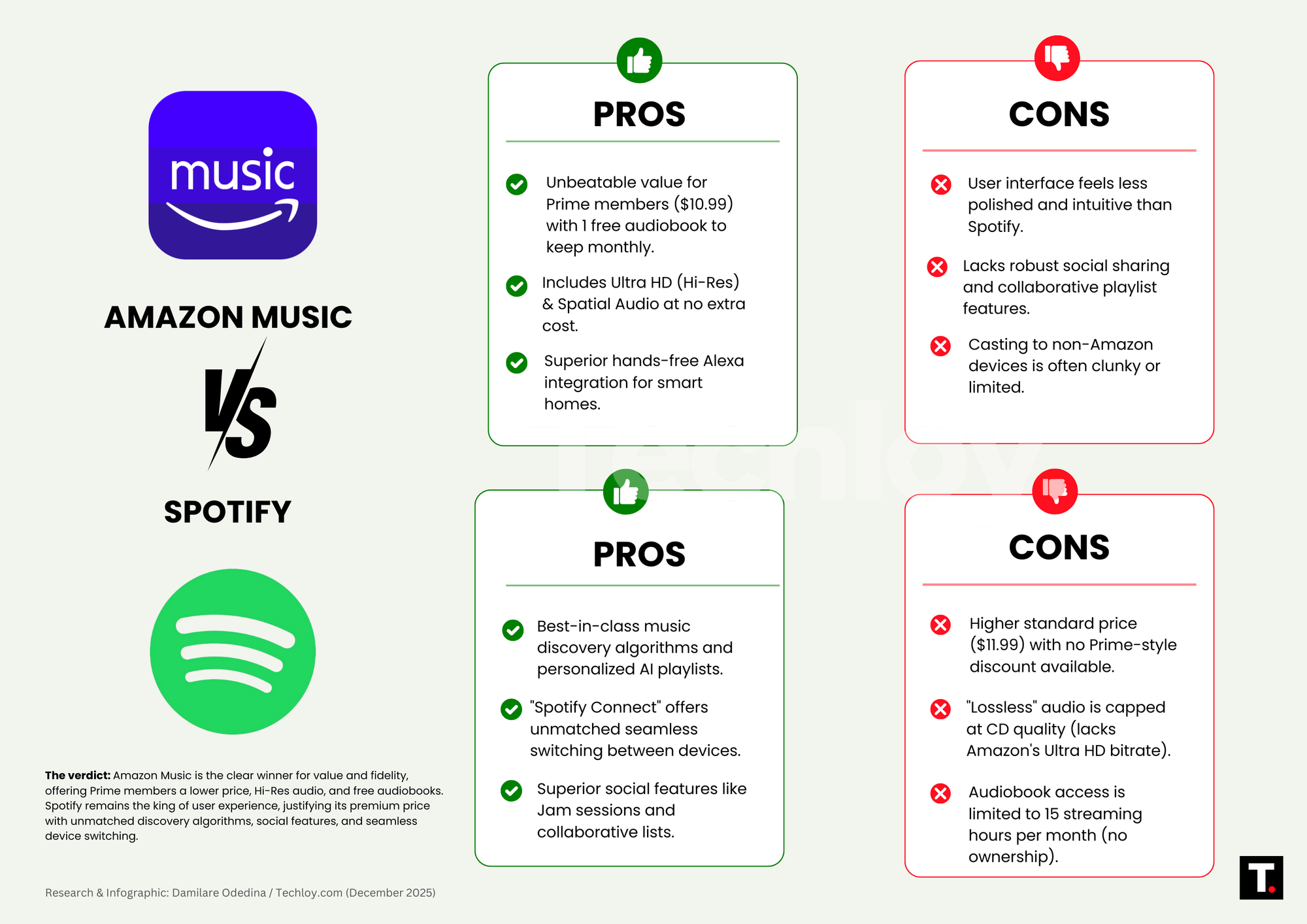
If music discovery, social features, and being able to use it on any device are important to you, then Spotify is the choice. Cultural relevance of the platform: in Q3, Spotify generated €4.3 billion in quarterly revenue with 713 million active users globally and 281 million Premium subscribers, creating network effects through playlists shared by them, Wrapped campaigns, and social listening. The algorithms are more intelligent now, the app works everywhere, and the ecosystem connects people via music.
If sound quality is non-negotiable, and you’re just tired of promises, then choose Amazon Music. They’ve been delivering lossless and Ultra HD since 2019, six years before Spotify launched comparable features. For Prime members, it’s also more affordable. Alexa integration proves genuinely useful if you’re invested in that ecosystem.
Both allow free trials: Spotify extends up to three months in its available promotions, while Amazon offers 30 days. You can try both before committing. Your listening habits, subscriptions, and equipment will tell you which one works best for you.
 David Adubiina